This Month in BackBay: The Part Fits. The Insurer’s Logic Doesn’t.

Every so often, a BackBay inquiry comes along that makes me stop and re-read it, certain I’ve missed something, and prompting me to ask for some clarification, to get to the root of the question. The initial question seemed simple enough: “…can someone direct me to the procedure for the uniside replacement for a 2023 Silverado?” (Figure 1)
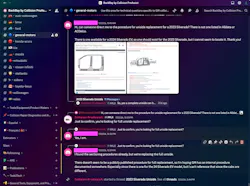
I started by asking a few clarifying questions before replying. I answered that there wasn’t a published procedure and, in that case, GM recommends “replacing body components at factory seams.” End of story, right? Well…maybe not.
To be clear up front: the head-scratching had nothing to do with the shop or the technician. It had everything to do with an insurer’s insistence on a position that defies both the manufacturer’s documentation and common sense.
The question itself was simple. A BackBay member was looking for the uniside (body side outer panel) replacement procedure for a 2023 Silverado. While GM offers several published options for sectioning the pillars, roof rail, and rocker panel, they don’t publish a complete uniside replacement procedure for this vehicle. That should have been the end of it. Instead, the absence of a published procedure was being used as a weapon against the seemingly straightforward repair.
The insurer’s stance was because there is no published procedure for complete uniside replacement, the uniside can only be sectioned. Wait, what?! A complete service part, one GM sells as a single panel (and how they built the truck at the factory…) supposedly could not be installed as a complete part. The proposed alternative was to stitch together multiple sectioning procedures rather than replace the panel the way it was serviced.
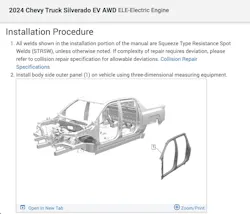
The insurer’s position was allegedly based on another vehicle, a 2024 Silverado EV, having a procedure for complete part replacement and their argument was ‘if there’s one for the EV and not one for the non-EV, it isn’t approved’ (Figure 2). To an untrained observer, and this adjuster, this thought process could make some sense, but that didn’t appear to be the real reason for the resistance.
The Documentation Was Already on the Technician’s Side
According to the BackBay member, “the lack of documentation is being used against us. Since there isn’t a published procedure for replacement, then the stance is that the uniside can only be sectioned.”
Except the documentation wasn’t against them; it was on their side. The damage called for replacing the majority of the uniside, including the B-pillar reinforcement, and that reinforcement’s own procedure tells the technician to “remove body side outer panel.” The manual itself takes the complete uniside off to do the job and, to remove the body side outer panel, a step in the removal procedure for the body side upper panel notes “remove roof outer panel.” I also shared with the member that the sectioning procedures (which are plentiful for this truck) are developed as an alternative to complete part replacement when warranted, not the other way around.
The published estimating data takes it another step further, listing a labor time for complete uniside replacement. Parts you supposedly can’t install as an assembly don’t get their own removal instructions or their own labor time.
None of it moved the needle. The position was escalated to a supervisor, which changed nothing. The customer even filed a complaint with the Department of Insurance, which again did nothing. The insurer had drawn its line in the sand and planted a flag in it.
So why the resistance? The motive isn’t too hard to spot. On this truck, removing the body side outer panel means removing the roof. Rather than do that, they preferred to section the A-pillar, section the B-pillar, and section the C-pillar, all of which require the challenging GM overlap sectioning joint, to ‘save the roof.’
Taking It to the Source
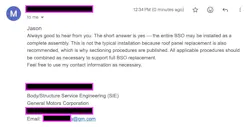
When a position statement, an excerpt from a repair procedure, and published labor times aren’t enough, sometimes I go straight to the people who engineer the vehicle. I reached out to a contact at GM, a body/structure service engineer, and asked the question that felt absurd to have to ask: “can a complete uniside be installed?”
The answer, in short: yes. GM allows full replacement (Figure 3). I posted the confirmation in a thread in the GM area of BackBay so it’s there for the next shop that runs into this; unfortunately, there will be a next shop.
Conclusion – Piecing it All Together
First, a complete service part can usually be installed as serviced. While it might not always make sense to do so, the absence of a complete part replacement procedure is not a prohibition. For GM, replacement at factory seams is the stated default and sectioning is the exception, so the burden isn’t on the shop to prove full replacement is allowed; it simply is.
Second, read the procedures beyond the panel. Replacing the B-pillar reinforcement requires removing the entire body side outer panel, and the manufacturer’s own procedure notes that the uniside is removed to get there; and to remove it, the roof must come off. That procedure should have dismantled the “section-only” argument.
Third, when logic stalls, it’s time to turn directly to the OEM. A single, clear answer from a structural engineer settled what pages of procedures and several weeks of back-and-forth could not. Those relationships are exactly what BackBay is built to provide: access to subject matter experts from OEMs and tool, equipment, and product makers.
Finally, ‘saving the roof’ isn’t always saving anything. When replacing the B-pillar reinforcement already dictates removing the panel, multiplying sectioning joints to avoid a roof replacement buys an arguably worse repair at a higher price. Efficiency and safety usually point the same direction; this was no exception.
The part fit. It was always going to fit. Sometimes (fortunately, rarely) the job isn’t finding the procedure, it’s convincing someone that installing a part the way the manufacturer built it is allowed; it was the only logical answer in this case.
One last note, because it might be my favorite part of this whole story: this inquiry came from a reader of this very column. After following along here, the technician signed up for a BackBay trial and submitted the question directly. So, if you’re staring down a repair where the part and the ‘policy’ disagree, do the same. Start a BackBay trial, send us your question, and we’ll go find the answer; and put it in writing.
Have a repair question you'd like featured in an upcoming This Month in BackBay? Get a free trial of BackBay at collisionproassist.com/trial and post your question in our members only Discord server.
About the Author
 Jason Bartanen
Jason Bartanen
Founder and Chief Technician Advocate
Jason Bartanen is the founder and chief technician advocate of Collision ProAssist, where he guides technicians through technical support and tailored education. He has been in the collision repair industry for nearly 30 years, including more than 23 years serving in various roles for I-CAR, the Inter-Industry Conference on Auto Collision Repair. He was most recently the director of industry relations at Collision Hub for nearly six years.