This Month in BackBay - Does Toyota's Sectioning Restriction Apply to Outer Panels?
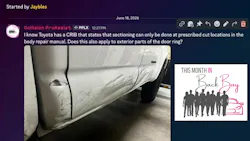
Vehicle: 2025 Toyota Tacoma
Technician's Question:
“I know Toyota has a CRIB that states that sectioning can only be done at prescribed cut locations found in the body repair manual. Does this also apply to exterior parts of the door ring?” (Figure 1)
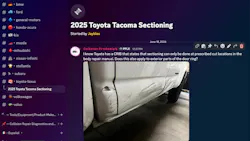
This is a question that has come up a few times in BackBay and in several offline conversations. And it’s one where mixing up two separate CRIBs can lead to unnecessary restrictions; or worse, an improper repair.
First Things First: What Is a Toyota CRIB?
A Collision Repair Information Bulletin (CRIB) is Toyota's way of communicating important repair guidelines, precautions, and approved repair methods. Think of CRIBs as targeted technical bulletins that sit alongside the vehicle-specific body repair manual. They often clarify approved procedures, highlight non-approved methods, and address real-world repair scenarios that technicians encounter. CRIBs cover a wide range of topics, from welding procedures and sectioning restrictions to corrosion protection and SRS/airbag precautions. They apply broadly across Toyota and Lexus vehicles, unless otherwise specified. It's worth noting that CRIBs used to be publicly accessible outside of Toyota’s Technical Information Systems (TIS), but they have since moved all CRIBs behind the login. Today, accessing them requires a subscription to TIS at techinfo.toyota.com (or third-party providers like ALLDATA Collision).
Breaking Down Two Key CRIBs
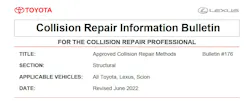
CRIB 176 - Approved Collision Repair Methods (Figure 2) covers structural repair operations. This bulletin, while not exhaustive, draws a clear line between approved and not-approved methods. Among the not-approved methods listed is "Sectioning at Non-Specified Locations.” Meaning that for "structural components," Toyota requires technicians to section only at the locations explicitly published in the vehicle-specific body repair manual. Also prohibited: butt joints with backings, installing aftermarket or recycled parts for structural repairs, and substituting adhesive for welds.
This is the CRIB many technicians are thinking of when they ask about sectioning restrictions, rightfully so. For structural components like rails, inners, and reinforcements, these restrictions are firm.
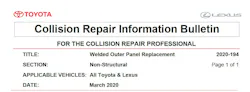
CRIB 194 - Welded Outer Panel Replacement, (Figure 3) however, tells a different story for outer panels. This bulletin specifically addresses mild steel outer panels, like quarter panels, and yes, the outer sheet metal of the door ring/uniside. Key points from CRIB 194 include:
- Unless noted otherwise, outer welded panels are typically mild steel, not high-strength steel
- Minor damage may not require full panel replacement; partial replacement is permitted to minimize intrusion
- Butt welding (an open butt joint) is the preferred sectioning method, with lap welding and flanging/backing approved as alternatives when open butt welding isn't possible Corrosion protection must be applied to the backside of all weld heat-affected areas
How Do You Know Which Steel You're Working With?
According to our contact at Toyota, the rule of thumb is straightforward: if a panel is not shown in the structural outline or doesn't have a steel grade indicator in the chart, it is mild steel, and CRIB 194 applies. In other words, the absence of a marking in the structural outline is itself the indicator that you're working with mild steel part, not a high-strength or ultra-high-strength steel part.
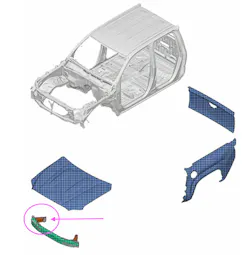
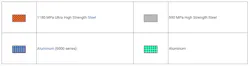
It's also important to review the entire structural outline, since a single image won't always show the complete structure. As an example, when I looked at the material identification for this Tacoma (Figure 4/4a) , I thought the entire cab structure was 590 MPa HSS, based on the key. However, upon closer inspection (much closer; it’s tiny!), the only 590 shown in the illustration is the bumper reinforcement bracket.
Conclusion: The Practical Takeaway for the 2025 Tacoma
For the door ring (outer pillars, rockers, and roof rail) on a 2025 Tundra:
- Outer panels (the exterior sheet metal) = mild steel → CRIB 194 applies → sectioning, based on the damage, is permitted
- Structural components of the door ring (inner pillars, rocker reinforcements, etc.) = check the structural outline for steel type → CRIB 176 applies → section only at Toyota-specified locations in the Collision Repair Manual
The critical step is always referring to the vehicle-specific body repair manual for material identification, sectioning locations, joint configuration, and attachment methods.
Have a repair question you'd like featured in an upcoming This Month in BackBay? Get a free trial of BackBay at collisionproassist.com/trial and post your question in our members only Discord server.
About the Author
 Jason Bartanen
Jason Bartanen
Founder and Chief Technician Advocate
Jason Bartanen is the founder and chief technician advocate of Collision ProAssist, where he guides technicians through technical support and tailored education. He has been in the collision repair industry for nearly 30 years, including more than 23 years serving in various roles for I-CAR, the Inter-Industry Conference on Auto Collision Repair. He was most recently the director of industry relations at Collision Hub for nearly six years.