This Month in BackBay: A Kia Carnival rear body panel puzzle
Some of the best BackBay cases start with a simple question that turns out to be anything but. This one did, and it kicked off what has become a recurring conversation with Kia about rear body panels. It began with a 2025 Carnival built on the KA4 platform.
The case came to me from one of our BackBay Pro subscribers. He was working on a Carnival with damage to the rear body panel and the rear floor panel. Straightforward enough, until the service part showed up. Here is the inquiry exactly as it came in:
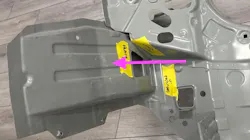
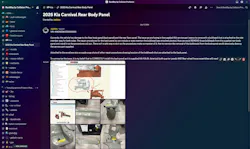
“…the vehicle has damage to the Rear body panel (back panel) and the rear floor panel. The issue we are having is the supplied KIA service part seems to come with a bulkhead that is attached to the side member assy (sic) for both sides. The repair procedures for the back panel do not include or even mention the bulkhead...it is my belief that to CORRECTLY install this back panel as it is supplied by KIA both quarter panels AND Rear wheel house assemblies will need to be removed.” (Figure 1)
The Conflict
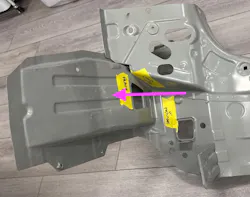
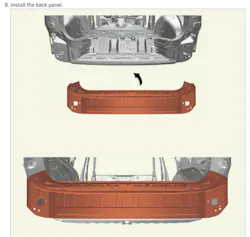
The back panel Kia supplied arrived with a bulkhead (a "transverse extension assembly") attached to the side member assembly on each side. (Figure 2) The published back panel repair procedure didn’t include, or even mention, those extensions. (Figure 3) That left the shop staring at two options: install the panel the way the procedure described, which meant cutting the extensions off the supplied part, or install the back panel as Kia North America supplied it. To do this, the technician would likely have to remove both quarter panels and the rear wheelhouse assemblies; a far bigger operation than the printed procedure offered. He asked me to get Kia’s take.
From BackBay to California, and Then to Korea
This was the subscriber’s first time reaching out to me on a Kia vehicle, and it became the case that would open an ongoing exchange with Kia, for similar rear body panel issues on other models. I forwarded it to my contacts at Kia North America. A definitive answer took some patience, as the inquiry had to be sent to Korea for their input; but it was worth the wait.
The reply from Kia, included a procedural change not found in the published body repair manual:
“The new panel must be cut and processed prior to installation. Please refer to the attached procedure for proper processing of the new panel.”
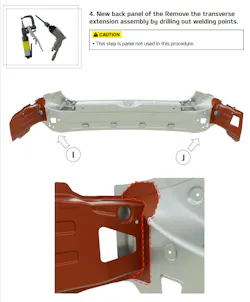
The rear body panel assembly requires removal of the extensions before it goes on the vehicle. (Figure 4) With the extensions removed from both sides of the rear body panel, the replacement assembly could now be installed following the published body repair manual procedure.
Conclusion - A Few Takeaways
First, when the service part and the printed procedure don’t agree, the part might be telling you something the procedure hasn’t caught up to.
Second, don’t simply modify a supplied assembly to fit the documentation, unless directed to. Removing those extensions to match the procedure, without the additional document we were sent, might have destroyed the part and produced a repair no one could stand behind.
Third, the definitive answer must come from the OEM; and sometimes it takes time. This one took over a week and a route all the way to Korea, but it produced a procedure the shop could follow. It also opened a door: since the Carnival, we’ve had similar issues with a K5 and an EV6.
This won’t likely be the last rear body panel to land in BackBay, but it’s the one that started the conversation across several Kia models. If your service part and your procedure are telling you two different things, that’s exactly what BackBay is here for.
Have a repair question you'd like featured in an upcoming This Month in BackBay? Get a free trial of BackBay at collisionproassist.com/trial and post your question in our members only Discord server.
About the Author
 Jason Bartanen
Jason Bartanen
Founder and Chief Technician Advocate
Jason Bartanen is the founder and chief technician advocate of Collision ProAssist, where he guides technicians through technical support and tailored education. He has been in the collision repair industry for nearly 30 years, including more than 23 years serving in various roles for I-CAR, the Inter-Industry Conference on Auto Collision Repair. He was most recently the director of industry relations at Collision Hub for nearly six years.