This Month in BackBay – By Collision ProAssist: General Motors Roof Skins & Windshield Urethane
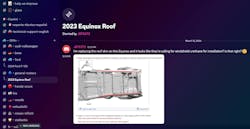
This month, I’ve got another one that I get frequently; it’s also a question I have seen repeatedly on social media platforms. There are several General Motors (GM) vehicles (the specific example I’ve is a 2023 Chevrolet Equinox) that are built with laser-brazed roof skins, and the replacement procedure gives technicians pause. The question usually goes something like this: “I'm replacing the roof skin on this ‘GM model,’ and it looks like they're calling for windshield urethane for installation? Is that right?” (Figure 1)
The answer: “Yes,” using windshield urethane to install the replacement outer roof panel on the 2023 Chevrolet Equinox, and other models, is exactly what GM specifies.

Why This Question Keeps Coming Up
As technicians, we are used to seeing roof skins attached with a combination of spot welds, plug welds, and maybe some adhesives. So, when a procedure suddenly calls for “windshield urethane,” it looks a bit odd and triggers an “is that really strong enough?” reaction. That’s understandable, because in most shops, urethane is mentally categorized as something that would only be used for stationary glass.
Windshield Urethane and FMVSS 212
Modern urethane adhesives used for glass installations are designed and tested as part of the windshield retention system under the Federal Motor Vehicle Safety Standards (FMVSS) 212. FMVSS 212 requires that, in a frontal barrier crash up to 48 km/h (just under 30 mph), the windshield mounting must retain at least a “50 percent of the portion of the windshield periphery” (in lay terms, the entire outer edge or border of the windshield where it meets the vehicle's pinchweld) “on each side of the vehicle longitudinal centerline.” The point of the standard is to keep the glass in place so it can act as part of the collision energy management system, help prevent occupant ejection, and remain intact when the passenger airbag deploys up and off the windshield.
A passenger airbag deployment loads the glass and the urethane bond with very high speed, rapid forces, and the system is engineered so that the glass stays bonded even after a deployment. So, when GM specifications for urethane adhesive states: “Use a urethane adhesive system which meet the FMVSS 212 crash test standard, suitable for structural glass bonding,” they are calling for a material and performance level that’s already been proven in crash testing.
Structural Role of the Roof Skin
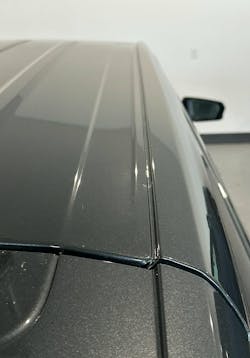
The Equinox outer roof skin (and the roof skin on most vehicles) is identified as mild steel. (Figure 2) While a roof skin does a little bit more than just keeping the rain out, most of the heavy lifting is done by the high- and ultra-high-strength steel (HSS and UHSS) side structures, roof rails, and roof bows. By contrast, the windshield, bonded with an FMVSS 212‑compliant urethane, plays a significant role in collision energy management and occupant protection.
That context matters; if the urethane is tough enough to keep the windshield intact under crash loads and airbag forces, using the same type of adhesive as part of the roof skin attachment strategy is more than “strong enough” when combined with the specified welds and adhesives called for in the replacement procedure.

Overview of a GM Roof Procedure
Using the 2023 Equinox as the example, here is a high‑level look at the GM replacement procedure.
Removal:
- Existing spot welds along the front and rear edges are removed.
- The center of the panel is cut inboard of the laser welds with a cut‑off wheel, then the remaining outer edge and laser‑weld joint are carefully removed. Any adhesive and anti‑flutter materials that remain are removed.
Installation:
- The new roof panel is test‑fit.
- All mating surfaces that will be welded are cleaned and a GM‑approved weld‑through primer is applied.
- Following the urethane and structural adhesive makers’ instructions, the mating surfaces are prepared.
- Anti‑flutter material is reapplied to the roof headers.
- A 12 mm (about ½") bead of windshield urethane is applied to the specified mating areas on the vehicle, and structural adhesive is applied to the designated areas on both the roof panel and vehicle.
- The roof panel is set, measured, and clamped; and any excess urethane is removed.
- Spot welds are made at the front and rear roof edges, where specified.
- Seam sealer and corrosion protection materials are applied.
Conclusion
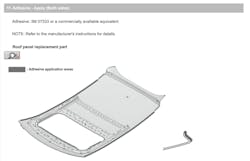
The GM laser-brazed roof replacement procedure is unique, but it is the approved and published procedure for a few of their vehicles. Other vehicle makers may a use similar joining method yet publish very different repair instructions. (Figure 3) Technicians must always use the correct, vehicle‑specific roof replacement procedure from the OEM service information to determine the proper replacement procedure; in the case of this Equinox, that means a combination of urethane adhesive, spot welds, and structural adhesive.
About the Author
 Jason Bartanen
Jason Bartanen
Founder and Chief Technician Advocate
Jason Bartanen is the founder and chief technician advocate of Collision ProAssist, where he guides technicians through technical support and tailored education. He has been in the collision repair industry for nearly 30 years, including more than 23 years serving in various roles for I-CAR, the Inter-Industry Conference on Auto Collision Repair. He was most recently the director of industry relations at Collision Hub for nearly six years.