The Best Repair Planner/Estimator Award Winner: Mike Mead
Key Highlights
- Mike Mead emphasizes complete disassembly, OEM repair procedures, and thorough documentation to create comprehensive repair plans that improve efficiency and safety.
- His approach includes detailed damage documentation, use of digital tools like RepairLogic and tablets, and cross-department communication to ensure alignment and quality.
- Mead’s resourcefulness in locating OEM parts and procedures, along with ongoing training, helps navigate complex repairs and enhances repair accuracy.
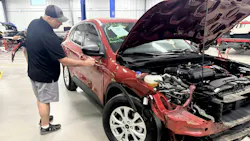
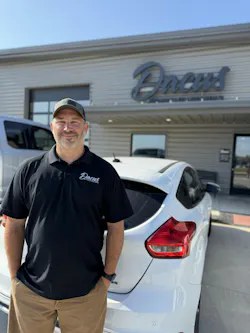
Mike Mead’s approach to repair planning emphasizes complete disassembly, OEM repair procedures, extensive documentation, and cross-department collaboration to produce comprehensive repair plans. And that’s why Mead, of Dacus Auto Body & Collision Repair in McPherson, Kansas, is FenderBender and ABRN's 2026 Best Repair Planner/Estimator.
Marketing Director Heidi Myers praised him in her nomination for consistently delivering accuracy, efficiency, and safety at a high level.
“His ability to combine deep OEM knowledge with a disciplined blueprinting process drives measurable results: fewer supplements, strong parts accuracy, improved cycle times, and more predictable repairs,” she wrote. “He doesn’t just plan repairs; he sets the entire team up for success.”
Mead turns a complex repair into a clear process before the vehicle enters production, she continued, by building OEM-driven repair plans that account up front for each step, including structural procedures, one-time-use parts, and calibrations. And beyond those skills, Mead was recognized for his leadership in the shop.
“He elevates those around him, communicates clearly across departments, and thrives under pressure, especially during high-volume periods,” she wrote. “Mike bridges the gap between departments by translating complex repair plans and OEM procedures into clear, actionable direction for technicians, parts, CSRs, and insurers. He ensures everyone is aligned from the start, which prevents breakdowns, keeps production moving, and creates a more cohesive team environment.”
After the nominations were whittled down to a half-dozen finalists, Mike Anderson and his team at Collision Advice judged their completed estimate exercises for a 2025 Ford F-150 Super Crew four-wheel drive selected on a salvage pool website. (Ford and OEC are this year’s award sponsors.) Contestants were provided the VIN and photos of the totaled vehicle and instructed on which major parts needed replacement, such as the rear bumper, left bedside, and complete frame.
“The reason we chose those, which was a pretty difficult task, was really to assess the knowledge of any of the candidates who were competing not only of not included operations,” Anderson said. “But more importantly, it was also their ability to navigate Ford's repair procedures through the electronic service manual to determine, what procedures and one-time use parts are required."
Mead’s completed estimate exercise totaled over $37,000 and included over 500 line items.
Industry Support and the Difficult Process of Selecting a Winner
Thank you to this year’s sponsors, the Ford Certified Collision Network and RepairLogic, which allow us to recognize Mead and help bring attention to the need for quality, safe repairs. We’d also like to give a special thank you to Mike Anderson and his staff at Collision Advice for their expertise and assistance with the estimating portion of the awards selection process.
Mead’s Repair-Planning Journey
Mead moved from repair planner into a production manager role in July 2025, and since he was nominated has been promoted to shop manager at the McPherson location.
“But I still jump in and help with repair planning whenever needed,” he says.
He has been in collision repair since 2011, working on semi-trucks for the next seven years, followed by three years on passenger vehicles before joining Dacus in 2021. Even before that, he painted school buses for about five years and even worked in building amusement park rides at Chance Rides in Wichita, Kansas.
“I worked on carousel animals and other fiberglass components,” he says. “We did all the bodywork, carving, sculpting, and painting. So, I've always been involved in painting and bodywork, just in different industries. I also worked on semis before that and got involved with a lot of custom trucks that were featured at shows like MATS, which is kind of the SEMA show for the trucking industry.”
His transition into full-time repair planning was in early 2022.
“ One of our repair planners went on maternity leave and didn't come back, so I applied for the position. At first, I handled my own disassembly and wrote estimates while we were getting staff in place. Once we hired enough people, I was able to focus fully on repair planning. At previous jobs, I wrote some estimates and larger supplements, but nothing nearly as extensive as what we do today.”
How He Approaches the Repair Planning Process
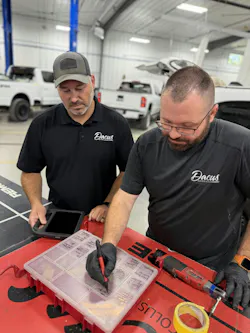
Once a vehicle has been detailed and checked in, it moves into repair planning. The staff reviews the estimate and notes and begins documenting.
“We use colored markers to identify damage,” Mead says. “Green marks indicate known damage already included in the estimate, while red identifies damage that's not yet included. We take extensive photographs to document damage, unrelated prior damage, and vehicle condition. Then every vehicle receives a pre-scan. We review the scan results, identify any related DTCs, and document those findings.”
Seat belt inspections are performed on every vehicle, and a technician then begins disassembly. The shop uses two parts tables: a black table for repair-and-install components and a red table for replacement parts. Every part is photographed and documented as it's removed. All photos are uploaded automatically to OneDrive, which allows the repair plan to be built from live documentation as the disassembly happens.
“If there's no photo, it doesn't go on the estimate. We label every photo with the corresponding CCC line item so it's easy to cross-reference later. Once the vehicle is fully disassembled, we complete our line notes and research OEM repair procedures through RepairLogic.”
After that, Mead says, the staff holds what they call a "hard-copy huddle."
“We print estimates for multiple team members, including body technicians, painters, reassembly technicians, and PDR specialists when applicable. Everyone reviews the repair plan and identifies anything that may have been missed or any labor times they disagree with. Any revisions are added before finalizing the estimate.”
Then all required calibrations and OEM procedures, including links, are attached to the documentation and OneDrive files, and the repair plan is sent to the front office for approval.
Tablets in Every Stall
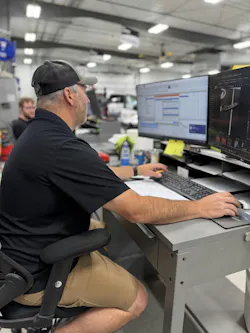
OEC’s RepairLogic is used to research OEM repair procedures on every vehicle.
“For Ford and Toyota, since we're factory-certified, we'll often go directly to the OEM information systems, because those are usually the most current resources,” Mead says. “We also use Toyota's TIS and Ford service information.”
If a repair involves structural components, quarter panels, bedsides, or similar repairs, printed procedures in addition to digital copies are provided to the technician. Every stall has a tablet, so technicians can access procedures, repair plans, and photos at any point in the repair.
“ Body technicians can take in-process photos during repairs, structural work, and refinishing,” Mead says. “Insurance companies want documentation, and this creates a complete record from start to finish.”
Later in the process, reassembly technicians can review photos taken during disassembly or structural repairs. It gives everyone visibility into what happened throughout the repair and improves communication, he says.
Getting Paid for OEM Procedures
This documentation aids in negotiating with insurers, Mead says.
“ We work closely with our claims specialist. If an insurer questions a procedure or line item, we can quickly pull the OEM documentation and attach it to CCC or OneDrive. For example, if an insurer questions a wheel repair procedure that isn't approved by the manufacturer, I'll locate the OEM documentation showing exactly what the procedure requires. Once we provide that information, the discussions usually go much smoother because they don't have to search through hundreds or thousands of pages themselves.”

Winning the Repair Planner Competition
This was Mead’s third year in the competition, and during the roundtable discussion we hosted with him, Anderson, Ford’s Chris Wallace, and OEC’s Tanya Sweetland, he estimated he spent 15 to 20 hours ensuring he captured every operation he could. What made this estimate particularly challenging for him was the frame replacement.
“Every year the repairs get more complex. At first glance, this one looked fairly straightforward, but then you get to the frame replacement and realize how many details are involved,” he says.“ The biggest challenge was finding all of the one-time-use fasteners Ford requires for suspension and structural components. CCC doesn't always contain all of that information. RepairLogic helps identify many of those items, but I also rely heavily on DEG [Database Enhancement Gateway] resources and OEM websites to locate information that estimating systems don't always include. Knowing where to find information is just as important as knowing how to write the estimate.”
Resourcefulness in repair planning is a major asset, Mead says.
“ We've even had situations where dealership parts departments couldn't find a component, and I'd locate it using OEM diagrams available through DEG resources. You have to know where your information lives.”
A lot of one-time-use parts are found in suspension systems, airbags, and safety-related components, Mead points out.
“Many people don't realize that common items such as locknuts, body mount bolts, and bed bolts are often single-use components. Ford does a good job of identifying them in the service information. Some manufacturers use icons like a trash can symbol, an X, or a black dot to indicate replacement is required. The challenge is identifying every one of those parts and documenting them correctly.”
Training and Continuous Learning
Mead says all in the shop train heavily with I-CAR.
This year, the shop personnel are focused on Toyota training because they are pursuing Toyota's Shop of the Year recognition. The more estimators, technicians, and staff members who complete training, the more points you earn, he says.
“Toyota uses a lot of manufacturer-specific online training. Ford tends to emphasize I-CAR training a little more. We also obtained Rivian certification last year, and much of their training is conducted directly through Rivian's platform.”
The shop has been certified for Rivian repairs for about seven months. In that time, it’s repaired two and totaled another. As one of the few Rivian-certified facilities in the region, Mead says, it draws those vehicles from as far away as Wichita, about 60 miles away.
Future Challenges for Repair Planning
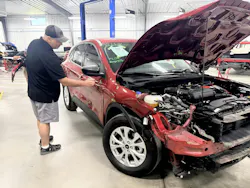
Looking ahead, Mead predicts safety inspections are going to become increasingly important as manufacturers further emphasize documenting proper inspections and repair processes. As vehicles continue to add additional safety systems, more calibrations will be required.
“I don't know if some systems will eventually become more self-learning, but either way, the complexity is increasing. One challenge we're already seeing is calibrations failing because of issues discovered only during the process.
For example, you can start a calibration and discover a service bulletin requiring replacement of another component before the calibration can be completed.
Those situations create difficult conversations because nobody knew the component needed replacement until the calibration process began.”
As parting thoughts for readers who would like to up their repair planning game, Mead says “documentation is everything.”
“Between photos, OEM procedures, proper line notes, scans, calibration documentation, and one-time-use parts research, the more thoroughly you document the repair, the easier it becomes to support the estimate and perform a safe repair.
And just as importantly, know your resources. The information is out there, but you have to know where to find it.”
About the Author
 Jay Sicht
Jay Sicht
Editor-in-Chief, FenderBender and ABRN
Jay Sicht is editor-in-chief of FenderBender and ABRN. He has worked in the automotive aftermarket for more than 30 years, including in a number of sales and technical support roles in paint/parts distribution and service/repair. He has a bachelor's degree in journalism from the University of Central Missouri with a minor in aviation, and as a writer and editor, he has covered all segments of the automotive aftermarket for more than 22 of those years, including formerly serving as editor-in-chief of Motor Age and Aftermarket Business World. Connect with him on LinkedIn.
Don't miss Jay's next article or podcast. Sign up for FenderBender Today's Collision Repair News and ABRN eNews here.