Innovating Collision Repair: FenderBender Award Winner Kyle Al-Rifai’s Manufacturing-Inspired Approach
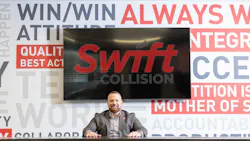
With his nontraditional background, Kyle Al-Rifai approaches collision repair a little differently than most. In a span of less than 10 years, he’s used his manufacturing mindset to grow from four employees in a 2,200-square-foot shop to a staggering 140,000-square-foot facility on 40 acres and more than 100 employees in the Tulsa, Oklahoma, suburb of Broken Arrow.
With over 20 OEM certifications and I-CAR Gold Class recognition, he says his company, Swift Collision, is built on a culture-centric, employee-first philosophy where people come before profits and innovation is powered by purpose.
For his innovation and dedication to his employees and community, Al-Rifai is our 2026 FenderBender Award winner.
Daniel Burkholder, founder of BodyShop Marketing, nominated several outstanding collision repair owners and operators, including Al-Rifai. He praised Al-Rifai for going above and beyond running a successful collision repair center.
“He is rethinking how a collision business should operate,” Burkholder wrote. “With a background in manufacturing and industrial engineering, he has brought process discipline, scalability, and innovation into an industry that often relies on outdated workflows.”
Under Al-Rifai’s leadership as CEO, Burkholder pointed out, Swift Collision has paired OEM-certified repair standards with a customer-first model built around transparency, convenience, and long-term trust.
“His work stands out because it improves three things at once: repair quality, employee opportunity, and customer experience.”
Al-Rifai is quick to share the honor with his employees.
“The recognition from FenderBender is meaningful because it reflects the work of the entire Swift Collision team,” he says. “It also reinforces the responsibility that comes with growth: to protect repair quality, invest in employees, serve customers well, and move the industry forward without losing sight of the fundamentals.”
Outside eyes looking in have been one of the reasons we have been successful,” he says. “I love innovation, and I want people to challenge the way we are doing things so we can continue to improve. -Kyle Al-Rifai, CEO, Swift Collision
A Better Way
Before venturing into the automotive industry, Al-Rifai built businesses in manufacturing. He then began a business in automotive remarketing, work that required him to sublet work to multiple repair and reconditioning vendors. He soon discovered inconsistencies in quality, timing, and communication. He was convinced there had to be a better method of organizing the work.
Drawing on his manufacturing background, he studied the repair process. He didn’t know how to massage dents or color-match a panel, but he understood processes. Workflow, accountability, repeatability, and the value of designing a system around the customer’s desired outcome were second nature to him.
“I kept asking what collision repair could look like if we applied manufacturing principles to it,” he says.
In 2017, Al-Rifai opened a 2,200-square-foot operation focused on dealer and fleet reconditioning with a painter, two body technicians, and detail team. The learning curve was steep, he says, but it also allowed him the freedom to question the industry’s status quo.
“Outside eyes looking in have been one of the reasons we have been successful,” he says. “I love innovation, and I want people to challenge the way we are doing things so we can continue to improve.”
As the business grew, the company moved into larger facilities and expanded its capabilities. The current facility opened in Jan. 2023 and features 15 paint booths, 90 body work areas, and 30 mechanical work areas. Al-Rifai found the former generator manufacturing facility in Sept. 2021. He designed the master plans and served as general contractor on the project to implement his vision. Through the expansions, Al-Rifai says his focus has remained on building an operating system that could support quality at scale.
“That meant creating specialized functions for training, certifications, process improvement, customer communication, and quality control,” he says. “It also meant applying lessons from manufacturing, such as clearly defined work stages, visual management, accountability, and a relentless search for bottlenecks.”
As it expanded into consumer-oriented collision repair, the name changed from Swift Recon to Swift Collision in Feb. 2026, which reflects not only a broader mission but a transformation, Al-Rifai says.
“It is not about the name. It is about consistency, doing the work correctly, and elevating the customer experience.”
The facility added 20 OEM certifications within a year, and 14 months later, it stands at 22. And beyond its immense size, Swift Collision has maximized efficiency by operating 21 shifts a week, round-the-clock, every day, compared to a typical shop’s 20 shifts per month.
“Technicians work three 12s, have four days with their family, and they love it,” Al-Rifai says.
We have to show the next generation that this is a skilled, technical profession they can be proud to choose.
Powered by ‘Swifties’
Swift Collision is “powered by its people,” affectionately known as “Swifties,” Al-Rifai says, a belief that shapes how he and company managers approach the workplace, career development, recognition, and the future of the skilled trades.
Employees work in a professional environment with modern equipment, ongoing training, team recognition, and leaders supporting those doing the work.
“Blue-collar work today should mean work/life balance, respect, smart tooling, and a real career path,” he says. “We have to show the next generation that this is a skilled, technical profession they can be proud to choose.”
Al-Rifai says this philosophy is necessary at a time collision repair competes for talent with many skilled industries, and he sees culture as a quality issue. It’s to what he points as a reason why the company’s retention rate over a year’s time is over 93%.
“When employees feel respected, understand expectations, and have the resources to perform at a high level, the customer ultimately benefits. A strong culture is not separate from operational performance. It is one of the conditions that makes consistent performance possible.”Al-Rifai says the workforce culture in collision repair is often damaged, and he describes it as new hires often having something akin to PTSD in dealing with chaos and worry.
“I had one employee who had been here two weeks come to me and he said, ‘I was a little concerned yesterday. A manager asked me to come to his office, and I only get asked to go to the office when I'm in trouble. But he actually wanted my opinion on changing a process and if I would be comfortable with it.’ He said, ‘That’s not normal. I thought for sure I was in trouble.’
“I said, ‘Well, did you do something wrong?’ He said, ‘Well, no, but that’s not how it usually is.’”
Another employee, a senior technician, came to Al-Rifai to pass along thanks from his wife for allowing him to discontinue taking his blood pressure medicine.
“So, those are the moments that make me want to drive even more into changing the way the employee experience is in the collision industry. I think employee by employee, region by region, state by state, we can create a benchmark and we can create a level where employees and other employers know that they have to meet so we can bring these great techs back to the industry and not lose them to HVAC and plumbing, because it is tough.”
The company has also been voted a Great Place to Work for the third year in a row.
“That’s a very vulnerable thing because we’re telling the whole world what our employees think of us internally,” Al-Rifai says. “Our industry standard is 57%, and I believe we scored a 79 or 81. So, 81% of our employees love us to death. That’s not easy.”
The company’s score has improved each year, and Al-Rifai says he hopes to score an 88 to 90 next time.
“Those tests openly and anonymously tell us where we’re dropping the ball as a company so we can fix it. Employees never want to come and talk about what’s wrong because they’re afraid that would hurt their job or their position, so it’s a great place to vent.”
The company has a program in place to help employees buy homes, and as of February, it has helped 17 employees, Al-Rifai says. The company assists with closing costs and deals with realtors that have a discounted rate.
“So, we can get the house a little more aggressively and cheaper for those employees.”
Inspiring Customer Confidence in the Repair Process
Considering other industries such as retail, banking, technology, and delivery services, Al-Rifai considered why collision repair should not be expected to provide customers with the same convenience and transparency.
“A collision repair will always involve technical complexity, insurance coordination, parts availability, and careful quality controls. The customer, however, should not have to navigate that complexity alone.”
It has pushed him to focus on timely updates, education, convenient approvals, and a more coordinated experience from first contact to final delivery, he says.
“The goal is not technology for its own sake. It is to reduce uncertainty and help customers feel informed and cared for during a stressful event.”
The company’s app, Swift Care+, is currently in beta testing to address some of these industry concerns.
“Customers do not compare their experience only with another body shop. Their expectations are shaped by every great service experience they have in the rest of their lives,” he says.
Combining technical excellence with hospitality will be what makes collision repairers stand out in the future, Al-Rifai believes.
“A safe, correct repair is the foundation. The differentiator is how well the company communicates, how consistently it delivers, and how much confidence the customer feels throughout the process.”
Related Reading:
 Mike 11 CROP
About the Author
 Jay Sicht
Jay Sicht
Editor-in-Chief, FenderBender and ABRN
Jay Sicht is editor-in-chief of FenderBender and ABRN. He has worked in the automotive aftermarket for more than 30 years, including in a number of sales and technical support roles in paint/parts distribution and service/repair. He has a bachelor's degree in journalism from the University of Central Missouri with a minor in aviation, and as a writer and editor, he has covered all segments of the automotive aftermarket for more than 22 of those years, including formerly serving as editor-in-chief of Motor Age and Aftermarket Business World. Connect with him on LinkedIn.
Don't miss Jay's next article or podcast. Sign up for FenderBender Today's Collision Repair News and ABRN eNews here.