Toby Chess talks Tools 4 Profit$ - Part 2

Editor's note: Toby Chess is back writing a series of columns and articles for ABRN. This is the second installment of his regular series on Tools 4 Profit$.
I stated in the first Tools 4 Profit$ column that our goal is to increase our profits by increasing sales, lowering costs, or both. Tools to help achieve our goal can be websites, books and articles, shop owner forums, and tools.
Question — do you get dirt in your paint?
I was at Autocraft Collison Center in El Monte, California, last year conducting a welding class, and I noticed that the shop was color sanding and polishing nearly every car. Jason Chin, the owner of the shop, asked for some advice to fix the problem. I suggested carpet and spray booth hose. Before discussing my suggestions, do you know what the letters HVLP stand for when discussing spray guns?
HVLP means high volume/low pressure. With traditional siphon-feed guns, the efficiency was about 30% of the sprayed material remaining on the vehicle and 70% going into the air. In the 1980’s, SCAQMD passed Rule 1151. This law banned spray guns in automotive and industrial facilities unless they could prove a transfer efficiency of 65% or higher. You would think after three decades that shops would have the proper equipment for HVLP spray guns, but the reality is most shops today are still using standard air hoses with standard fitting,
Look at the picture of a standard air fitting vs a high flow air fitting.
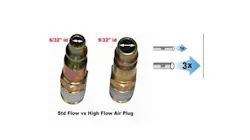
Inside Diameter (I.D.): 3/8-inch is the standard for automotive and fine-finish painting booth setups. A 1/2-inch I.D. hose to feed high-demand HVLP guns (which draw 8–12+ CFM or 3 times the volume compared to ¼ I.D. hose) to ensure the gun is never starved of air. Using a 3/8 I.D. air hose allows for higher fluid volume (remember HVLP), reduced pressure drop and a smoother finish.
The second item suggested was carpet in the booth.
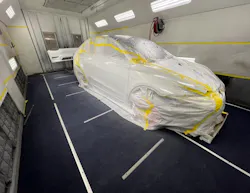
In traditional solvent-based painting, wetting the paint booth floor is comely used by painters to trap dust and prevent airborne circulation. However, doing this when spraying waterborne paint can severely compromise the finish (clearcoat may lose its gloss and take on a dull appearance or dieback). Having this knowledge, you would think putting water down is a thing of the past, but I see it being done every week.
So, here is simple and inexpensive solution. Put indoor/outdoor carpeting (which costs about 80 cents per square foot at Home Depot) on the floor of the booth. Once a week, blow or vacuum the dust. I asked Jason how the carpet was working out and his response, “GREAT and thank you.”
I have a question for you — do you make money when you color and sand polish? I will bet most of you will respond with a NO. Another question — does your detailer use steel wool or a razor blade to remove overspray on glass? The majority of you will answer yes.
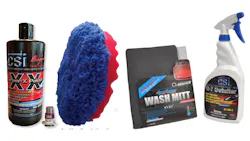
How would you like to save 50% or more on labor and materials in your detail department? The above two liquids and three pieces of equipment are all you need in your detail department. Let’s start with CSI’s Ceram–XX.
Ceram-XX is a water-based polishing compound engineered to perform both cutting and finishing with a single product. Use a wool pad for defect removal and simply flip to a foam pad for final polishing; no need to switch compounds and reduce inventory, training, and process complexity. The company recommends sanding with 2000-grit paper for maximum efficiency, although 1500-grit scratches can also be removed with slightly more buffing time.
Because Ceram-XX is water-based, cleanup is fast and easy. Residue reactivates with water and cleans up like soap. If your wool pad begins to load up, simply mist it with water and continue polishing — no spur cleaning required. Using the CSI double-sided pad and a 3M Quick Connect adapter, technicians simply flip the pad over and continue polishing with the same product. The result is a leaner process that can reduce labor time, lower material consumption, minimize training requirements, and eliminate swirl marks.
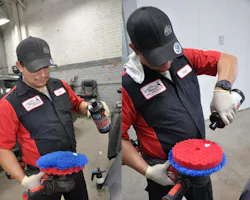
A couple of side notes — you can clean up oxidized headlamps with the product in a couple of minutes and consider a battery-operated buffer. I have a Milwaukee Polisher, and it is a work horse.
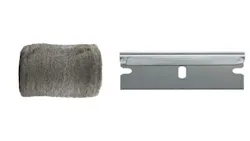
Are you using steel wool or a razor blade to remove overspray from glass?
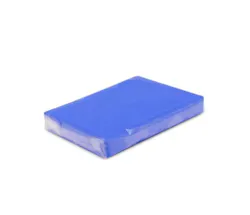
Are you using a clay bar to remove overspray from painted panels? If you answered yes, you need to look at CSI’s Q7 Detailer and Nanoskin Wash Mitt (a synthetic clay bar).
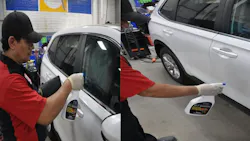
Q7 detailer is a versatile waterborne product that cleans and polishes in one step. It will emulsify dirt and oil, so that it can be wiped away instead of remaining on the vehicle. It works on glass, rubber, vinyl, plastic and leather (always check a product on small out of sight materials for color transfer). Using Q7 with the clay mitt will remove overspray with very little effort (no more steel wood or razors). Several body shops have reduced a few of their detail materials to just one by switch to Q7 Detailer. It is the best glass cleaner that I have ever used, and I have tried them all.
The Nanoskin Wash Mitt has a number of advantages over clay bars. It works three times faster than a clay bar and lasts five times longer. If you drop a clay bar on the ground, you will need to throw it away, whereas the wash mitt you just rinse it off with water and it is ready to go. It should be noted water (as the lubricant) should not be used with either a clay bar or Nanoskin Wash Mitt. Before moving to the last item, answer five questions:
- Do you repair cars at your facility?
- Do you give a lifetime guarantee on your paint?
- Do you guarantee a lifetime warranty on any area that you applied corrosion protection products?
- Do you guarantee that the vehicle will have the same dimensionality after the repairs to the factory specs?
- Do you guarantee that the vehicle will behave in the same manner if involved in another accident?
Nearly everyone I ask these questions will respond “yes” to all 5 questions. I contend that repairing a car is changing brakes or replacing an alternator and not collision damage. I further maintain that collision repair facilities remanufacturer a vehicle. Remanufacturing is "the rebuilding of a product to specifications of the original manufactured product using a combination of reused, repaired and new parts”. Isn’t that what we do by the definition of remanufacturing? If you agree, then the next step is employing manufacturing techniques to our businesses. Let’s look at the 5S’s.
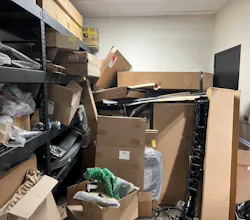
The 5S methodology originated in mid-20th century Japan as a core component of the Toyota Production System (TPS). It was designed to eliminate waste, optimize workplace organization, and improve manufacturing efficiency. There are five steps that need to be followed – Sort, Set, Shine, Standardize, and Sustain. I am going to show a couple of examples of the before and after of the 5S’s.
This was a parts room (one of two). It turns out that none of the parts were marked with a repair order number or any invoices. Sort is removing unnecessary items from the workspace, keeping only essential materials on hand. Some parts were purchased more than three years ago and the owner made the decision to throw away everything. He employed a marking system for all parts the entered the shop.
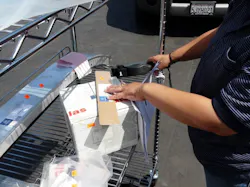
Every part in the shop has a repair order tag on it.
At another shop I counted 46 bumpers (only three had repair order numbers on them) in the shop, but there were only nine cars missing bumpers.
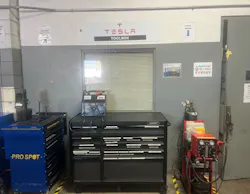
Set is keeping things organized by labeling and assigning each item its own place. This facility has an area for all their equipment with a system that alerts management of any problems that may pop up. Keeping with our topic, Tools 4 Profit, I found a web site that has simple, but very effective tools for getting started and it is free – duralabel.com.
I needed some facility safety signs and the representative of the company told me about the free brochures. Go to Free Guides on their web site and scroll to “5S System Best Practice” and “5S Quick Start Guide,” download it, and get started. The guides are free. If you need any safety signs, give them the business.
About the Author
 Toby Chess
Toby Chess
A Hall of Eagles recipient, Toby Chess is known throughout the collision repair industry for his training for I-CAR and SCRS, and technical presentations at CIC meetings. He estimates he's taught more than 7,000 hands-on I-CAR welding classes, plus 15,000 other live classes in multiple states.
An advocate for body shops and their consumers, Toby has been awarded the SCRS Lifetime Achievement and Industry Achievement Awards, Collision Industry Individual Service Award, Humanitarian Award, and the ABRN Leadership award.