Editor's note: Toby Chess is back writing a series of columns and articles for ABRN. This is the first installment of his regular series on Tools 4Proft$.
In 2011, I was walking the floor at SEMA looking for equipment to support a presentation. I realized there were a lot of items that I came across that I felt needed to be written about that were not part of the presentation. The following year, I started to look for new items and I wrote about them. In 2014, I presented to the CIC and SCRS meeting in Palm Springs – along with my friend Kye Yeung – Kool Tools of SEMA. We would purchase or borrow the equipment and try it out. Eventually, SCRS (the Society of Collision Repair Specialists) took over the project to expand the items presented. As I walked the floor at SEMA looking for new and unique tools, I realized that there were only a couple of new items that I would consider for my article. The one thing that stood out was that a number of items from prior articles that have been improved and I want to revisit some of the products. Before moving forward, remember this formula: SALES MINUS COST EQUALS PROFITS.
Thinking of a title, I decided on Tools 4 Profit$. To increase one’s profits, one could increase their sales, lower one’s cost, and – most important – do both at the same time. My definition of tools is not just a special drill bit, but I have included various web sites, articles, books, show owners, just to name a few. I was limited to usually one article annually, but with this new direction, I am free to get information out faster with more details. The first item on my list is a new addition to the KECO Tabs GPR System.
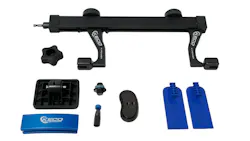
KECO introduced its second-generation K-Power Lateral Tension Tools.
What sets KECO’s Lateral Tension Tools apart from the other manufacturers is twofold. First, KECO’s bar rotates right and left or up and down so the tool does not interfere with the pulling or lifting tool.
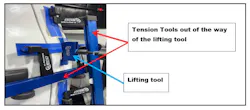
The other item that makes KECO’s different is the tab. The holddown tabs need to be in same plane as the beam for the tool to work properly. KECO’s tabs have been engineered to flex, which allows the tab to be in the same plane as the bar. Continuing with GPR repair, I tested a new type of blending hammers from Dent Fix (also available from KECO).
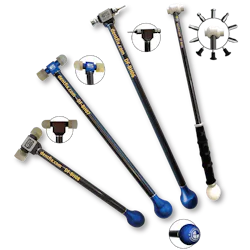
Blending is a PDR procedure to remove shallow dents by striking the crown of the dent and moving the metal to the valley of the dent.
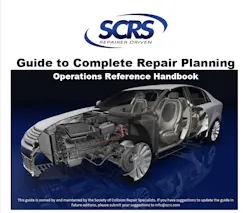
The next item is “The Guide to Complete Repair Planning” at SCRS.com.
The Guide has 24 pages of non-included items that are often overlooked, and it may serve as a reminder for your repair planner as they evaluate damage. It is a task that the technician is performing, and it can be added to your estimate. The PDF download of the Guide is free to everyone in the collision industry. Going back to the formula, you are probably doing a lot of the items listed (Cost) and adding a line item (Sale); you just increase you profits.
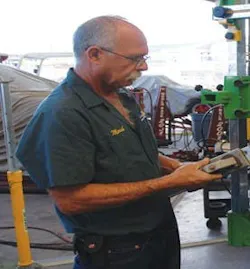
Now, a little bit of history. I met March Taylor at a CIC meeting in 1999, and we both knew we would be brothers for life. We shared our list of non-included items on replacing a doorskin to see who had more. I won. We started to look at how the list of non-included items would help repair facilities improve their repair plans. We combined our items and decided to put our combined items into one document. Over the next few years, we compiled a document of about 500 non-included items we’d identified. March, being the consummate technician, would get to the shop at 5:00 a.m. and answer emails from his friends on the mainland who dealt with repair times provided by the information providers. With his knowledge on repairs, he would email the three companies to review the concern times with an explanation of why the times were wrong. This collaborative approach to identifying and addressing these issues resulted in a very high percentage of times increasing. As word spread, he was getting more and more inquiries, and it got to point he had to stop.
With Barry Dorn and Aaron Schulenburg leading the charge, SCRS, AASP and ASA started the Database Enhancement Gateway. March passed away on August 27, 2007. After March’s passing, Aaron and Barry asked if SCRS could take over the Non-Included List, and I said sure. They have expanded it to its present day offering. It is a powerful tool for your estimator, and it is provided at no cost to you. There is an electronic version (there is a cost), the Blueprint Optimization Tool (BOT), and you can get more details at SCRS.com. Before moving on, I want to discuss SCRS.
This organization is the leading nationwide voice for the collision repair industry, period. I have participated with SCRS as a speaker, committee member and as a board member, as a longtime believer in the power this organization has for being good for the industry.
SCRS, along with I-CAR, provides high-end training at SEMA. SCRS provides you nationwide daily coverage of the collision industry through its Repairer Driven News (www.repairerdrivennews.com). They offer one of the best 401(k) programs for you. Along with their 401(k) program, SCRS has a very affordable health care program for collision repair shops. The Guide for Repair Program is also free and is a great a tool to increase a shop’s sales. SCRS is only as strong as its members, and its strength comes from having more members. The cost of membership is $475.00 yearly and if you use the free Guide to Repair planning, you will get your membership covered in 10 repair orders. Remember again, reducing your costs and increasing your sales means more profits. Let’s move on to the DEG, supported by SCRS.

Developed in 2007, “The Database Enhancement Gateway (DEG) is an initiative that was developed to help improve the quality and accuracy of collision repair estimates, through proactive feedback from the collision repair industry and other “end users” to the information providers (IPs) that supply the databases for the various estimating products.” An example of end-user feedback resulting in updates to the estimating system would include identifying labor times that are not accurate by providing photos and supporting repair information to validate a time study review. After reviewing supplied information, the information provider may update database time in the following months update. In the interim, with a email response that can support a manual correction to the current repair plan. Another example is having to chase down a part not identified in the estimating system. Once a part number is located through the OEM, users can submit parts to be added to the estimating system. Any change corrected or added can be viewed by anyone using that information provider, which is a benefit to the industry by having accurate information. Additionally, users can utilize the FREE DEG resource for access to all three information providers’ P-Pages found under the estimator’s toolbox (DEG.org Industry estimating systems as well as accessing free weekly estimating tips that are distributed through SCRS email communications every Monday morning.
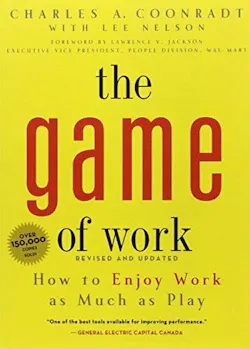
Next up is the “Game of Work”, by Charles Coonradt.
“Since its original printing in 1984, The Game of Work helped thousands of companies and hundreds of thousands of managers and employees experience increased job enjoyment while producing extraordinary results. The Game of Work examines the question of why people work harder at sports and recreation than they do on the job and uses these as metaphors for inspirational leadership strategies. Corporations worldwide have enjoyed the increased productivity, employee satisfaction and motivation, and bottom-line profits by implementing the concepts taught in The Game of Work. As qualified people become increasingly difficult to attract and retain, the implementation of the five principles in this book is the one key factor to improving results, retention, and recruitment.”
I heard Chuck Coonradt speak back east in the late ‘90s and bought his book afterward. I read the entire book on the plane ride back to California, and it was life-changer for me.
Chuck Coonradt applies basic principles of motivation that exist in sports and leisure to running a business from small to large. He looks at five factors that create a better run company, but I found that creating defined goals and scorekeeping are the most lacking areas in the collision industry. Get off the treadmill and try something different. You will be amazed at the results!

About the Author
 Toby Chess
Toby Chess
A Hall of Eagles recipient, Toby Chess is known throughout the collision repair industry for his training for I-CAR and SCRS, and technical presentations at CIC meetings. He estimates he's taught more than 7,000 hands-on I-CAR welding classes, plus 15,000 other live classes in multiple states.
An advocate for body shops and their consumers, Toby has been awarded the SCRS Lifetime Achievement and Industry Achievement Awards, Collision Industry Individual Service Award, Humanitarian Award, and the ABRN Leadership award.