Work with tech schools to attract the next generation of repairers
I grew up in the Midwest in a small suburb of Chicago. When I was young, eight out of 10 of my friends had fathers who worked in industry in some capacity. Some were supervisors, some were steelworkers, and some were boilermakers. They worked long, hard hours in hot mills, welding and building bridges, roads and skyscrapers. I chose a different path and entered the collision repair industry.
It wasn't until many years into my career that I recognized one of the greatest problems affecting the collision industry's outlook was the lack of skilled people. From porter to manager, we, as an industry, were doing a poor job of training and attracting future collision repair employees.I thought about those steelworkers and boilermakers and realized these industries had developed programs to make certain there was always an available stream of well-trained and motivated apprentices entering their respective fields. They developed specialized schools and programs to assure proper training was provided, along with a regimented program that included classroom training, testing and grading levels. Unfortunately, I began thinking about this issue almost 15 years ago, and presently, we haven't made great strides to improve this issue.
Generally, the problem is more recognized – largely because of the multi-shop operators (MSOs) who have brought more business savvy to the industry. Many shops are attempting to do a better job bringing employees along in their careers. As the collision repair population ages, it has, and will, become more difficult to replace older employees leaving the industry.
The news isn't all bleak, though. It is within your control as a shop owner or manager to begin a training program of your own that ensures your longevity as a quality repair facility.
Square one
Only a handful of large collision groups have the financial wherewithal to operate a division that is truly devoted to training its employees. It is wonderful news if you are in one of these groups. It is likely, though, that even if you are working for a MSO with five or more shops, your group doesn't have this expensive luxury. Generally, people are trained by the tried-and-true, baptism-by-fire method. If they last through the first couple weeks, they are good. Obviously, this is not the best way to develop the hidden talent in your people.
First, it is important to consider how the trades train new employees. The answer is through an apprenticeship program, a formal method of training in a skilled occupation, craft or trade. During the apprenticeship period in the construction trades, for example, an apprentice generally receives 2,000 hours or more of structured on-the-job training with at least 144 hours of related classroom instruction. Apprenticeships usually require a written agreement between the program's sponsor (employer) and the apprentice. In the construction trades, the U.S. Department of Labor helps employers develop apprenticeship programs. They help do the same in the collision industry, too.
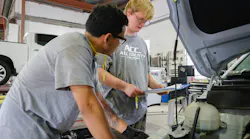
This training is expensive and time consuming. If you are a one- or two-shop owner, how can you afford to implement and run an effective program of this nature? The answer is simple. Your local trade school is doing much of it for you already. All of us have heard horror stories about the tech school graduate who destroyed the first car he worked on, but that is more of the manager's/owner's fault than the fault of the employee. No matter what someone says he can do, you have to verify competency yourself, slowly, not through baptism by fire. Trade schools are one fantastic resource for potential superstar techs, managers and estimators of the future. Often, these programs are overlooked, so it is critically important that you know how to work with them.
Building a relationship
To work with a trade school effectively, you cannot just call and order a couple new techs on the spot. You have to develop a relationship with the school and be willing to commit time and effort to build it and make it work. Remember, you are building the future of your company. Don't rush to call a couple schools without examining them closely. If you look up the schools in your area, you may be surprised by the number of schools. You will find programs through private trade schools, colleges and high schools. Every program is looking for good quality shops in their area that they can work with to get their students on-the-job training in a shop setting and for potential placement for graduates. Many of the larger schools offer lifetime placement assistance as part of their allure.
These schools are interested to develop a relationship with quality shops. What you probably don't know about these schools is they are watched closely by the National Automotive Technicians Education Foundation, the organization that evaluates collision repair technician training programs. It compares the content of a training program against training and testing standards developed in conjunction with the automotive industry. It recommends which programs qualify for certification. Look for schools that have attained certification.
Once you have identified at least three schools that you would consider working with, contact them and set up a formal meeting. Remember, you are in the driver's seat. Interview the schools as thoroughly as you would if you were going to be attending the school. Tour the facility and speak with the instructor and students.
Before your meetings, prepare a short list of questions, the answers to which will help you gain insight into the school, its instructors and its curriculum. Here are some questions to consider asking:
2) What does the curriculum cover? Ask for a course syllabus or a detailed overview of what the students will be learning. Verify that the material the students are being taught is current and pertains to modern repair methods. Review the length of time spent on each facet of the repair process. Some classes focus much time on interesting, but not necessarily, pertinent topics, such as custom painting. I love custom painting, but in a production collision shop, not much happens in this arena daily.
3) What industry recognized certifications will the schools' graduates achieve during the training? Many schools offer their students the opportunity to earn Automotive Service Excellence certifications or I-CAR training as part of their training. Because these certifications are the industry standard, they are important considerations when choosing a school to align yourself with.
4) What kind of equipment and facility does the school have? A modern school should be well equipped and maintained. In most cases, the school facility will be better than what many techs encounter after graduation when they work in private shops. You will want your prospective employees to have been trained on the proper equipment.
5) Ask yourself how well the staff interacts with you in your interview? How do they interact with the students? Are they willing to work with you as a potential source for student placement after graduation? If you feel comfortable with the school's staff, then you should be able to work with them throughout the training process.
Another benefit of working with formally trained apprentices is that they have been trained about the importance of personal safety. Many old-timers in the industry still don't protect themselves as well as they should, which can expose you and your shop to potential legal problems.
Once you have chosen a school (I recommend working with several), work with the instructor or administrator to lay out a program using your shop as part of the students' training. Many schools like to have students work in real-world conditions during training. While the student is working for you as a paid employee, you'll have the opportunity to see which students are good and would be an asset to your shop. You'll be able to see what potential an employee has before you hire them.
This is something you can't ever do outside this apprentice scenario. You'll literally be able to pick the cream of the crop. This process involves a high level of commitment from you, so if you go into the process haphazardly, you'll get poor results.
By becoming involved in training and growing future employees, you're helping ensure your company's future. Once you work with a reputable trade school and develop a specialized apprenticeship program that involves your shop, the industry can't help but improve. That's something to anticipate.
About the Author
 Kevin Mehok