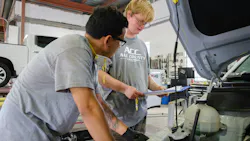
At first glance, the shop floor of All County Collision in Eustis, Florida, appears to be your typical busy body shop. Impact guns rattling, vehicles mid-disassembly, technicians moving with purpose between bays. Everything flows with the familiar rhythm of collision repair.
Look closer, however, and you’ll start to see something else taking shape: a deliberate, structured approach to developing the next generation of technicians from the ground up.
For Ryan DeMarco, owner of All County Collision, that approach didn’t come from chasing a trend. It came from necessity.
“I’ve been working in my family business since 2016,” DeMarco says. “And like everyone else in this industry, we’ve lived with the technician shortage conversation for years.”
Rather than continuing to compete for the same shrinking pool of experienced technicians, DeMarco decided to take a different route, one that focused less on finding fully formed talent and more on building it.
From the ground up
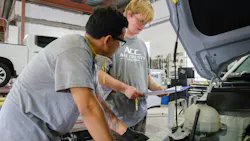
About a year and a half ago, All County Collision shifted to a team-based production model. Repairs are segmented, with highly skilled technicians handling complex operations while less-experienced team members take on foundational tasks under close supervision.
“That structure made it easier to bring in lesser-skilled technicians and actually develop them,” DeMarco says. “They’re not on an island. They’re working alongside people who know what they’re doing from day one.”
Around the same time, DeMarco learned about the I-CAR Registered Apprenticeship Program (RAP). The alignment was immediate.
“We were already training people internally, but RAP gave us structure,” he says. “Instead of just assigning I-CAR classes and hoping it all made sense, this was a defined progression that matched where they were in their careers.”
That structure became especially important in a shop where flat-rate economics can often discourage investment in green talent. All County Collision adopted a hybrid pay model that allows multiple hands on a single job without penalizing productivity or morale.
“The incentive is simple: If an apprentice becomes productive, everyone on the team benefits,” DeMarco says. “So, the faster and better they learn, the better it is for everyone.”
And that learning doesn’t happen by accident. It’s driven by a culture where mentorship is engrained in the fabric of the team’s culture.
“I would say every technician in my shop is a mentor,” DeMarco says. “That didn’t happen overnight, but it’s become part of who we are.”
One of those mentors is David Baskette, All County Collision’s production manager. Baskette has been in the industry since the late 1990s, holding roles that span nearly every corner of a shop, from body tech and painter to estimator and insurance adjuster.
“What appealed to me about being a mentor was simple,” Baskette says. “Making sure people learn the proper procedures, the right way to do things, and how to stay productive with a positive attitude.”
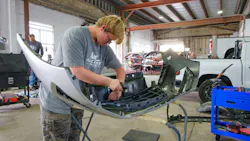
One of the people Baskette mentors is Aidan Richardson, an apprentice who’s been in the industry just over a year. Richardson splits his time between detailing, teardown work, and ADAS calibrations, an area that didn’t exist when Baskette was coming up.
“He’s helped me out a lot,” Richardson says. “Anytime I run into something I haven’t seen before, I can ask him, or another tech. There are a lot of different ways to get to the same result, and I’ve learned how to notice things I might’ve missed before.”
The learning, Baskette says, goes both ways.
“Aidan does all our ADAS calibrations,” Baskette says. “That’s stuff we didn’t do when I was a tech. As he learns, he shows me, especially on newer vehicles. It’s helped me identify things earlier in the process that we might not have caught before.”
That reciprocity — experience flowing down, new knowledge flowing up — is one of the most powerful byproducts of an apprenticeship model done well.
For Richardson, the I-CAR apprenticeship program reinforces lessons learned on the shop floor while adding consistency and accountability.
“It makes you more aware of safety and procedures that can get overlooked when you’re rushing,” Baskette says. “And once you see those things through the program, you start catching them everywhere. And not just with the apprentice, but across the shop.”
DeMarco agrees, saying the starter toolkits included in RAP were a game-changer.
“Not having to borrow tools removes friction immediately,” DeMarco says. “But the biggest benefit has been structure. Knowing what comes next, what someone needs to master, and when they’re ready to move forward. It’s all laid out.”
That clarity matters, especially in smaller shops where traditional “career ladder” titles don’t always exist.
“There aren’t ten levels of promotion in a 20-person shop,” DeMarco says. “But if someone’s value increases, their pay increases. RAP helps explain that path in a concrete way.”
Scaling the model
While All County Collision represents a single-shop view of apprenticeship in action, the same themes are playing out on a much larger scale at VIVE Collision.
Mike Joyce, director of quality assurance and the ambassador program at VIVE, has spent years working to connect education, mentorship, and operational consistency across the company’s footprint.
Joyce became deeply involved with I-CAR about six years ago while serving as chairman of the Rhode Island I-CAR committee. At the time, structured apprenticeship paths were limited.
“We were working with local schools and state-funded programs,” Joyce says. “But it was hard to line everything up the way we wanted.”
That changed as I-CAR developed its Academy and Registered Apprenticeship Program. Today, wherever VIVE has an ambassador — a designation reserved for elite technicians — it also has an apprentice or Academy participant.
“We have 16 locations with ambassadors and 13 registered apprentices right now,” Joyce says. “And that’s intentional.”
VIVE’s ambassadors serve as mentors, quality leaders, and cultural anchors within their shops. RAP’s curriculum doesn’t just develop apprentices — it actively builds leadership skills in those mentors.
“They’re taking classes in team effectiveness, mentorship, leadership,” Joyce says. “So while we’re growing students and employees, we’re also growing our next generation of leaders.”
For Joyce, the biggest benefit of RAP isn’t just skill development. It’s confidence.
“You see it in the mentors, the managers and the employees,” he says. “Everyone knows where they’re going and what’s expected.”
The program’s built-in wage progression plays a major role. As apprentices complete milestones throughout the roughly two-year program, raises are triggered automatically.
“It takes pressure off managers,” Joyce says. “Progress is visible. You see test scores, logins, and coaching points. One-on-ones are more productive because you’re not guessing.”
That visibility also changes how shops approach hiring.
“We’re not afraid to hire entry-level technicians anymore,” Joyce says, “because now we have a plan.”
Just as importantly, RAP removes administrative hurdles that historically kept owners from starting apprenticeship programs at all.
“I-CAR handles the Department of Labor paperwork. The curriculum is set. The tooling is provided,” Joyce says. “There’s no easier way I’ve seen to get something like this rolling.”
Now more than ever
The collision repair industry is changing faster than ever. Electrification, advanced materials, and ever-evolving repair procedures demand constant learning—not just for technicians, but for managers and leaders as well.
“If you’re not investing in your people, you’re going backwards,” Joyce says. “Repair procedures can change day to day.”
Apprenticeship programs such as RAP address more than the technician shortage. They create clarity, consistency and continuity, three things the industry has historically struggled to offer entry-level workers.
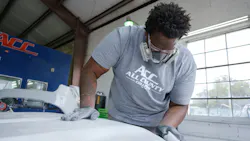
Back in Eustis, Richardson doesn’t talk much about industry trends. He doesn’t have to. His experience already reflects what structured development can do.
“I’ve learned to notice things I would’ve missed before,” he says. “And I know there’s someone I can go to when I’m not sure.”
For Baskette, that’s the point.
“If we can get people in early, teach them the right way, and keep them safe and confident,” he says, “the whole shop gets better.”
DeMarco puts it more plainly.
“New technicians are the future of this industry,” he says. “And if we don’t build them ourselves, we can’t expect them to magically show up.”
Across shops large and small, apprenticeship programs are proving that developing talent doesn’t have to be a gamble. With the right structure, support, and commitment, it can be one of the most reliable investments a shop makes not just in its people, but in its future.
About the Author
 Noah Brown
Noah Brown
Noah Brown is a freelance writer and former senior digital editor for 10 Missions Media, where he facilitated multimedia production several of the company's publications.