Richard Romero was only months into his time as the general manager of Dan’s Paint and Body in Tucson, Ariz., when the economy tanked in 2008. If the shop was going to move forward during some difficult times, Romero knew it would have to grow organically.
Repeats and referrals—that was the target, Romero says. And to do that, the shop focused on an underutilized marketing product it already had: its warranty.
“[The process] all comes down to an official warranty that we mail out to customers after the repair,” he says. “We now emphasize it throughout the repair process, really sell people on it, and by the time it’s mailed to them, they’re waiting for it, anticipating it.”
More than anything, it builds trust with that customer and creates an on-going contact stream for several years after the repair.
Since enacting this campaign, sales at Dan’s Paint and Body have gone from $2.8 million in 2008 to just above $4.3 million in 2012, all while dropping from six DRPs to just two.
Romero says a great deal of the credit goes to this new marketing initiative. It’s a highly powerful marketing tactic that relies heavily on consistency, he says, but, in the end, it’s fairly simple to utilize.
The Concept
Steve Schoolcraft is the president of Phoenix Solutions Group, a collision industry marketing firm that works with nearly 500 shops around the country, including Dan’s Paint and Body. When meeting with clients, he often reminds them of a simple fact about customers: They aren’t going to remember you—unless you make them.
“There’s this misconception that if they can deliver a vehicle with a quality repair, the customer will always remember them,” Schoolcraft says. “It’s simply not true.”
What shops need to do is keep their names top of mind with customers through post-repair marketing. That’s where your warranty should come in. A personalized, custom warranty for each customer provides a reassurance of the work completed, and it helps build trust between shop and customer, Schoolcraft says.
“It’s an on-demand product, it’s something they should want,” he says of the warranty. “It’s your job to sell them on it.”
The idea, Schoolcraft says, hinges on creating specialized warranties that are mailed to customers after the repair. Mailing it creates an initial post-job touch point with that client, and it sets the stage for valuable contact with the customer for the next several years. In the end, it will keep your name fresh in the customer’s mind the next time they get in an accident.
To be successful with this, though, shops need to have an overall sales and marketing campaign built around this product, from the time the customer first comes in the shop for an estimate to several years after the repair is completed.
The Warranty
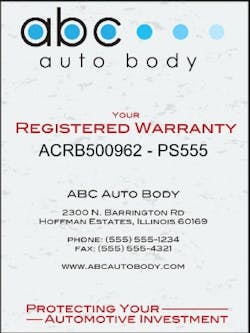
Any shop can create a warranty in-house. Here is a look at an example of the warranties crafted by Phoenix Solutions, like the one used at Dan’s Paint and Body.
1) Warranty Information. The details of the warranty should be explained in full. This example has a portion of the information at the top, while directing the customer to look at the reverse side of the document for the rest of the information.
2) Customer Information. Name and address are to be expected, but this warranty customizes it a step further with the vehicle’s year, make and model, as well as the date the repair was completed (i.e. the “effective warranty date”).
3) Logo and Contact Information. Your company’s branding should be clearly visible, in color, on the document, along with your address, phone number and website.
4) Registration Information. Having your warranty registered through a third party like the Automotive Customer Relations Bureau (ACRB) adds to the credibility of the product, and makes it look more official.
Why It Works
One of the biggest issues with most marketing pieces is that they get ignored. Emails can be deleted without opening. Social media posts rely on someone checking in with you. Mailers can be tossed in the recycling.
The reason Schoolcraft’s warranty concept is effective, he says, is that when the warranty arrives at a customer’s home, they are already waiting for it.
“You’re sending them something of value, something that you know they will open up the envelope to get,” he says.
From then on, that warranty creates a connection between you and that customer. All future correspondence will remind them of that, increasing the likelihood of them being interested in future letters.
“We find that people trust that logo on the envelope now,” Romero says. “And they’ll open it up. We get people coming in all the time with the letter in hand. Just seeing that shows that it’s working.”
How It Works
Typically, shops hand over their warranties to customers when the repaired vehicle is delivered. That’s a mistake, Schoolcraft says.
“You’re giving it to them at a moment when they’re more apt to be anxious to leave, get back in the car, and get on with their lives,” he says. “They probably aren’t listening, and it’ll just get shoved in a drawer somewhere and forgotten.”
That’s why Schoolcraft and Romero recommend a three-stage process for using the warranty to your benefit.
1. The Set-Up
The warranty needs to be a focal point of the entire repair process, and that starts when selling the customer on the estimate. Schoolcraft says to “fully explain just how powerful the warranty is” during that initial consultation. Describe how it is a customized document, unique to their vehicle, while explaining some of the major ideas within it and how that benefits them as the vehicle’s owner.
Three Things to Think About
1. Know your talking points. Schoolcraft recommends creating a tip sheet for customer service representatives to use when discussing warranties with customers. It ensures they hit all the important parts and can answer any questions the customers may have.
2. Spelling. Schoolcraft’s company prints roughly 40,000 personalized warranties for clients each month. Of those, roughly 500 need to be reprinted because shops didn’t have the correct spelling of a customer’s name. This mistake throws away all the credibility and trust you worked to obtain. Simply put: Make sure the spelling is always correct.
3. Put it in the glove box. Remind customers to keep the warranty in their vehicle, so that it’s easily accessible the next time they’re in an accident. While the warranty won’t cover the new accident, your contact information displayed on it should help ensure they call your shop.
“It has to be a part of your service,” Romero says. “They need to fully understand it and the value it adds, so that it’s fresh in their minds throughout the process.”
2. The Legwork
During the repair process, Schoolcraft says to regularly remind the customer that at the time of delivery, you want to thoroughly review the warranty with them.
“It’s just a simple reminder every time you’re giving them an update on the repair,” he says. “It’s something like, ‘Mr. Jones, your car has moved from body to paint. It’s right on schedule for your Friday pick-up. I also wanted to remind you that when you pick up your car, I want to take a few minutes to go over your warranty with you because it’s a really important element of the repair.”
Then, when the repair is completed, follow up on your promise and explain in great detail what the warranty covers. Because the customer is prepared to have the conversation, Romero says, they won’t automatically tune out. Take your time and make sure all their questions are answered.
Also, at this point, Schoolcraft says to give each customer a temporary warranty—a small slip of paper with your company’s logo and an acknowledgement of the existence of the warranty agreement—and explain that the official warranty will arrive in the mail in five to 10 days.
3. The Follow Through
Now, the customer should be anticipating your letter. With each warranty, Schoolcraft recommends sending a personalized thank-you note that should not only include your company’s branding, but also have details about the repair; vehicle make, model and year; the extent of the work performed; etc.
And the focus now shifts to customer retention.
Schoolcraft recommends follow-up letters every six months after the repair for up to five years. Each letter should be checking in to make sure the customers are still satisfied with their work, and to remind them, if they aren’t, that the vehicle is still under warranty.
“It’s another display of trust—that you stand by your work so much that you will remind them of the warranty and check on how they feel about the work,” he says. “Customers are only going to be coming in every few years, and you want to make sure you’re the name they think of the next time they’re in an accident or a fender bender.”
About the Author

Bryce Evans
Bryce Evans is the former vice president of content at 10 Missions Media, overseeing an award-winning team that produces FenderBender, Ratchet+Wrench and NOLN.