Editor's note: In a previous version of this story, Will's brother, Robert, was incorrectly identified as Pete, who is their father.
A lot has changed on St. Paul, Minnesota’s University Avenue since 1933. But the echoes of tradition can still be heard along this major east-west thoroughfare. The sounds are just a bit more high-fidelity.
Where minor league baseball’s St. Paul Saints once called Lexington Park home, Major League Soccer’s Minnesota United now play less than a mile west of the long-gone ballyard at state-of-the-art Allianz Field. Trains still run down the street’s median, though instead of the click-clack of streetcars, the sound of modern light commuter rail is more of an electric hum, occasionally punctuated by prerecorded bells and whistles.
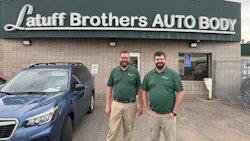
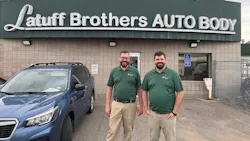
Life is very much modern-day but carrying on beloved aspects of yesterday. The same is true for another University Avenue landmark: Latuff Brothers Auto Body, established 1933. The building looks a lot different, a lot bigger, and the services they perform include things that would’ve been pure science fiction back in 1933. But the basics of the business remain the same. And its steward carries on those standards, as well as the family name.
I truly believe in a short and flat-style org chart, where there shouldn’t be a lot of levels between the people doing the work and leadership, and so I don't want people to have to go through multiple rungs to get an answer. Will Latuff, co-owner, Latuff Brothers Auto Body
The Family Business
The name Latuff Brothers is as true today as it was when the business opened — only the names have changed. Brothers Joe, Mike, and John founded the shop, with the help of their father, a woodworker originally from Lebanon who had a knack for fixing wooden frames. Their stewardship led the shop through the early challenge of the Great Depression to the point that the shop is now in its fourth generation of family ownership. The brothers today are Robert and Will, who run the day-to-day operations.
For Will Latuff, neither the shop’s permanence nor his place in its success was ever in doubt. Now in his mid-40s, Latuff says he always dreamed of taking his place in the family business. His memories of growing up in a body shop include using steel pulling plates to hold Pinewood Derby cars and standing on a frame machine just to hear the clicking sound as it did its work. He recalls in one instance liking that noise a little too much, to the point the shop’s body man had to pull it back the other direction the next day. Having already worked with body men and in the paint department by the time he was in high school, Latuff recalls attending a presentation by Mike Anderson that inspired the direction he chose to take in business.
“He had his bible of estimating, whatever he called it, it was like a 400-page printed booklet of everything you need to charge for estimating, and I was absolutely captivated by his presentation,” Latuff says. “It was all fire and brimstone, and that really sparked my passion for estimating, and that’s the direction I headed then in business after that.”
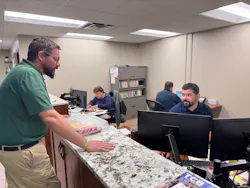
Any day of the week you can find Latuff at the shop. And if he’s not at his desk, odds are you’ll find him blueprinting. Latuff’s brother largely runs the front of the house, working with customers and writing counter estimates, while Will is in the back of the shop overseeing production. That’s a choice which is both a reflection of his passion for estimating and also a philosophy toward management and efficiency.
“I truly believe in a short and flat-style org chart, where there shouldn’t be a lot of levels between the people doing the work and leadership, and so I don't want people to have to go through multiple rungs to get an answer,” Latuff says.
You always have to be looking forward, because your competitive advantage only lasts so long. -Will Latuff
Running the Show
You don’t get to nearly a century in business without doing some things the same way. Company values and standards are how excellence is maintained and passed down through generations. But everything else is open for innovation, and Latuff always has his eyes on getting better.
“You always have to be looking forward, because your competitive advantage only lasts so long,” he says.
Latuff recalls when his father switched the shop over to spraying waterborne paint in the early 2000s, at a time when environmentally friendly practices were less common and really resonated with consumers. But it wasn’t long before shops all over the country followed suit, erasing that point of differentiation. And then it’s onto the next thing. For Latuff Brothers, certified repairs have become one of those new points of differentiation, and that’s a message that has really resonated with customers.
“Certifications, safety inspections, being willing to do what most others choose not to do, and support our customer no matter what it is,” Latuff says. “We’ve terminated DRPs because they didn’t agree with fixing the car properly, or they didn't want us to do safety inspections, and tried to coerce us into not doing them, and every time we choose the customer without thinking twice.”
Latuff has also started experimenting with AI, even as a management tool. AI organizes notes for the shop’s daily production meeting into a single-page handout, helping all team members stay up to date with the day’s top takeaways. It’s something Latuff says has been well-received. He’s also looked at using AI to relieve some of the administrative burden within a shop, such as generating summary notes from emails or having AI discern the key differences between estimates.
Continuing the Legacy
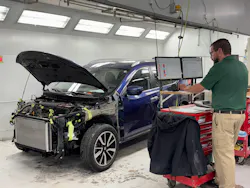
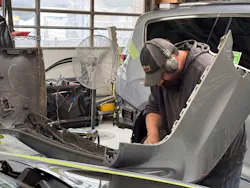
As far as the rest of a typical day at Latuff Brothers, Latuff notes that his on-the-ground role is a dual one, doing blueprinting and supporting technicians with whatever they need. That might mean a second check before cutting off a panel or reviewing a procedure for proper documentation. Then, when production starts to ramp down, Latuff has time to focus on the higher-level tasks, closing tickets, balancing ROs, and considering broader business matters.
“In between, it’s all the other things that it takes to run the business,” Latuff says. “You know, looking for our next step of what we’re going to do.”
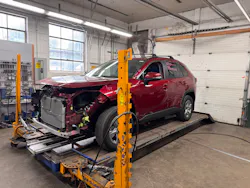
With many years of shop ownership ahead, Latuff is always looking ahead and anticipating challenges that may arise. One of those is related to physical space. Latuff Brothers has never moved locations, but it has steadily bought neighboring lots over the years to expand its square footage. But there isn’t a limitless amount of real estate for sale, plus there are extensive zoning and permitting requirements to deal with being in an urban location. Latuff says the shop would love to bring more sublet operations in-house to increase profits, but space remains a limiting factor.
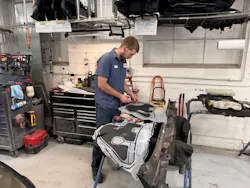
“It’s pretty tough to get approved to build additional space where we’re at, so we’re going to have to look creatively for solutions around that,” Latuff says.
When reached on a rare day at home for his first interview with FenderBender , Latuff was about to continue work on an engine swap for a 1972 Chevelle Super Sport. While cars remain a passion of his — and the initial reason that made him interested in making his career in the family business — it’s not his primary motivation these days. Instead, it’s the people aspect of business, and the opportunity to help and influence the individuals he interacts with every day.
“That’s what really fills my bucket,” Latuff says. “It could be a customer, it could be an employee; it’s having that connection that is really more meaningful than the cars right now. Yeah, we fix cars, but we help people. That’s our business.”
About the Author
 Todd Kortemeier
Todd Kortemeier
Todd Kortemeier is former editor of FenderBender magazine and started writing as a contributor in 2024.