Why We Eliminated Parts Carts and Rebuilt Our Parts Department Around Repair Flow
Key Highlights
- Transitioned from traditional metal carts to collapsible, pallet-sized plastic crates to increase capacity and optimize space usage.
- Created clearly defined parts zones for each repair stage, improving visual communication and reducing handling errors.
- Implemented zone management by department leads to enhance accountability and operational visibility without constant oversight.
- Redesigned workflow to minimize unnecessary movement, search time, and transitional waste, boosting overall efficiency.
- Continually refining the system with better protection standards and evolving zone processes to adapt to repair needs.
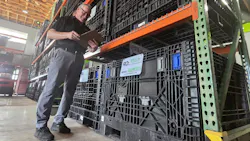
For decades, the traditional red parts cart has been treated as a required piece of equipment in collision repair. When a vehicle enters production, the cart follows it. Removed parts go on the cart. New parts go on the cart. The cart moves from department to department until the repair is complete.
At DB Orlando Collision, we stopped asking how many more carts we needed and started asking whether the cart itself was contributing to the problem. What initially started as a capacity problem became an opportunity.
Traditional parts carts consume a tremendous amount of valuable floor space. More importantly, they quietly reduce production efficiency through unnecessary movement, excessive handling, and transitional waste. Each time a cart is moved, searched, repositioned, or worked around, time is being consumed without adding value to the repair.
Our parts department had reached its physical capacity. Even inside our brand-new facility, we could not add one more cart. We needed more capacity, but simply purchasing more equipment or expanding the same system would have created more congestion, not more efficiency.
So, our team locked ourselves in a room and began brainstorming outside the traditional collision-repair model.
We Did Not Want a Bigger Parts Area
Our objective was not simply to create more storage. We wanted to address several smaller operational problems at the same time.
We reviewed the flow of our delivery drivers, the daily receiving process, the amount of walking required from our team, and the way parts activity could interfere with client and production movement. We also wanted clearer visual communication throughout the facility.
Anyone standing inside the parts department should be able to identify whether a bumper or panel is waiting to be reinstalled, repaired, matched to a replacement part, prepped for paint, or returned to a vendor.
Instead of creating one large parts area, we created clearly defined parts zones.
Those zones make capacity, work in progress, and repair-versus-replacement decisions visually obvious. Our teams should not need to dig through a weekly report to understand what is happening. In many cases, the condition of the department should be understandable simply by standing in front of it.
Replacing Carts with Industrial Crates
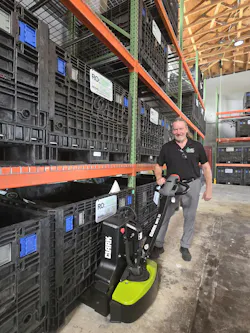
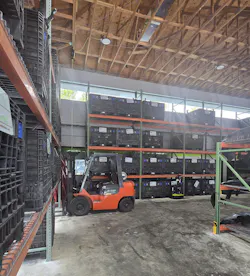
We transitioned from traditional metal carts to industrial, collapsible, pallet-sized plastic crates. These crates are commonly used for commercial shipping and material handling. The change increased our capacity from approximately 53 traditional carts to more than 120 available parts bins.
Because the crates are modular and designed for pallet storage, they can be stored vertically on pallet racks instead of consuming prime production floor space. Empty crates can be collapsed and stored outside without the same weather concerns associated with traditional metal carts.
The crates are moved using removable wheeled dollies. Once a crate reaches its designated zone, the dolly is removed and used elsewhere. That eliminates the risk of a wheeled cart being accidentally bumped or rolled into a client’s vehicle. The crate remains stationary until the parts are needed.
This also created a clearly defined location where parts can be delivered to technicians. Parts are no longer placed on random tables or open surfaces, where several team members may eventually waste time searching for something that was misplaced, assigned incorrectly, or poorly communicated.
Our Parts Zones:
Today, our system includes dedicated zones for each stage of the repair process.
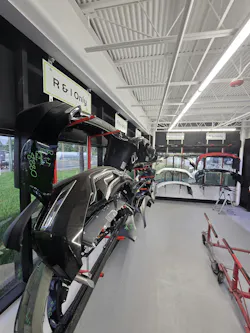
R&I Bumpers and Panels
Parts being removed and reinstalled are labeled with the repair-order number immediately after repair planning. They remain in this zone until reassembly is ready for them.
They do not move throughout the repair. That reduces handling, clutter, and the risk of shop-inflicted damage.
R&I Glass
All reusable glass is stored in one designated area. It is no longer leaning against walls throughout the shop or being stored inside the vehicle.
Body Repair Needed
Any removed part being repaired instead of replaced is labeled and moved directly from repair planning into the body-repair zone.
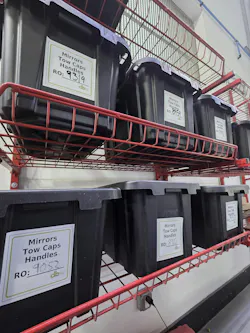
Prep for Paint
Once the body department completes a panel repair, the part transitions into the paint-preparation zone. This becomes the staging area for the next phase of production.
Freshly Painted Parts
Everything leaving the booth is placed into a dedicated zone while awaiting reassembly and final quality assurance.
Cores
Parts carrying core charges are labeled and placed in a dedicated core-return zone once the replacement has been installed.
Without a defined system, cores can leak through the repair process, become misplaced, or be unintentionally discarded. When that happens, the shop absorbs a core charge that directly reduces parts margin.
Client Belongings Hold
Items removed from total-loss vehicles are labeled and stored for 30 days. If the client does not retrieve them, the items are donated to a local Goodwill.
They are never allowed to become an unidentified pile in the corner of the shop.
Returns
Incoming and outgoing returns are separated and organized with the supporting invoice documentation. The visual system allows vendor drivers to confidently self-service pickups and deliveries while our parts team continues checking in parts, gathering payments, and confirming receipts.
Bumper, Rocker, and Panel Replacement
Replacement bumpers, rockers, and panels are stored on empty pallet racks and panel stands. This gives our team clear space to mirror-match incoming parts against the original components.
Once the part is confirmed, it transitions to the appropriate production zone. A replacement bumper cover, for example, can be labeled and moved directly into the prep-for-paint area while the original bumper is properly disposed of.
The System Creates Accountability Without Constant Enforcement
The end results most significant benefit is not storage capacity. It is operational visibility.
Each zone is managed by a department lead who is responsible for understanding what entered the zone, what takes priority, and why anything has remained there for more than a day or two.
I compare it to a plated meal sitting under the heat lamp in a restaurant. Even the busser eventually asks why the food has been sitting there for so long.
The system does not depend on every employee being perfectly connected, perfectly informed, and incapable of making mistakes. Instead, the environment itself helps maintain discipline.
When each department controls its zone, the team begins supporting one another through confidence in the process. Repair Planning places the correct parts into the system. Body Repair completes its work and advances the parts. Paint prepares and refinishes them. Reassembly receives the parts when they are ready.
Each area depends on the previous department doing its job correctly.
What We Are Still Refining
The system continues to evolve.
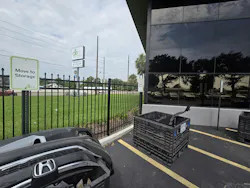
We currently maintain three exterior crate zones: empty crates waiting for repair planning, crates pulled from storage and waiting for reassembly, and crates completed by repair planning that are awaiting transportation to formal pallet rack storage and mirror-matching review.
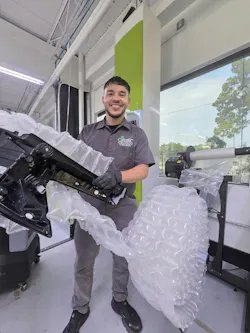
We are also developing better protection standards for headlights, textured plastics, trim pieces, and other damage-sensitive components. Our team is testing different bubble-wrap materials and reusable protection solutions that are practical, sustainable, and affordable.
That is especially important because insurers do not always fairly compensate shops for the labor and material required to protect parts during the repair process.
What Other Shops Should Consider
This system should not be copied simply because it replaces a cart with a crate.
The real improvement comes from designing the flow around the needs of the repair. Shops should first identify where parts are being handled repeatedly, where employees are walking unnecessarily, where damage occurs, and where accountability disappears.
The red parts cart is not automatically the problem.
Accepting it as the only possible solution is.
About the Author
 Drew Bryant
Drew Bryant
Drew Bryant has been the owner of DB Orlando Collision since August 2011. A 20 group leader, in-demand conference speaker, and award-winning shop owner, Bryant takes a nontraditional approach to process implementation, lean process development, and overall operational experience while remaining dedicated to his staff's personal and professional development.