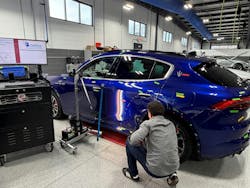
It’s natural for shop operators and employees alike to get caught up in day-to-day business and forget just how remarkable collision repair is. Customers might refer to it as “magic,” but there’s nothing supernatural about it. It takes advanced knowledge, extensive experience, and highly refined skills to make it happen. And it’s a process that starts with the repair planner.
“With blueprinting and being at a body shop, you have to be an expert in all types of damage, as well as all types of vehicle manufacturers,” says Anthony McNee, blueprinter at Ultimate Collision in Edison, New Jersey. “So I have to be an expert in knowing every single procedural website, the parts catalog, the calibration systems, every single thing. And it’s a lot to try and figure out, because every car is different, and everything is completely independent from one another.”
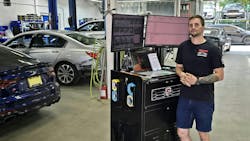
Someone like McNee, the winner of our 2024 Best Repair Planner/Estimator Award, might make it look easy, but repair planning is challenging work. 2025 award winner Will Barkley, of K&M Collision in Hickory, North Carolina, might also seem like someone who has it all perfect, but he knows to focus on one job at a time, never taking anything for granted.
“Take your time; you don’t want to cut the process ever,” Barkley says. “You want to have the same approach whether you’re doing a bumper job or you’re doing a quarter panel replacement. Whether it’s minor damage versus a hard hit, you’ve got to have the same approach.”
These award-winning estimators offered a few of their top tips for success in blueprinting, from the tools of the trade to what they need from management. In an era where repairs are more complicated than ever, blueprinting success is directly linked with shop success.
Some Helping Hands
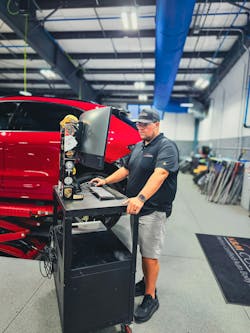
To be a blueprinter today is also to be a researcher, and both McNee and Barkley emphasized taking the time to find out what you need to know about each vehicle to write the estimate. “Procedures change all the time,” McNee says. “Sometimes they even change weekly, or they get updated. So, I always reference the latest information. Just because I did the same thing last week, for example, I still double check it and I go and check the latest information.”
McNee mentions storing files like position statements in files on a device where you can easily find them, as opposed to having to navigate a website where files can change locations and names without warning. Barkley says it’s vital to have access to scan reporting and have that information in front of you so you know what ADAS equipment is on the vehicle.
At K&M, Barkley maps out the vehicle using estimating stickers. Red is for parts to be replaced; yellow is for repairs or a blend panel, and green is for R&I parts. Those things are also noted in the written description, with paint markers used for emphasis in photos so that whoever looks at that car is on the same page. Barkley also stresses the importance of workstations being located at the vehicle, so that you’re not going back and forth to the office trying to put the estimate together.
McNee also notes the importance of marking vehicles, so that everything is clear both in photos and in person. McNee also utilizes a dent board to show grid lines and illustrate depth in photos. But maybe the most important tool? A simple notepad. Technology is great, but if you’re walking through the shop and someone reminds you of something, you’re not at a keyboard to add it to a file. You might not have your phone on you. So, it is forgotten 10 minutes later.
“It’s very easy to get distracted in this industry with how many things are going on,” McNee says. “... Just having a notepad with you to document it, it just ensures consistency and accuracy. Because if I write something down, I’m going to reference it. I can cross it out. I can double check it.”
Too much paper gets messy quickly, however. McNee recalls he used to over-rely on Post-it notes with reminders, but he transitioned those into checklists of universal things to do on each repair. “Every single time I’m going to write an estimate,” he says, “I have a series of checklists as well as a whole operation database for an estimating tool I created, and I’m just referencing it every single car that I have to write.”
Communication and Support
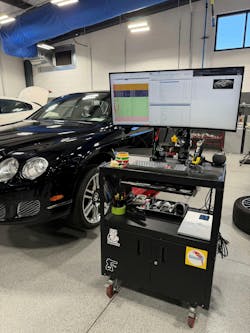
You already know how important communication is in any business, but it is especially true in a body shop where many hands and eyes combine to work on a single repair. The estimator really sets that tone and can help facilitate communication throughout the shop. If not, “every department is going to be doing whatever they think is next, going through the review process as you’re as blueprinting,” Barkley says. “I think it’s always good just to kind of recap on what you’re adding to your sheet.”
Everyone needs to be on the same page, and that comes down to the application of your SOPs, Barkley says. He gives the example of how at K&M, there are two teams: One estimator each has a team. Those two teams must be operating off of the same procedures, otherwise their results are going to be far different. Barkley also says that at his shop, techs have the same access to pulling procedures, so they don’t have to rely on the estimator to communicate information that they need to know.
Lastly, support from shop ownership and management is crucial in a number of ways. It is financial support, ensuring the estimator has whatever equipment they need to do the job properly. Support comes via trust, allowing employees the freedom to find processes that work best for them, while still adhering to shop SOPs.
Shops should also be permissive with time. Time is money, but the cost of not doing a job properly is exponentially more. If an estimator needs more time to do research and prevent a mistake further along in the repair process, then that is time well spent.
“Your management has to understand that if you roll up to a car, it may take you two hours,” Barkley says. “It may take you three hours to complete that repair plan to the full extent where that car can go through the process without any hiccups.”
Shops also should consider being tolerant with allowing time for training, whether that is training done on a computer in the shop or allowing estimators to get hands-on training off-site. It’s like an investment in the future success of the shop. Given the increased importance of proper repair planning, it’s one that’s likely to pay off.
“There are some hands-on trainings where if you’re never allowed to leave the shop and go do those things and learn from that, I think that's a real holdback,” Barkley says. “I think there are a lot of people who would like to go to stuff like that, but don't get the opportunity.”
Related Webinar: "The Evolution of Repair Planning: Why OEM Research and Documentation Matter More Than Ever," Sponsored by OEC
About the Author
 Todd Kortemeier
Todd Kortemeier
Todd Kortemeier is former editor of FenderBender magazine and started writing as a contributor in 2024.