Family-Driven Expansion
Key Highlights
- CDE Collision Center expanded from a three-man shop to over 200 employees across 16 locations in Illinois and Indiana, emphasizing strategic growth and operational discipline.
- The company maintains a family-oriented culture, prioritizing employee support, community involvement, and a consistent brand look modeled after dealership service departments.
- Transitioning toward OEM-certified repairs, CDE invests heavily in training, technology, and process standardization to meet manufacturer standards and improve repair quality.
- Geographic proximity of stores allows for efficient oversight, faster problem-solving, and uniform standards, supporting sustainable growth without rapid expansion.
- Plans include strengthening OEM capabilities, refining internal processes, and developing leadership, all rooted in the core principle that a strong team drives success.
The right team can take you places you never imagined were possible, and no one knows that better than CDE Collision Centers.
What began as a three-man operation is now over 200 strong, with 16 shops across northern Illinois and Indiana, making them one of the largest independent MSOs in the country. At EOY 2024, Focus Advisors estimated them in the top six, in fact.
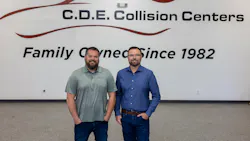
“It’s surreal to see our shop on that list,” admit brothers Eric and Brian Freiberg, second-generation partners and vice president and COO, and building and equipment manager, respectively.
“Everything we’ve built — it all traces back to the team,” Eric says. “You don’t get to this size without having the right people in place — and supporting them the right way. We couldn't do what we do without all the time, effort, and care they put into the business day in and day out. Our success is truly the result of everyone's joint efforts."
A Family Business Through and Through
Chuck Freiberg, C.E.O. and president of CDE (and Eric and Brian’s father), founded the business in 1982 with a single location and a hands-on approach that still defines the company today.
Within just a year of opening, he’d already purchased his second location, the shop he’d been working in with his two original partners when they set off on their own. After his partners departed the business, Chuck’s parents joined him, and several other family members would follow suit over the years, reinforcing a model that blended family involvement with operational discipline.
That combination — hands-on leadership paired with strong internal support — became a defining trait of the business, Eric says.
By the time the third and fourth locations took shape in the ‘90s, Eric and Brian — who both grew up in the business — were kids doing all the odd jobs around the shop they could: cleaning floors, moving vehicles, organizing parts, and helping technicians wherever they needed it.
“We were around it every day,” Eric says. “You learn how a shop works just by being in that environment — how production flows, where bottlenecks happen, how important communication is between the front office and the shop floor.”
During those formative first years, he says, his father’s focus wasn’t just on adding stores — it was on building processes that could scale.
And scale they did.
In 2010, CDE opened its first out-of-state shop in Hammond, Indiana, and from there, expansion accelerated. Nine additional shops were added over the next decade, building “operationally intentional” density across its core markets — five more in Illinois, and four more in Indiana — sometimes at a rate of more than one per year. Two additional shops opened in the last several years as well, bringing the current count to 16 locations.
“Geography matters more than people think,” Eric says. “We’ve built our footprint so that leadership can be present, teams can support each other, and resources can be shared efficiently.”
The proximity of their shops, he says, allows for tighter oversight, faster problem-solving, and more consistent execution across locations — something many growing MSOs struggle to maintain.
And while there are no plans for more expansion in the immediate future, the family is always keeping an eye out for the right opportunity.
“We get calls constantly from owners looking to sell,” Eric says. “But not every opportunity is a good opportunity.”
For CDE, he explains, growth decisions are filtered through a clear operational lens: Can the facility support modern repair requirements? Does the location fit the company’s geographic strategy? And just as importantly — has the business invested in its people?
“If a shop hasn’t kept up with training, equipment, or technology, you’re starting behind. You’re not just acquiring a location — you’re inheriting its problems.”
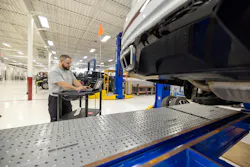
For that reason, CDE prioritizes facilities with strong infrastructure, or properties that can be developed to meet current and future demands. “We’re not looking to add a bunch of locations,” Eric says. “We’re focused on doing things the right way. We’re looking to create sustainable growth…not rapid expansion.”
It’s an approach that has helped CDE compete in one of the most challenging markets in the country.
“In Chicagoland, you’re surrounded by large MSOs,” Eric says. “And in some cases, they’ve built locations within a block of ours.”
But, the Freibergs don’t see that as a threat — just part of the landscape.
“It doesn’t change how we operate,” Eric says. “We’ve always focused on our own processes, our own people, and our own standards, and that’s what we’ll continue to do.”
The team is also willing to think creatively about what a collision center can look like. One of their high-volume locations, Bolingbrook, for example, was previously an Aldi grocery store in the middle of a busy retail area.
“That’s a completely different type of spot for us,” says Eric, “but the amount of walk-in traffic it has is astronomical.”
Their Tinley Park location is another unique footprint for the company.
“We expanded from an industrial space; we still have that original building,” Eric says. “Then we bought an old furniture store about a block away that was on a major artery in and out of Tinley Park, and we now operate both facilities together as one with a combined approximate 35,000 square feet.”
No matter where or how the shops come together, however, they all share commonalities, a signature “look” that’s consistent across the board.
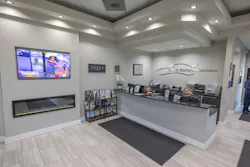
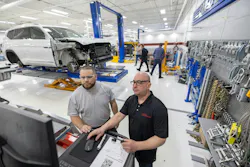
“We kind of model our shops after a service department at a dealership, that kind of look and feel from a cleanliness and organization standpoint,” Brian says. “Bright floors, bright lighting, they’re all similar that way.”
Proudly Independent
Much like their father — who famously ripped up an offer from a large consolidator as he stood and watched Eric and Brian play in the yard as kids, imagining a future of independent, family ownership — the brothers “can’t imagine wearing anyone else’s names on their shirts.”
“That stuck with us,” Eric says. “It shaped how we think about the business.”
Despite the long hours and personal sacrifices, the brothers say it’s what they love doing, and they’re honored to continue a business that reinvests back into the community and provides a living for so many families.
“That drives us to keep it going, to keep it as successful as possible,” they agree.
“Tip to tip, we could drive store-to-store in around two hours. We hire people from the community, and I think that means something to people, too, and it’s a big reason they choose us over competitors…we're a multi-location brand, but we're local, and we’ve earned a reputation for excellence. We pride ourselves on how well we take care of our customers.”
The same care is extended to the company’s team, too. No matter how large they become, says Brian, they’ll always be a family business.
“That mindset doesn’t change just because you grow. It’s still a family business, just on a much bigger scale.”
That philosophy shows up in hiring decisions, where cultural fit often carries as much weight as technical experience. “We’ll train the right person,” Eric says. “What’s harder to teach is attitude, work ethic, and how someone fits into the team.”
It also shows up in how the business supports its employees.
From company events and community involvement to day-to-day flexibility when team members need support, CDE has worked to create an environment where employees feel valued.
“We have people who’ve been with us for decades,” Eric says. “That doesn’t happen by accident.”
An OEM Future
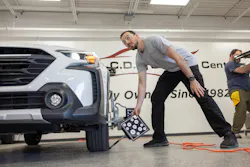
For much of its history, CDE’s business model and growth was built around DRP relationships, and acquisitions and brownfield renovations in mutually beneficial markets drove expansion. Moving forward, the team is shifting focus to a certified repair model.
“I foresee manufacturers taking a bigger role in the repair of their vehicles and taking further control of that for a whole multitude of reasons,” Eric says. “I think being more aligned with the manufacturers — and particularly manufacturers that put a lot of effort back into their certified repair programs — is the future.”
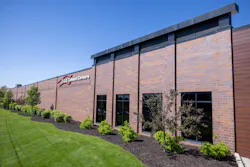
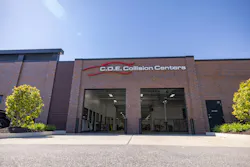
CDE’s newest facility — a greenfield build adjacent to a Subaru dealership — reflects that shift in strategy. The location was designed from the ground up to meet OEM requirements, from equipment layout and repair planning areas to workflow design.
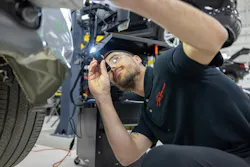
“That project really represents where we see things going,” Eric says. “Working more closely with manufacturers and dealerships, and building facilities that support that level of repair.”
Across its network, CDE now holds certifications with a wide range of manufacturers, including BMW, Tesla, Rivian, Mercedes-Benz, Subaru, Honda, VW, Ford and several others. But earning certifications, says Eric, is only part of the equation.
“Maintaining them is where the real work comes in,” he says. “You have to stay current with training, tooling, and procedures. It’s an ongoing commitment.”
That commitment extends to every part of the operation—from blueprinting and parts procurement to final quality control. “OEM repair brings a different level of accountability. You’re following exact procedures, using approved equipment, and documenting every step. It forces a higher level of discipline, and ultimately, that leads to better repairs.”
From purely a numbers standpoint, CDE’s certified shops tend to stay more steadily busy compared to the insurance-driven stores, too…another motivating factor to focus more attention on the OEM side of things.
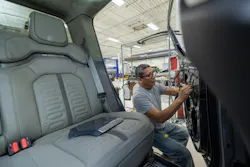
But change is never easy.
“It [shifting to an OEM model] is a huge investment, and it's a huge shift in culture,” Eric says. “It’s a different mindset, a different way of doing business, essentially.” But, he adds, it “definitely seems to be the right direction to move, based on what we’re seeing being immersed in both models. And we’ll still maintain a few key DRP relationships.”
The Framework for Success
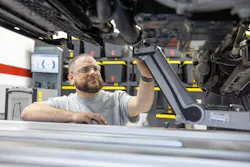
To support the shift toward certified repairs, CDE is investing heavily in training as a core component of their operational strategy.
“All of our technicians maintain I-CAR Gold status, but that’s really just the baseline now,” Eric says. “On top of that, we’re investing heavily in OEM-specific training for both technicians and estimators, sending team members to manufacturer training programs, bringing in outside specialists, and working with partners like Axalta and CCC to deliver advanced instruction.”
And, as the company has grown, CDE has placed increasing emphasis on process standardization and communication — two areas that can make or break multi-shop operations.
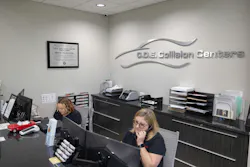
“We’ve rolled out new SOPs, updated our handbook, and implemented more structured processes across all locations,” Eric says. “That’s been a big focus.” There’s also been a renewed emphasis on soft skills training around customer service and implementing new technology into workflows. As a CCC Elevate customer, CDE has implemented web-based estimating tools, improved parts management systems, and explored AI-driven features designed to increase accuracy and efficiency.
The end goal, he says, is consistency — ensuring that a repair completed in one location meets the same standards as one completed in another.
“We’re always evaluating where we can improve,” Eric says. “Whether that’s training, technology, or how we operate day to day.”
The Long Game
Looking ahead, the team plans to keep focusing on strengthening its existing foundation by investing in OEM capabilities, refining internal processes, developing leadership within the organization, and staying disciplined about growth — only pursuing opportunities that align with the company’s long-term vision.
“At the end of the day, it comes back to people,” Eric says. “If you have the right team, and you support them properly, everything else follows.”
For CDE Collision Centers, that wisdom has driven more than four decades of growth — and as the industry continues to evolve, it remains the one constant they’re not willing to compromise.