Building a Modern Collision Shop: The Vision and Growth of Flower Hill Auto Body
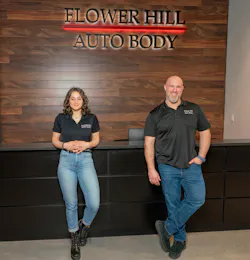
For generations, the owners of Flower Hill Auto Body, an independent MSO on Long Island, New York, have shared more than just a last name; they’ve shared an unwavering commitment to run a collision shop that “does right by everyone.” That simple mantra has built the customer base, impressive OEM portfolio, and loyal team on which Flower Hill has anchored its success for over 70 years.
Now, with tech-forward third-generation Vice President John Picciano III leading the business alongside his niece, Regional Operations Manager Ghaliya Ibrahim, the organization is positioned to capitalize on whatever the future holds.
“I try very hard not to live in a world with limiting beliefs,” Picciano says. “You don't know what opportunities are going to come your way…and if you're just positioning yourself based on the opportunities that are right in front of your nose at any given time, you could potentially be limiting the opportunities that come in the future.”
A Legacy of Integrity
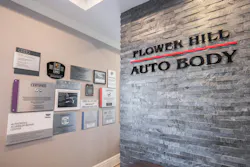
With 36 OEM certifications to its name, Flower Hill is, undoubtedly, one of the most decorated independent OEM shops in the country.
“There’s basically not a certification program out there that we don’t have,” Picciano says, which was a strategic business move that’s required a great deal of investment and sacrifice but has benefited the shop in countless ways. “We’ve built our entire business on certification programs.”
By the time the first manufacturer — Aston Martin — came knocking in 2003, the business had already been operating for over 50 years and had a reputation in the community for excellence. It was founded in 1949 by John III’s grandfather, John Picciano Sr. and his brother, Nick, following their service in WWII. The second and third generation — John Jr. (“Jack”), and Jack’s son, John III — continued to grow the business and bolster the shops’ investment in technology. Jack also established the distribution of Spies Hecker paint products in the U.S., becoming the first distributor for the Americas in the ‘80s and ‘90s.
“We have a lot of history,” says Picciano proudly. “It’s really something special.”
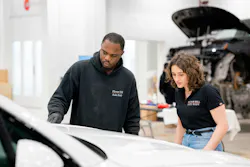
And now, as the fourth generation emerges with Ibrahim leading the charge (Picciano’s high school-age son also has an interest in the business, working part-time in blueprinting), the future looks bright not only for the family’s legacy and business, but the industry as a whole, he says.
“There is a really, really wonderful group of men and women across this country right now that are positioning themselves very well for, I think, a rapid expansion in a positive direction. For the people willing to continually invest in it, the future is very bright.”
Flower Hill is certainly in that camp.
All in on OEM
“Our first obligation is to the employees of our company,” Picciano says matter-of-factly. “But our other obligations are to our OEM partners. We hold those relationships very near and dear to our hearts. We do everything that we possibly can to create the best customer experience for those OEM relationships, as well as the individual customer. And you know what? That's paid dividends for us.”
Those dividends, he admits, didn’t happen overnight. And it requires a multi-certification strategy to achieve, in his experience.
“To anyone who's looking to do it [obtain certifications], I can say this: you will probably not see a full return on investment if you're just going after one certification. But with each subsequent certification that you obtain after that, there's a cross-referencing of tooling, equipment, and sometimes training that builds on top of each other.”
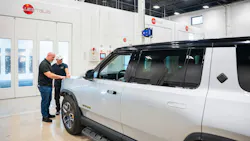
As an example, he says, the investment that it took for them to complete their recent 36th certification with Rivian Commercial was “a drop in the bucket” compared to previous certifications, because they already owned most of the tooling and equipment.
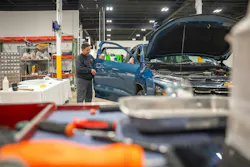
And one relationship has rolled into the next, and the next, and the next over the years, starting with that very first knock on the door in 2003.
“When Aston Martin decided to open a dealership in this area back in the early 2000’s, they went out and they were asking as many people as they could, ‘Who's the best body shop in this area?’ We’ve always been proponents of safe, proper repairs, and, being a fixture in the community, our name kept coming up.”
One day, out of the blue, says Picciano, “three guys in suits with English accents” walked in the door and said they were building a dealership nearby, and they wanted to know if we were interested in becoming a certified repair shop for them. The rest, he says, is history.
“We took that opportunity and ran with it. From then on, I made it my mission to be first in line for every new certification program that was introduced. Now here we are, 25 years later, looking back and saying, ‘We got 36 OEM certifications. How did that happen?’ The vast majority of it happened through relationships.”
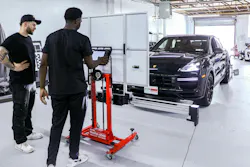
Case in point, the same man who ran the Aston Martin program eventually went to work for Tesla and brought Flower Hill on as a certified repair shop right out of the gate. That then opened the door for other EV certifications like Lucid, Rivian, and Polestar in the years to follow.
“He called me up one day, told me he was moving to America to work for a new company, was building out a collision repair program, and he wanted us to be one of the first certified repair shops in the Northeast. ‘Who did you get hired by?’ I asked him. ‘Tesla,’ he said. ‘Cool!’ I responded… ‘What in the world is a Tesla?’ That’s how early it was. We didn’t even know yet what they were!”
So what is Picciano’s advice for other shop owners?
“If you're going to go down this [certification] road and you really feel strongly about building your business on that path for the future, then it's go all in or don't do it. That's my feeling.”
A Hub and Spoke Future
OEM certifications aren’t the only area of the business the team is going all in on. Picciano and Ibrahim say the shop’s mission is simple — they want to revolutionize not only their customers’ perception of the collision repair industry but also society’s.
“We’re actively trying to look at the business through a different lens and not just do things because ‘it’s the way it’s ‘always been done.’ How can we use processes? How can we use technology and systems across preproduction, production, and administration? How can we use forward thinking to deliver a world-class experience for every customer and deliver a safe and proper repair every time, so that getting into an accident is not this monumentally difficult and frustrating experience?”
Picciano and Ibrahim believe they have the solution, and it involves expanding the business using a hub and spoke model.
“We want to centralize tooling, equipment, training, staffing, and certifications within large collision hubs,” they explain, “then build a strategic network of spokes around those hubs to place ourselves in various markets for relatively little expense.”
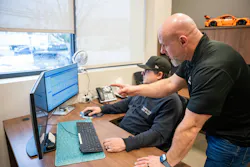
Eventually, they envision a business powered by artificial intelligence (AI) — from AI vehicle scanners to robotic production processes — to enhance efficiency and “create as seamless a workflow as humanly possible.” Down the line, they’d like to get to a place where they’re operating around the clock.
“What we'd like to do is generate an AI estimate as quickly and efficiently as possible on the front end, before a wrench is even on that vehicle. We can have a vehicle run through the scanner and within less than two minutes have a preliminary estimate, a parts order created, an alignment check created, a condition report created, and potentially, hopefully sometime in the future, a pre-measure with that first scan,” explains Picciano. “Before we lay a wrench on the car, we already have those things done.”
Operating this way would allow for dramatically reduced cycle times, generating a highly accurate outer body parts order for vehicles that aren’t severely damaged.
“From there, the vehicle goes to full blueprint and 100% teardown, then we fill the gaps of any items that are missed from that preliminary scan. But by that point, our preliminary parts order has already been placed and is already en route to our facility…so we've been able to very quickly get a vehicle production ready. Then, as the vehicles go through our production process, we can source the remaining parts from that order.”
On the back end, he says, a legal and billing staff will ensure proper compensation is received to fix the car correctly per the manufacturer’s standards, with little to no interference in the customer's experience.
They hope to have the AI estimator in place later this year, and the business’ first robotic painting equipment was installed only weeks after this interview.
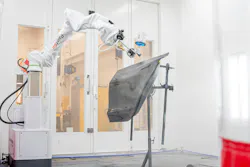
"I think robotics is one of the things that's really going to separate us from everyone else,” Picciano says. “We love to be the tip of the spear and be the first ones to the market in a specific area. Our feeling is that if we can work the kinks out and get robotics working into our workflow before it really hits the mass market, we'll be that much more ahead of the curve. When everyone else is doing it, we've already perfected it."
They also envision a pickup/drop-off service so customers never need to leave the comfort of their home.
“We’re constantly thinking about what we can do to really revolutionize our customers’ experience, and how we can create an infrastructure that can support that.”
Operating in this manner, says Ibrahim, would yield great benefit for the shop’s employees, too.
“This model that we’re looking to build, it would increase training opportunities for our team, further streamline processes, and allow people the ability to move between locations more easily.”
Putting it to the Test
The industry, says Picciano, has been “extremely kind to us as we’ve grown.”
“Dave Luehr's Elite Body Shop Solutions group, they've been an integral part of our success. Mike Anderson, too, and the other shops across the country we’ve built relationships with. And of course, our OEM partners. Mentors are everywhere we look now, because we've really put in the time and effort to foster those relationships.”
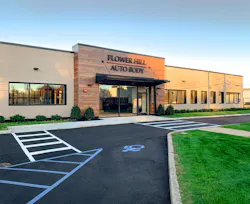
The business now has three locations: their Huntington, Roslyn, and Glen Cove offices, with about 60 employees between them.
The Huntington location just opened at the beginning of 2026 and will serve as the first hub, with Roslyn and Glen Cove as spokes.
“We’re keeping those two locations (Roslyn and Glen Cove) as category one and category two repairs, from light repair to maybe a mid-size repair,” Picciano says. “Any of the more involved repairs go to the collision hub in Huntington, where we're properly equipped to handle them.”
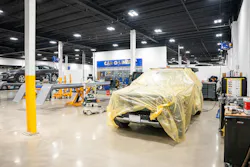
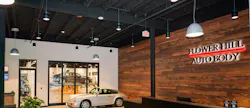
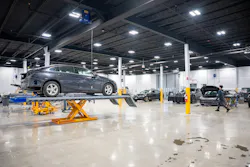
The design and workflow of the new hub was carefully considered from day one and, he adds, it took a lot of patience to find the right building. What the team wanted, he says, was simple…a giant rectangle that they could knock all the interior walls out of to create their ideal workflow. They found it in an old 38,000 sq. ft. industrial factory set on 2.2 acres—and the new shop has proven worth the wait.
“In Roslyn and Glen Cove, they’re both a blend of multiple buildings put together over time; just make the workflow work,” Picciano says. “The systems are more important than the actual footprint, but in Huntington, we had the opportunity to have it all — we have the world-class systems coupled with a world-class workflow. It’s built for the modern repair process, and we’re really starting to see the benefits of both of those things being put together.”
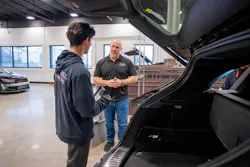
The new shop boasts a dedicated area for pre-production and a horseshoe configuration for production, which keeps everything moving smoothly from one stage to the next. There’s also a separate parts warehouse on the property.
The process of bringing Huntington online was intense, Picciano admits. It took three years, and completing the expansion during the industry downturn in 2025 was “really tough.”
But, now that they’re on the other side of it, he feels confident about the future.
“Now that we’re over that hurdle, I see nothing slowing us down. Now it's time to really buckle down and build out this business that we’ve envisioned.”
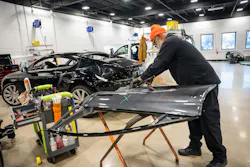
Ibrahim agrees, adding that she already sees things moving in a very positive direction.
“I see a lot of possibilities coming from this. The future is definitely bright, and there's a lot more opportunities coming our way, for sure. From when I started five years ago to what the shop is now, it is a completely different business model, completely different type of workflow, and it's a beautiful thing.”
Jack (who has now retired to Florida), she says, is especially pleased with what’s happening at the shop.
“He’s very proud of us, and how much growth we’ve had — he expresses it constantly.”
But none of it, say Picciano and Ibrahim, would be possible without Flower Hill’s employees.
“Surround yourself with employees who truly feel, at their core, the same way that you feel, who share your vision and mission as ours do, and it’s no longer about just working for a paycheck; it's about what we're going to do in the industry, how we’re going to change it, how we’re going to change people’s lives, support them, and create an environment where employees feel valued. As a collective, we’re building something of importance. Fixing cars is just what we do. It's not why we do it.”