Transparency and OEM Procedures: The Success Story of 821 Collision
Key Highlights
- 821 Collision prioritizes full transparency with customers, including OEM repair procedures and upfront pricing, fostering trust and informed decision-making.
- The shop strictly adheres to OEM standards, refusing to cut corners, which ensures safety and high-quality repairs, even if it means losing some business.
- Founders Ken Miller and Pete Kelly built the shop from scratch, emphasizing customer education, integrity, and a team of highly certified technicians.
- Miller’s leadership extends to his role as president of AASP/NJ, where he promotes industry education, collaboration, and the adoption of OEM repair standards.
- Participation in events like the NORTHEAST Trade Show allows industry professionals to access valuable training, networking, and technological updates, supporting continuous improvement.
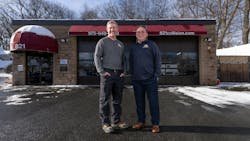
For Ken Miller and Pete Kelly, a successful collision repair shop is a transparent one. And their shop, 821 Collision in North Haledon, New Jersey, is nothing if not transparent.
“Families are depending on us for proper repairs,” Miller says. “That’s a responsibility we all carry. It guides every decision we make, and how we repair cars.”
At 821, that means full disclosure of everything from their OEM repair procedures to pricing up front with every customer, even if it means losing business from time to time.
“We have learned that this process may not be for everyone,” Miller says. “If someone is of the mindset that it’s ‘just a car’ and they don’t care about what standard to which it’s fixed, then we're not the right fit for them. We try and get that out up front; there's an exorbitant amount of time that goes into the discussions beforehand, learning everything about what the client is looking for, and then determining if it’s a good fit.”
Miller is adamant about never cutting corners under any circumstance, and the shop refuses to make exceptions based on customers’ preferences. Fixing every car according to OEM standards is non-negotiable.
“The OEM defines what a proper repair is, how the manufacturer wants things done. To me — and it's just my opinion, and it's not always popular — that's the right way to do things. They've dictated how they want these cars repaired.”
The integrity of the repair and their customers’ safety are the “most important” things to the team at 821, he says.
“Our team is incredible. We all adhere to the same high standards, to putting the customer first. The team truly understands what it is we're looking for, and they pull it off.”
“It’s really rewarding, because customers get to see the difference [an OEM repair makes],” Miller says. “When you explain the ‘why’ to them, they really appreciate it.”
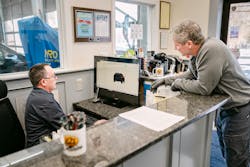
The Origin Story
After running his own PDR business from 1994 to 2011, Miller went to work for a dealership as the general manager of their reconditioning center. That’s where he met Kelly, who was working as the general manager of the dealership’s body shop.
“I was always intrigued by the world of collision repair,” says Miller, “and constantly going in and out of shops for my PDR work only solidified that interest, and gave me a clear idea of what I’d want my own shop to be, should I ever have the chance to open it.”
A “self-employed kind of guy,” Miller always kept his eye out for the opportunity to strike out on his own, and Kelly, similarly, saw shop ownership as the next logical step, having risen through the ranks from apprentice to shop manager over the course of his career.
“Pete and I had a very good dynamic working together — we knew it would translate into a great partnership running a shop. We just have a synergy that’s hard to describe.”
Every night on his way home from work, Miller would pass what’s now 821 Collision, and it got his wheels spinning.
“The shop had gone dark; it had closed,” he reminisces. “I knew the owner of the property, and I decided to reach out and see what his intentions were. After probably about six months of bugging him, he said, ‘Yeah, sure. I'll rent it to you guys.’ I pitched him the idea of what I saw 821 Collision being, and he loved it. He gave us the opportunity to take the place over and turn it into what it is.”
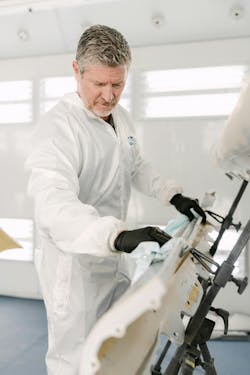
It hasn’t always been an easy road, Miller admits. He and Kelly didn’t buy a book of business, so they had to develop, nurture, and grow the shop from the ground up with the help of a business coach.
“That business coach was all about customer transparency and making sure that everything you do is right, and it's always done for the right reasons. We internalized that and just ran with it, and that’s what’s gotten us to where we are today.”
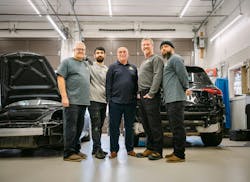
Now a highly cohesive shop of five, Kelly serves as the main estimator and one of two points of contact for clients and insurers. He’s also the main “problem solver” in the office. Miller, on the other hand, works primarily on the shop floor.
“I still love working on the cars,” he says. “I love turning ugly cars into works of art.”
821 has about 12 certifications at the moment, but Miller says he and Kelly are evaluating which ones make sense to keep and which no longer serve them. The team is most interested in pursuing manufacturers that invest in their network, Miller says, like Lexus, their newest addition.
“I am very impressed with Lexus' commitment and how they do things, the way they listen to input from the network and invest in it. It’s a really well-run program. I believe it will serve as a model for others.”
From Ownership to Presidency
Miller and Kelly’s commitment to transparency and OEM repairs were always a part of the original vision for the shop, and now it’s an integral focus of Miller’s tenure as president of New Jersey’s largest association of collision and mechanical repairers, the Alliance of Automotive Service Providers-New Jersey (AASP/NJ).
Miller first became involved with the organization at the encouragement of the association’s previous executive director, who Miller says was instrumental in helping him get the licenses he needed to open 821 Collision.
“I attended a few events, training events, and I sat in on some board meetings, and I found it all very interesting. Then the next thing I know, I’m president!” he chuckled. “I’m fast-forwarding several years there.”
His honest, straightforward approach to proper repairs resonated with the board, and he now finds himself starting his second two-year term with the association.
“I think my message was fundamentally different than what they were accustomed to hearing at the time. I'm not young, but I was fresh. I was different; I was new. They pushed me up the ladder pretty quickly.”
Holding the position, he admits, is a labor of love — with three or four meetings a week on top of training, it’s a serious commitment. And it’s one to which he and his fellow board members donate their time.
“I do enjoy it, and I do enjoy helping people. We are an active association. I like to think we're one of the more active associations in the country. I always have to give a shout-out to my board members. Many of them sit in on multiple meetings a week with me, and we're all volunteers. We all do this for the good of the industry.”
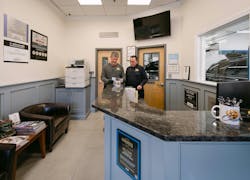
Sharing Knowledge
Miller, who describes himself as a “training geek,” loves the certification and education side of the business and never shies away from an opportunity to learn about new technology and repair procedures, a huge boon to him in both business and as president of the AASP/NJ. Growing the association and expanding its education initiatives are two of his main focuses.
“We are very education-driven in our association; it was one of the things that was just a natural fit for me.”
The collaborative learning that takes place within such an organization is its main benefit, he says, and is a great reason for everyone in the industry to get involved.
“Even though I'm president, I still feel like I know nothing, because every time I get into different environments with these high-level people, you're always learning new things. You're always taking things away from them. If we can say anything, it’s that we're all short on knowledge, and a rising tide raises all boats. If we could get everybody involved in this and get everybody a little bit more information and education and a little smarter, we might start to change the direction of things.”
NORTHEAST Trade Show
One of the best educational opportunities of the year, Miller says, is at AASP/NJ’s NORTHEAST show March 20-22 at the Meadowlands Exposition Center in Secaucus.
Created for repair professionals from every corner of the industry, attendees can experience hands-on tools and equipment, product, and technology demonstrations, expert-led seminars, networking opportunities, giveaways, and more.
“There's no other place where people can get this amount of training from a three-day pass for the price we’re offering, anywhere,” Miller says. “It’s a tremendous value. We’re the largest trade show next to SEMA — we have a similar slate of educators who come present for us, tons of vendors, and about 60,000 square feet of floor space. There’s a lot for people to get out of it.” To purchase tickets and get up-to-date information on exhibitors and event schedules, visit www.aaspnjnortheast.com.
Against the Grain
Miller readily shares his knowledge with his fellow peers, colleagues, and customers through videos posted to his social media channels, too, something he says has “100% benefited the business,” but does sometimes result in pushback from colleagues in the industry.
“I’ve heard it all: that we’re overcharging, causing insurance premiums to go up, over-repairing cars,” he says. “We definitely get some pushback for going against the grain sometimes.”
It’s all the more reason to keep posting the videos and disseminating information, he says, to counteract the lack of education on the importance of OEM repair procedures.
The bottom line, Miller concludes, is that the industry has become exponentially more complicated in the last 10 to 15 years, and everyone working in it has an obligation to continue their education and keep up with the changing technology, considering the customers’ safety and best interests above all else.
“The customers that come in are expecting that we, as professionals, are putting them and their families in a safe vehicle. That's the responsibility we all share that should guide all our decisions.”