From Punch Cards to AI: The Evolution of Collision Estimating
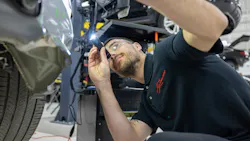
I’ve spent more than 20 years working in auto claims and collision estimating. During that time, I’ve watched the tools we use change considerably.
When I first came into the business, I would hear stories from the generation of appraisers who had worked before computerized estimating. One that always stuck with me was the sheer amount of reference material they carried around. Mitchell guides and other estimating books could amount to volumes of information. I remember hearing about field appraisers keeping what was essentially a small estimating library in the trunk of the car.
That was their database. There was no search box, no automatic parts-price update and no vehicle graphic to click through. If you needed information, you looked it up.
What I hadn’t given much thought to until recently was just how early the industry started trying to automate that process. Once I started looking into it, I found a history that went back much further than I expected.
When the database was made of paper
Glenn Mitchell founded Mitchell Manuals in 1946. About 12 years later, he published the first pocket Estimator Guide, bringing labor-time information into a compact reference for the industry.
As vehicle coverage and the amount of available information expanded, that pocket guide grew into a booklet, then a roughly three-inch-thick bound book and eventually a multi-volume set. The database had effectively outgrown the estimator’s pocket, and eventually it would outgrow paper.
Estimating by punch card
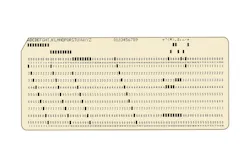
This is the part of the history that really caught my attention. In the 1960s, German engineer and vehicle damage expert Wilfried Reuter began looking for a way to automate collision estimating. By 1966, manufacturer information on replacement parts and repair times was being stored on punch cards.
A punch card was essentially physical computer storage. Patterns of holes represented information that a card reader could convert into data for a computer. These weren’t simply estimates with holes punched into them. The cards were being used to make the information behind the estimate, including parts and repair-time data, machine-readable.
Before that information could live in a digital estimating database, it could literally be stored as holes in cardboard. The significance wasn’t just that a computer could perform calculations. Collision repair information was being structured in a way that allowed a computer to process it consistently.
Swiss Re acquired Audatex Reuter in 1966. Six years later, it granted Fireman’s Fund Insurance Company the North American license for Audatex. According to Audatex, Fireman’s Fund became the first North American provider of automated partial-loss collision estimating in 1972. Computerized collision estimating had reached North America nearly a decade before the IBM PC.
The hardware would be unrecognizable to an estimator today, but the concept wouldn’t be: structure vehicle, parts and labor information so a computer can use it to help calculate the repair. We have spent the last 60 years finding better ways to do that.
As computers became smaller and more accessible, estimating technology moved closer to the person inspecting the vehicle.
From codes to screens
As computers became smaller and more accessible, estimating technology moved closer to the person inspecting the vehicle. CCC was founded in 1980. Mitchell continued moving automotive information from printed products into electronic systems. Audatex continued developing its automated estimating technology and, by 1991, had introduced portable estimating using custom handheld computers.
Estimators who once worked from books and coded information increasingly worked from computer screens. Text-based systems became more visual, vehicle graphics made navigating an estimate easier, and parts information and labor operations could be retrieved without flipping through a manual.
By the late 1990s, graphical estimating was becoming a bigger part of the workflow. CCC, for example, introduced a “Select from Graphics” feature in its Pathways products in 1999 that allowed an estimator to select a part by clicking on its image. Its appraisal product also incorporated digital imaging, and a pen-compatible interface intended for field use.
For those of us who came into the industry during the computerized era, these systems were simply part of the job. We inspected the vehicle, identified the damage, and selected the operations. The software organized the information, performed the calculations, and gave us access to an amount of vehicle data that would have been impractical to carry around in the trunk of a car.
The estimate becomes connected
The next major change wasn’t necessarily how we wrote an estimate. It was what could happen around it. Digital photography, internet connectivity, and increasingly integrated claims platforms changed the workflow.
Assignments could move electronically. Photos could be attached to a claim almost immediately. Estimates could be reviewed remotely, supplements could move between shops and carriers electronically, and parts information could be updated more frequently. Estimating platforms became connected with repair management, insurer workflows, parts procurement, and other parts of the claims process.
The estimate was no longer just a document calculating the cost of a repair. It had become part of a much larger digital claims workflow. At the same time, desktop computers gave way to laptops and tablets, and mobile applications brought more estimating capability to the vehicle. Information that once required shelves of books could now be accessed while standing next to the car.
Each generation removed some manual work from the process while also changing what we expected from the estimator.
Then the photograph became data
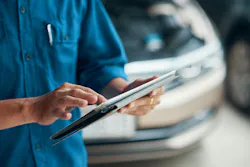
For years, digital photographs primarily documented what an appraiser or estimator had already identified. Computer vision changed that relationship because the photograph itself could now become an input.
In 2018, CCC introduced Smart Estimate, combining photo analytics, AI and existing estimating logic to pre-populate estimate suggestions for human review. That represented another change in where the information entering the estimate could come from.
The earliest computerized systems needed people to translate information about the vehicle and repair into something the computer could process. Modern computer vision can begin that translation itself by analyzing photographs, identifying visible damage and suggesting estimate operations.
Looking at the history as a whole, there is a fairly logical progression. Human knowledge was organized into structured information, that information became machine-readable data, computers made it searchable and calculable, graphical interfaces made it easier to use, and connectivity allowed it to move between everyone involved in the claim. Now computer vision and AI can help generate some of the input as well.
Seen through that history, AI feels less like a break from collision estimating and more like the next step in a process that has been underway for decades.
There are operations a photograph may never reveal, and AI does not change that reality. What it can change is how much repetitive work has to be performed manually.
Another tool in the toolbox
There are legitimate questions about how AI should be used in estimating. Anyone who has spent enough time around collision claims knows that identifying visible damage is not the same thing as developing a complete repair plan.
Modern vehicles bring ADAS systems, calibrations, scanning requirements, advanced materials, one-time-use components, OEM repair procedures, and increasingly complex electronics into the equation. There are operations a photograph may never reveal, and AI does not change that reality.
What it can change is how much repetitive work has to be performed manually. That isn’t particularly new. Printed guides organized information that estimators once had to gather independently. Computerized databases reduced the need to search through those books. Graphical estimating reduced our dependence on codes and text-based navigation. Digital photography changed how inspections and reviews could be performed. Connected platforms automated parts of the claims and repair workflow, and mobile technology brought those systems to the vehicle. AI can now assist with identifying visible damage and assembling portions of an estimate.
Each of those technologies took over work that previously required more human effort. None eliminated the need to understand collision repair. What changed was where that knowledge provided the most value.
If AI can handle more of the routine work, experienced people can spend more time on the parts of estimating where experience actually matters.
The estimator changes with the tools
That is the more interesting conversation to have about AI. Knowing how to produce estimate lines is one skill. Knowing whether those lines accurately represent what is required to properly repair the vehicle is another. As the software becomes better at producing the first, the second becomes more important.
An experienced estimator knows when something doesn’t look right. We know that what is visible in a photograph may only be the beginning of the repair. We know when additional research is necessary and when the estimating database does not tell the entire story. Those aren’t arguments against technology. They are reasons to use it well.
If AI can handle more of the routine work, experienced people can spend more time on the parts of estimating where experience actually matters. Viewed against the history of estimating, that is something the profession has already done many times.
From punch cards to pixels
There is something fitting about comparing the beginning of automated estimating to where we are today. In 1966, the challenge was taking manufacturer parts and repair-time information and converting it into data a computer could read. Today, one of the challenges is taking photographs of a damaged vehicle and converting what is visible in those pixels into data an estimating system can use.
The inputs have changed considerably, but the need for good information has not. A computer in 1966 could only work with the information someone had carefully structured and provided to it. An AI estimating system today is still dependent on the quality of its data, its logic and the information available to it.
Better technology does not eliminate the importance of understanding the output. If anything, it puts more emphasis on knowing when that output is incomplete or wrong.
I see AI as another tool in a toolbox that has been getting better for nearly 80 years.
What comes next?
I’ve seen enough changes in estimating technology to be cautious about predicting exactly what the job will look like ten years from now. I’m much more confident that the tools will continue to change because they always have.
The objective hasn’t changed nearly as much. We still need to identify what was damaged, determine what is required to properly repair it and establish what that repair should cost.
Over the years, we have used printed manuals, punch cards, computer terminals, PCs, graphical estimating platforms, digital photography, connected claims systems, and mobile devices to help us do it. Now we have AI.
I don’t see that as something collision professionals need to fear. I see it as another tool in a toolbox that has been getting better for nearly 80 years. Our responsibility is what it has always been when a better tool comes along: learn how to use it, understand what it does well, recognize where it falls short, and know when experience and judgment still need to take over.
The views expressed in this article are the author's own and do not necessarily reflect those of Branch or its affiliates.
Source notes
- Mitchell 1, “Evolution of an Estimator Guide – A Brief History of Mitchell 1.” Mitchell states that Glenn Mitchell founded Mitchell Manuals in 1946 and published the first pocket Estimator Guide about 12 years later; the guide later grew into a booklet, a roughly three-inch-thick bound book and a multi-volume set. https://mitchell1.com/shopconnection/evolution-of-an-estimator-guide-a-brief-history-of-mitchell-1/
- Solera Netherlands, “Schadecalculatie vroeger en nu; Van nattevingerwerk naar algoritmes.” Solera’s historical account says Reuter began automating the process in 1966 by storing manufacturer parts information and repair times on punch cards. https://solera.nl/nieuws-1/schadecalculatie-vroeger-en-nu-van-nattevingerwerk-naar-algoritmes
- Audatex, “History.” Audatex states that Swiss Re acquired Audatex Reuter in 1966 and granted Fireman’s Fund the exclusive North American Audatex license in 1972, making it the first North American provider of automated vehicle collision partial-loss estimating. https://www.audatex.id/cms/en_GB/history
- Audatex, “History.” The company’s timeline dates its portable automated estimating application using custom handheld computers to 1991. CCC’s 1980 founding date is also reported in CCC Intelligent Solutions Holdings Inc.’s 2026 SEC filings. https://www.audatex.id/cms/en_GB/history
- CCC Information Services, “CCC Introduces New Pathways Solutions for Insurance And Collision Repair Industries,” Sept. 21, 1999. The release describes “Select from Graphics,” a pen-compatible interface and integrated digital imaging. https://www.theautochannel.com/news/press/date/19990921/press030236.html
- CCC Intelligent Solutions, “CCC Introduces the World’s First Artificial Intelligence Estimating Tool,” Dec. 3, 2018. CCC described Smart Estimate as using estimating logic and AI photo analytics to pre-populate estimate suggestions for human review and editing. https://www.cccis.com/news-and-insights/posts/ccc-introduces-worlds-first-artificial-intelligence-estimating-tool
About the Author
 Andrew Nelson
Andrew Nelson
Unit Leader - Auto, Branch Insurance
Andrew Nelson is an auto physical damage and collision estimating professional with more than 20 years of experience in claims, estimating, and material damage operations. The views expressed are the author's own and do not necessarily reflect those of Branch or its affiliates.