Total Loss Tiebreakers: Mediating ACV, Options, and Tax/Title in 90 Minutes
Key Highlights
- Mediation separates total-loss valuation into component decisions, allowing for clearer testing and understanding of each factor involved.
- Preparation is key: parties should exchange valuation reports, policy language, and vehicle documentation at least 48 hours before mediation.
- Focus on vehicle-specific proof for options and condition, rather than relying solely on software-generated valuations, to ensure accuracy and fairness.
- A disciplined 90-minute process involves framing the dispute, building an agreed vehicle profile, testing comparables, resolving options, and reconciling tax and net payments.
- Collision repairers should act as neutral facilitators, providing transparent documentation without advocating for either side, to support trust and clarity.

The vehicle is gone, but the argument is still accruing costs.
Storage continues. Rental days disappear. The customer calls the shop because the shop is the only place where a human being has actually seen the vehicle. The adjuster has a valuation report. The owner has screenshots. Everyone has a number, and no one believes anyone else’s number.
This is no longer a marginal problem. CCC’s 2026 Crash Course report placed total-loss frequency at 23.1% of claims across all loss categories - an industry high. For collision repairers, that means more vehicles occupying space without becoming repairs, more customers receiving unwelcome news, and more relationships strained by decisions the shop did not make.
Yet the typical dispute is approached backward. The parties first debate the final settlement figure and investigate how it was determined only after trust has collapsed. Mediation reverses that order. It separates the number into its component decisions, tests those decisions symmetrically, and gives the parties a way to price uncertainty without pretending uncertainty does not exist.
A total-loss valuation is not a fact. It is a chain of judgments wearing the clothes of arithmetic.
The Paradox: Total Losses Happen at Scale But Resolve One Vehicle at a Time
Valuation platforms create necessary consistency. They can process enormous volumes of vehicle data, locate comparable inventory, and apply adjustments faster than any human could. But standardization can create false precision. A report that reaches $18,247.63 may look objective even when the result depends on debatable choices: which comparables were included in the set, whether a trim was decoded correctly, how condition was scored, what mileage adjustment was used, and whether a listed price should be reduced for expected negotiation.
The 2026 en banc decision in Clippinger v. State Farm Automobile Insurance Co. arose in the class-certification context, not as a universal ruling that a particular valuation practice is fair. Still, the court’s conclusion carries an operational lesson: individualized questions about each vehicle’s actual cash value can predominate over the common methodology. In other words, the system may produce disputes at scale, but those disputes are resolved through vehicle-specific proof. That is precisely the terrain where focused mediation can add value.
Mediation is also not appraisal with softer chairs. Appraisal generally asks a defined valuation question under the policy and may produce a binding number, depending on the governing language. Mediation is broader and consensual. It can address the valuation, disputed equipment, tax and title treatment, salvage retention, payment timing, documentation gaps, and, when properly included, related shop charges or vehicle-release logistics. It does not erase appraisal, regulatory, contractual, or legal rights. It helps the parties decide whether a complete agreement is better than exercising those rights separately.
One Settlement Figure is Often Four Different Disputes
When one side says, “The vehicle is worth $21,000,” and the other says, “Our offer is $18,600,” the apparent gap is $2,400. The real gap may be a combination of four smaller disagreements:
• Base market value: Which vehicles are genuinely comparable in model year, trim, drivetrain, body style, mileage, geography, and timing?
• Vehicle identity and options: What equipment was on the loss vehicle, and does that equipment affect market value?
• Adjustments: What evidence supports mileage, condition, prior damage, or negotiation adjustments - upward or downward?
• Tax, title, fees, and deductions: Which items are owed under the applicable policy and law, when are they payable, and how do the deductible or owner-retained salvage affect the net payment?
These categories should not be blended. A tax dispute cannot be solved by manipulating a mileage adjustment. A missing option should not be hidden inside a round-number compromise. And a deductible should not make a low ACV appear reasonable merely because the parties are comparing different versions of “the offer.”
The Tiebreaker is Symmetry
A credible process applies the same burden of explanation to both sides. If an owner must prove a premium package before receiving an upward adjustment, the carrier should be prepared to explain the evidence supporting a downward adjustment for the condition. If a claimant’s online listing is discounted because it is an asking price, a projected negotiation adjustment should be tested against the same local market and time period. If aftermarket equipment is offered at its original purchase price, the owner must determine whether that cost was actually transferred to the pre-loss market value.
This is not a presumption that every adjustment is wrong. It is a refusal to treat an adjustment as self-proving because software printed it. The practical rule is simple: no material adjustment without a reason, a source, and a calculation that another person can reproduce.
Options deserve particular discipline. Their existence is a vehicle-identity question before it is a dollar question. The parties should first establish whether the feature or package was present through VIN-specific OEM data, a window sticker, build sheet, photographs, repair records, or receipts. Only then should they debate market impact. Replacement cost is not automatically value contribution, especially for aftermarket equipment. Conversely, an option does not become irrelevant merely because a database failed to decode it.
The 90-Minute Total-Loss Mediation
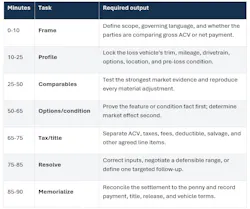
Use this protocol only for a prepared, narrow valuation dispute with the necessary documents and decision-makers present.
Why 90 Minutes Can Work
Ninety minutes is enough for a narrow total-loss valuation dispute only when the mediation starts before the meeting. Speed comes from preparation and sequence, not pressure. At least 48 hours beforehand, the mediator should receive the valuation report, relevant policy language, the parties’ strongest comparables, VIN-specific option evidence, pre-loss condition documentation, and a line-item tax/title/fee calculation. Each party should identify the authority it relies on for any state-specific tax or fee position and ensure that someone with settlement authority attends.
The protocol below assumes that coverage and liability are not in dispute and that the parties are mediating the amount and mechanics of a total-loss settlement. If coverage, fraud, ownership, bodily injury, bad faith, or systemic regulatory conduct is part of the conflict, the file needs a different scope and likely more time.
0-10 Minutes | Frame the Question
The mediator identifies exactly what is and is not being decided. Is this a first-party or third-party claim? Is the total-loss determination itself accepted? Are the parties resolving only the ACV, or the complete payment ledger? What policy language and state authority govern? The parties also identify the version of the number they have been quoting: gross ACV, ACV plus applicable taxes and fees, or net payment after deductible and salvage. Ten minutes spent defining the problem can prevent 80 minutes of arguing past one another.
10-25 Minutes: Build One Agreed Vehicle
Before comparing prices, the parties create a single agreed vehicle profile: year, make, model, trim, body style, drivetrain, mileage, loss date, garaging or market location, major factory packages, material aftermarket equipment, and documented pre-loss condition. Agreed facts are locked. Disputed facts are labeled. A mediator should not allow the loss vehicle to become a moving target as each new comparable appears.
25-50 Minutes: Test the Comparable Market
The parties examine their three strongest comparables, not a digital haystack of loosely related listings. For each one, ask: Is it the same trim or merely the same model? Is the drivetrain and body configuration comparable? Is the listing geographically and temporally relevant? Is it active, stale, duplicated, or already sold? Is the source a dealer asking price, a verified transaction, or a private-party listing? Can every material adjustment be traced and reproduced? A vehicle that requires so many adjustments that it no longer resembles the loss vehicle may be mathematically usable but practically unpersuasive.
50-65 Minutes: Resolve Options and Condition
The mediator uses a two-step test: establish the fact, then determine its value effect. Was the option present? What is the best proof? Does local market evidence show that buyers paid more for it? For condition, the question is pre-loss evidence, not post-collision appearance. Maintenance records, dated photographs, tire measurements, recent repair invoices, prior inspections, and consistent shop records are more useful than adjectives such as “excellent” or “average.” The same proof standard should govern both additions and deductions.
65-75 Minutes: Audit Tax, Title, and the Net-Payment Ledger
Tax and title are not rounding errors. They are separate line items governed by policy language and state-specific law, and the rules may differ by claim type, timing, and whether a cost has been incurred. The mediator does not give legal advice or negotiate away a mandatory entitlement through ambiguity. The parties identify the ACV, applicable tax base and rate, title/registration/transfer items, deductible, owner-retained salvage deduction, and any other agreed item. Then they reconcile the arithmetic. A small line item should not disappear simply because the larger number is emotionally louder.
75-85 Minutes: Price the Remaining Uncertainty
Once factual corrections are made, the remaining gap is usually smaller and more honest. The parties can choose among three paths: adopt a corrected valuation; negotiate within a defensible range to allocate uncertainty and avoid further transaction costs; or identify one decisive missing item, obtain it on a short deadline, and reconvene for 30 minutes. The mediator may also help structure owner retention, vehicle release, payment timing, rental transition, lienholder coordination, or storage resolution when those matters are within scope, and all necessary parties are present.
85-90 Minutes: Write a Settlement That Can Be Audited
The term sheet should state the agreed ACV, any additions and deductions, the net payment, payees, the payment deadline, title and salvage obligations, vehicle release terms, and the exact scope of any release. It should also identify what remains unresolved. The final number should reconcile to the penny. A vague ‘all-in’ settlement may end the meeting while planting the next dispute.
The Collision Shop’s Role: Trusted Translator, Not Partisan Adjuster
Collision repairers often become the relationship shock absorber. The customer associates the shop with the total-loss decision because the vehicle is there, the estimate came from there, and the shop delivers much of the unwelcome information. That does not require the shop to become an advocate for either side or to offer legal or valuation advice beyond its role. It does mean the shop can make the file more transparent.
A neutral total-loss documentation packet can include the VIN and available build data, photographs and source-labeled condition information, the repair estimate and supplements, relevant OEM procedures, the custody and communication timeline, and itemized charges for work actually performed. The shop can explain the difference between physical repairability and an economic total loss, state who made the decision, and direct valuation questions to the appropriate party. Transparency is a customer service — and an operational-control practice — without becoming advocacy.
The Boundary That Protects the Process
A 90-minute time box should discipline the process, not truncate due process. It is not the right container for disputed coverage, alleged fraud, bodily injury, contested ownership, complex classic or heavily modified vehicles, unresolved lien priorities, systemic market-conduct allegations, or a party who lacks information about legal rights. Those files may still benefit from mediation, but only after appropriate disclosure, advice, and scope-setting.
The same caution applies when one party seeks mediation only to create the appearance of fairness while withholding the valuation inputs needed to test the offer. Confidentiality should support candor; it should not launder an opaque process. A mediator cannot guarantee agreement, but the mediator can insist that the decision-making process be intelligible.
The Real Tiebreaker
The best total-loss settlement is not necessarily the midpoint. A midpoint can split error as easily as it splits the difference. The better tiebreaker is traceability: Can both sides identify the facts they accepted, the assumptions they changed, the uncertainty they priced, and the exact obligations they resolved?
Software can calculate a valuation. Only people can decide whether its assumptions fit this vehicle, this market, this policy, and this moment. When the report is treated as evidence rather than an oracle, disagreement becomes testable. When tax and title are separated from ACV, arithmetic becomes visible. When options are verified before monetization, vehicle identity stops drifting.
Total losses are called losses for a reason: no settlement recreates the day before the collision. But a disciplined 90-minute mediation can keep the first collision from becoming a second one - this time between a customer, a shop, and an insurer. That is not compromise for compromise’s sake. It is structured closure, grounded in evidence and delivered with enough transparency to preserve the relationships that continue after the vehicle is gone.
Disclosure: This article is educational and reflects a neutral dispute-resolution perspective. It is not legal advice. Laws, regulations, policy language, and remedies vary by jurisdiction and claim type.
About the Author
 Elisabeth Sobczak
Elisabeth Sobczak
Elisabeth Sobczak, LL.M., MS.B., is a mediator and automotive leader who helps shops and carriers resolve disputes quickly, accurately, and with less drama. She facilitates Mediation Days for multi-shop operators and insurers nationwide.