Goaltending: Keeping Your Team’s Eyes on the Prize

Any basketball fan knows that the final few minutes of a close game can feel like a whole other game unto itself. The strategy can shift from possession to possession, and it’s all dependent on the game situation: who has the ball, what the score is, and how much time is remaining. Everyone needs to be locked in.
Dave Dunn is a big basketball guy. His son was a highly recruited Division I player, and he recalls that even at that level, at every timeout the coach would impress upon the team the score and the time on the clock. Father and son later played together in a YMCA league for years, and Dunn says that there was many an argument late in games over what the actual score was. The reason being, there wasn’t a scoreboard in the gym.
How is a team supposed to know the situation if they don’t even know the score?
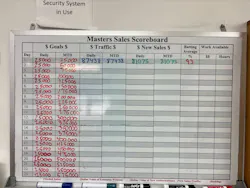
Making the Scoreboard Visible
It’s no surprise, then, that when you walk into Dave’s Auto Body in Galesburg, Illinois, that you’ll see a scoreboard. Instead of a game clock or fouls to give, however, the numbers this board relays are production goals vs. actual production, as well as gross profit figures and the amount of work available. This leads to Dunn’s first tip about setting goals. They have to be visible.
“Let it be public to them, where they can reference that scoreboard, just like you were a player in a game,” says Dunn. “If there’s any kind of mechanical thing that we’ve done, it’s that; I think it’s proved to be quite beneficial.”
Dunn recalls from his time as a technician that he wouldn’t learn until the end of the month how the shop’s production went—and it came in the form of the size of his paycheck. That made it hard to trust the numbers, and it felt as if he wasn’t as involved with the shop’s success.
“Basically, I was getting a scoreboard 10 days after that game was over, and I couldn't do anything to affect that loss or that win,” says Dunn. “And so the idea of scorekeeping goes hand in hand with goal setting, and that’s something we preach and teach at Masters, and it’s something that’s integral into our operation and our subsequent success here at Dave’s, everybody knows what good performance looks like in quantifiable terms.”
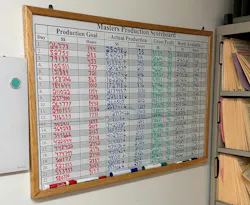
Turning Big Goals into Daily Wins
“Masters” is Masters School of Auto Body Management, which Dunn operates alongside his body shop in Galesburg. Goal setting is certainly one of the topics covered with students, and one of the things Dunn emphasizes is setting realistic goals. It’s great to be ambitious, but it’s easy for the team to get discouraged if they’re not set up to reach achievable goals.
“If you start posting unrealistic goals, you get zero buy-in,” Dunn says. “You put me on the basketball floor, I’m 6 foot 3 and played a lot of basketball in my day, and tell me, ‘Now I want you to guard Victor Wembanyama, and he’s 7’7 and I expect you to block his shot.’ You can make that goal all you want, but it’s so unrealistic, I’m not probably going to buy into that.”
Dunn explains that it’s helpful to break down goals into understandable terms. It isn’t as helpful to say, for example, that the shop wants to do $600,000 this month. Instead, look at it like the shop needs to do $27,000 per day, and be able to outline how the team is going to do that. Dunn looks at eight criteria when determining a monthly production goal: number of technicians, anticipated hours worked per day, number of working days in month, average shopwide labor efficiency, average labor rate, average labor-to-sale ratio or percentage, anticipated gross profit percentage, and anticipated monthly overhead dollars.
These are used in a number of formulas to generate reasonable goals, such as multiplying the number of technicians times the expected hours worked per day and the number of working days to equal the expected hours worked. Dunn utilizes an automated Excel tool to generate goals, but notes that it’s vital to understand the criteria that go into setting the goal to generate useful numbers.
“The technicians and the office workers who are responsible for executing the plan have to understand how the plan was built,” Dunn says. “… They will understand that, you know, as long as you put it in terms that that they use, and they’ll strive to meet the goal.”
Everyone Plays a Role in the Win
Of course, sometimes your shop won’t hit its goal. That’s just the reality of business, but it’s not a reason to not share goals. Employees will wonder about the numbers anyway, and it’s better if they have the fullest picture possible.
Dunn says that at Masters, one of the things they emphasize the most is transparency. Some students come in afraid to share information, thinking that bad news will make employees fear for their jobs, or that good news will make them think they aren’t being compensated fairly despite the shop’s success.
“One of the big boogeymen that the owners often worry about is, ‘I don’t want to post that we’re doing $600,000 a month here, because they’re going to think I’m getting rich.’ And my answer to that is, ‘So if you don’t share the information, do you think they don’t think you’re getting rich, you know? Like, you have nothing to fear from accuracy.”
Dunn wants employees who are invested in success and want to compete against a goal. After all, it’s something the entire team is invested in together. At Dave’s Auto Body, some incentives are paid out equally among team members when they hit a goal. There are individual bonus programs as well, but having shared incentives can help all employees feel like they are pulling on the same rope, whether they’ve been there one year or 10 years.
“We don’t want to undervalue the new, nor do we want to overvalue the more experienced,” Dunn says. “We want the older people to realize they can’t make their goal if they don’t help these rookies do their job as well.”
Dave’s Auto Body has been in business for about 49 years, much of that time without Dunn having to be involved in day-to-day operations. Dunn recalls a quote he read earlier in his career from Harvard professor Theodore Levitt, who argues that action dictates philosophy more often than philosophy dictates action. Goals are nothing without action, and sometimes it is bold decision-making that shows what is possible to achieve.
“I set a ridiculous goal for a high school dropout to retire by the age of 30, and by gosh at the age of 29 I stepped away from the daily operation,” Dunn says. “I’ve never been required to be back at the daily operation, not that I don’t pay attention to it, but yeah, I had that big, giant goal, and it was probably seen as a preposterous goal by most people’s standards. But I thought, why not me? And it worked out OK.”
Criteria for Determining a Monthly Production Goal
1. Number of technicians
2. Anticipated hours worked per day
3. Number of working days in month
4. Average shop wide labor efficiency
5. Average labor rate
6. Average labor to sale ratio or percentage
7. Anticipated Gross profit %
8. Anticipated monthly overhead dollars
Formula:
- Number of techs X expected hours worked per day times number of working days = expected hours worked
- Expected hours worked x average labor efficiency = expected hours produced
- Expected hours produced x average labor rate = expected labor sales dollars
- Expected labor sales dollars divided by average Labor to Sale percentage = total anticipate sales dollars
- Total expected sales dollars minus anticipated overhead = expected Net Profit Dollars for the month
About the Author
 Todd Kortemeier
Todd Kortemeier
Todd Kortemeier is former editor of FenderBender magazine and started writing as a contributor in 2024.