How Rising Bodily Injury Claims Could Mean a Boon for Collision Repairers

For the first time ever, CCC Intelligent Solutions reported that bodily injury claims accounted for 52.3% of the combined dollars paid across bodily injury and auto physical damage claims in 2025. The shift could indicate a future increase in auto physical damage claims as injured parties have less incentive to avoid filing a claim. Additionally, insurers that push for anything less than safe, proper repairs risk greater costs on the next injury claim.
The report, “Auto Claims Payout Trends in the Age of Generative AI,” says 15 years ago, BI accounted for approximately 45% of dollars paid across BI and APD claims. The largest shift happened in 2025 – 2.6% – which also had a significantly lower frequency of casualty claims compared to APD claims.
“It’s unprecedented. The real baseline of this going back about 20 years was about 45% of the dollars paid for liability coverage,” said CCC Director of Casualty Industry Analytics Erik Bahnsen in a video interview with FenderBender. “It wasn't until officially the last year where that was flipped on its head because of the pressure of both a rise in relative BI claim frequency and notable severity pressure at the same time.”
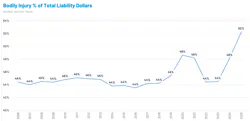
The report explores what factors are causing the shift including:
- Increasing numbers of uninsured/underinsured motorists
- Healthcare inflation, particularly auto liability claims
- Changing treatment patterns
- Greater attorney involvement
- Rising social inflation
- More sophisticated claim narratives
- The introduction of generative AI technology
For collision repair shops, Bahnsen says this has a more indirect effect. Any property damage claim requires better documentation, making it easier to attribute the cause of injury based on vehicle damage.
“What happens with a property damage claim? It's more about documenting the damages to where we can basically recreate the collision forces,” Bahnsen said during the interview. “You may have heard us reference delta V or change in velocity, right? So, better documentation around the damages to ideally both vehicles, not just one vehicle, allows us to have better support to say, hey, is this injury likely based on what damages we see on the vehicles?”
For insurers, the change is putting more pressure on the bottom line. The combined ratio would run five to 10 points lower, but the industry remained profitable due to premium increases in 2023 and 2024. Bahnsen said if this continues, consumers will have more increases to their premiums.

“Up until this point, the property damage line and just the improving profitability of just property damage claims or material damage claims has been sort of offsetting the pressure that's happening with bodily injury,” he said. “But if bodily injury continues to increase and become a larger percentage of the dollars that are paid, that is ultimately going to impact the consumer. They're going to have to pay more insurance because even if it's offsetting to a certain degree, the point is that the claims are likely still being overpaid to a certain degree.”
For a legal perspective, FenderBender reached out to Sean Preston, managing attorney at Coverall Law. He said that the rising BI claims figure should make insurers more serious about safe, proper repairs and not more aggressive about cutting the physical-damage side of the claim.
“When a carrier pressures a shop to skip a necessary operation, substitute a cheaper procedure, or underfund a calibration, it may save money on today’s repair only to increase the risk and cost of tomorrow’s injury claim,” he said. “Shops must follow manufacturer procedures and clearly document the repair and payment decisions, because the shop is ultimately expected to stand behind the repair.”
Bahnsen said over the last three years, collision claims, comp claims, and property damage claims have decreased in frequency. Two lines that increased in frequency are bodily injury claims and uninsured, underinsured motorist injury claims.
“If you didn't cause any damage to anybody else and you can maybe pay it without even filing a claim, you don't want your rates to go up. There's an incentive to not make a claim there,” Bahnsen said during the interview. “Whereas a third-party injury claim or a large percentage of those involved an attorney, there is a financial incentive to make a claim on that side.”
Notable stats cited in the report include data from CCC’s 2026 Crash Course report, which estimated a 33% increase in liability costs associated with social inflation between 2020 and 2024, a 52% year-over-year increase in verdicts of $10 million or more, and a cumulative economic and social inflation impact of $92 billion to $102 billion on personal auto over the past decade. The report concludes “these trends suggest that BI severity could be the result of a system in which medical, legal, economic, and operational complexity increasingly reinforce one another.”
About the Author
 Peter Spotts
Peter Spotts
Associate Editor
Peter Spotts is the associate editor of FenderBender and ABRN. He brings six years of experience working in the newspaper industry and four years editing in Tech. He has a bachelor's degree in journalism from Western New England University with a minor in integrated marketing communications and an MBA. A sci-fi/fantasy fan, his current 2010 Honda Civic is nicknamed Eskel, after the character from the Witcher book series, for the scratch marks on its hood.
Don't miss Peter's next article. Sign up for FenderBender Today's Collision Repair News here.