Essential Inspections: Why Identifying and Documenting Prior Repairs Protects Safety and Repair Quality
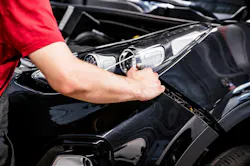
As a former technician, I learned quickly that what begins as a routine disassembly can become one of the most important safety checkpoints in the entire repair process. Over the years, I’ve removed bumper covers, wheel well liners, or washer bottles only to discover shipping stickers still attached — clear evidence that a previous component was never properly prepared or installed. In some cases, I’ve seen parts painted directly over those stickers with explanations like, “No one paid me to remove it,” or “That’s not my job.” Regardless of why it happened, findings like this are more than cosmetic oversights -they are red flags that demand further investigation.
Even when the current repair appears simple, such as a quick bumper refinishing or a one-hour scratch repair, any sign of a past shortcut means it is time to pause and look deeper. The intention is not to criticize the prior technician or shop; rather, it is to understand whether the previous work followed OEM repair procedures, whether it could interfere with the current job, and most importantly, whether the customer unknowingly received a vehicle that may not perform safely in a future collision. At that moment, the technician’s role shifts from repair specialist to post-repair inspector — an essential responsibility that should not be overlooked.
If we fail to identify previous repairs and document their condition, our current work may not perform as intended when it matters most. — Ryan Marrinan, application engineer, training and education, 3M Automotive Aftermarket Division
Customers trust that when they pick up their vehicle, it has been properly repaired and restored to its pre-accident crashworthiness. Unfortunately, this is not always the case. If we fail to identify previous repairs and document their condition, our current work may not perform as intended when it matters most. This includes welds or fasteners that were improperly installed, dressed incorrectly, or in some cases, missing entirely. Hardware that is chipped, mismatched, or incorrect for the application needs to be noted. Many fasteners are designed for single use only, and others — like Flowform screws — should never be reused or replaced with generic hardware. Instead, they should be replaced with the correct Hemlok rivet and adhesive process the OEM specifies.
Seam sealer is another indicator of prior repairs. Every replaced panel requires seam sealer application, whether it was obvious on the original part or not. Matching the OEM appearance is important for both structural integrity and corrosion protection, yet this is an area often skipped or underbilled in the original repair. The paint match also offers clues. Color variations, blends that stop abruptly, or overspray can help determine how far the previous repair extended. Missing cavity wax on replaced structural components is a further sign that a prior repair may not have been completed correctly. Adhesives are more difficult to evaluate because their type may not be easily identifiable, but you can usually determine whether one was used — and whether it was applied appropriately.
Following OEM inspection procedures is not optional, nor is it simply a best practice; it is a fundamental responsibility. These procedures exist to help ensure the vehicle will perform as engineered if it is ever involved in another collision. Thorough inspections help protect the customer, the shop, and reinforce the technician’s role as the final safeguard in restoring a vehicle’s structural integrity and crashworthiness.
Technicians should not pull only the OEM repair procedures for the work they are performing but also reference procedures that help confirm and document the condition of previously repaired areas.
In today’s industry, documentation remains one of the most powerful tools a shop has. It provides transparency, supports proper repair planning, and helps safeguard against liability. When evidence of prior repairs is discovered, documentation becomes even more critical. Technicians should not pull only the OEM repair procedures for the work they are performing but also reference procedures that help confirm and document the condition of previously repaired areas. Clear, accurate documentation creates a factual record that supports the repair plan, informs the customer, and protects the shop’s reputation.
Proper inspections are not just about identifying problems-they are about elevating the quality and safety of every repair. By taking the time to examine, verify, and document prior work, technicians strengthen the reliability of their own repairs and uphold the standards the industry strives to maintain.
About the Author
 Ryan Marrinan
Ryan Marrinan
Application Engineer, Training and Education
Ryan Marrinan is a senior application engineer, training and education, for 3M’s Automotive Aftermarket Division, supporting global fillers, adhesives, coatings, and sealers. Prior to moving into a full-time role with 3M, Ryan served as a collision repair technician for 20 years and during that time, as an independent consultant for 3M’s Automotive Aftermarket Division for 15 years. During his time as a technician, Ryan specialized in heavy collision and structural repairs, as well as glue pulling and paintless dent repair. Ryan is an I-CAR-certified technician with vast experience and understanding of OEM repair requirements and procedures. As a 3M application engineer, Ryan has the understanding and knowledge to replicate and develop OEM coatings and seam sealers to meet the standards and needs of the collision industry.