Navigating Appraisals and Documentation: Ensuring Fair Compensation in Collision Repair Claims
Key Highlights
- Using the right to appraisal can often result in settlements closer to or above the shop’s repair estimate.
- Proper documentation, including detailed photos and OEM procedures, is crucial for supporting the appraisal process and protecting the shop from liability.
- Shop owners should educate customers about their options without overwhelming them, and know when to refer customers to appraisers or let them go based on safety and cost priorities.
- Active involvement in industry organizations and advocacy is essential for repairers to influence policies and support fair reimbursement practices.
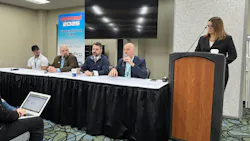
Bridging the gap between proper repair costs and what an insurer is willing to pay is a difficult challenge shops grapple with every day. Three shop owners and an attorney brought their tips and best practices to the NORTHEAST 2026 Automotive Services Show on March 21 to help shops and customers get the reimbursements they deserve.
Moderated by Liz Stein of Certified Collision Group, the panel discussion “Using your right to appraisal: A Practical Guide for Collision Repairs” featured Kyle Bradshaw of K&M Collision, Justin Lewis of Accurate Auto Body, Jerry McNee of Ultimate Collision Repair, and Sean Preston of Coverall Law.
Right to Appraisal allows the policyholder and insurance company to each bring in appraiser to write the vehicle. If they disagree, an umpire makes the final determination of what the settlement amount is. It only applies to first-party claims and if it’s written in the policy.
The panel discussed how difficult it is for customers to find and select an appraiser. The message to shops was they shouldn’t be telling customers who to use but instead offer suggestions and educate them on their options.
“Companies are springing up all over the place that do right to appraisals and diminished value claims,” McNee said. “Sometimes you've got to give them a few options. You'll know who the players are once you start getting into the game of where you're going and what direction you're suggesting that they go in. You explain it all to them, and I can tell you the conversations get easier.”
Opting for the RTA is important as the appraisal will rarely, if ever, come back lower than the insurers' initial offer. It’s more likely it will come back closer to — or above — the shop’s repair plan. There is a cost to do an appraisal, which is typically shouldered by the customer and can be recovered in the settlement. Bradshaw said, in his experience, exercising an RTA has been effective every time.
“I've never seen one come back that's less than what the carrier has already authorized or paid, and the majority of the time it may be 10% less from the shop. It's significantly closing the gap. I’ve seen some that are $30-$40,000,” he said.
Preston added, “If you are at a shop that has never used it and you feel like you're bleeding financially, this is a tourniquet that can stop the bleeding. Don't do it on every single darn one, because you're going to find it really hard to make payroll as you push your cash flow out. You need to know what’s going on here and you need to know that you’ve got options.”
Shops can help customers by educating them on the RTA process. However, McNee cautioned that it’s important to do it slowly, because too much information risks overwhelming them.
“Some of the other customers who have no clue, that's where you've got to kind of slow load it. You've got to lead it in,” McNee said. “And again, we're going to break that news or that conversation once we get their supplement back and we look at the discrepancies… Because if you do that up front, and we have done that back in the beginning of 2024, you're literally cutting your own throat and they're not coming; they don’t want to be bothered.”
Lewis said one of the difficult decisions shops need to make is when to let a customer go. The initial consultation or estimate is a chance to evaluate if the customer is prioritizing cost or safety. He said it’s difficult for shops to turn down potential business in the current market, but time and liability are important, too.
“If I’ve got a customer who tells me that having a little bit of out-of-pocket expense is more important to them than the car getting fixed properly, I'm thanking them for coming in and sending them down to the next shop,” he said. “I'm going to take that liability off -- for what? To save them a little out-of-pocket expense. It doesn't make sense for a business decision for me.”
Once a customer is on board, the panelists emphasized the importance of documentation. Proper documentation is one of the best ways to ensure a successful invocation of an RTA. McNee said to photograph and document everything you touch on the vehicle so the appraiser can support the customer during the appraisal.
“I think from the failure point, talking to appraisers on the body shop side is poor documentation,” he said. “Not having the right photos, not having OEM procedures, not having your test welds, not having all of the things that you need to put a complete file together [makes] it extremely difficult for an appraiser to go through and take care of your customer because they don't have anything to substantiate what's done.”
Lewis said they have an unspoken rule at his shop that every $10,000 in repairs has 100 photos. Bradshaw said the average file they have is 225 photos from the time the vehicle arrives at the shop to the time repairs are done. He said it’s not necessarily for the customer or to get paid, but to protect the shop from potential liability concerns if the customer is involved in another accident.
“The way that we train our people is if it's not in the file, it never happens,” he said. “So, anything that they're doing for the vehicle from the pre-watch to pre-checking the suspension, testing the battery condition, everything should have photo evidence, which is date and time stamp…then obviously invoices, repair procedures, things like that, all that is just building that document.
RTAs take time. And during that time shops are waiting for payment, the car is taking up storage space, and the customer is anxiously uncertain. McNee said in New Jersey, it averages three to six weeks to complete one. In 2025, the Washington Independent Collision Repairer’s Association helped pass SB 5721, which mandates that any insurance policy that covers physical damage coverage must include an appraisal clause. Lewis said it also caps the RTA to 30 days unless both appraisers agree within 25 days that they need more time. Prior to that, there was no limitation, and Lewis said prior to that they’d had some RTAs last longer than six months.
The panelists concluded the panel with a call to action for the repairers in the room. McNee said to all the repairers in the room that you don’t get anything out if you don’t put anything in.
“If you're not going to do it, who's going to do it for you? There are a handful of people in the industry who are supporting you with or without you, whether you know or you don't know. So, you need to be involved,” McNee said. “You need to support those. You've got SCRS, CIC, you've got [AASP-NJ]. There are things that you can do to help support them. Again, I'll say it clearly – nothing in, nothing out. If you do nothing, expect nothing, but if you're going to put the time in, you should reap some of the rewards.”
About the Author
 Peter Spotts
Peter Spotts
Associate Editor
Peter Spotts is the associate editor of FenderBender and ABRN. He brings six years of experience working in the newspaper industry and four years editing in Tech. He has a bachelor's degree in journalism from Western New England University with a minor in integrated marketing communications and an MBA. A sci-fi/fantasy fan, his current 2010 Honda Civic is nicknamed Eskel, after the character from the Witcher book series, for the scratch marks on its hood.
Don't miss Peter's next article. Sign up for FenderBender Today's Collision Repair News here.