Required vs. Recommended: Breaking Down OEM Safety Inspections
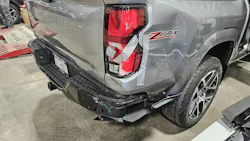
Take a moment to picture the following scenario: A late-model Honda sedan has been repaired after a bad collision and is ready for customer pickup. On the surface, the repair looks like a success. The panels line up, the paint matches, and there are no warning lights glowing on the dash.
The customer gets the keys and drives away confident it’s been restored. But what they can’t see — and what many shops never look for — are the safety systems beneath the surface that may no longer function as designed the next time that vehicle is involved in a collision.
The next crash could be that driver’s last.
As vehicle systems continue to become much more sophisticated, repairs increasingly hinge on post-collision safety inspections dictated by OEM procedures. Yet across the industry, confusion persists about when those inspections are required, what they include, and who is supposed to pay for them. Shops are often caught between vague OEM language, insurer resistance, and customers who don’t fully understand what’s at stake.
“People think if there’s no light on the dash, everything’s fine,” says Gerry Rosenbarker, general manager of Mohawk Collision Center in Schenectady, New York. “That’s just not how these systems work anymore.”
Across the country, from Rosenbarker’s 20‑OEM‑certified operation in the Northeast to Andrew Batenhorst’s BMW-focused shop in California, one message has become painfully apparent: skipping safety inspections is a business and liability risk shops can no longer afford.
Getting on the same page
Despite the confusion that persists about when inspections are necessary, Rosenbarker says that, for the most part, the process should be pretty straight-forward.
“OEM safety inspections are requirements after a collision of going through, in many cases, the entire vehicle and all of the safety systems,” Rosenbarker says. “That includes pre- and post-scans, calibrations, seat sensor calibrations and all of the components the manufacturer requires to be checked, inspected, or measured. We don’t define them; the OEM does.”
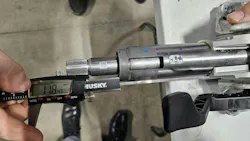
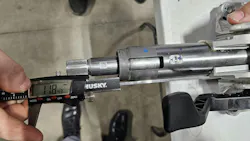
Those inspections often extend far beyond a scan tool and a visual check. They may require partial disassembly, measurements, or the removal of components to verify mounting points and structural integrity.
Batenhorst, body shop manager at Pacific BMW in Glendale, California, says the challenge is that there’s no universal checklist.
“I could have a Honda parked next to a Mercedes, and the safety inspection path could be completely different,” he says. “You have to go into the repair procedures and find out exactly what that OEM wants examined after a collision.”
The common misconception, both inside and outside the industry, is that safety inspections can be optional add-ons in some instances. In reality, they are OEM-engineered evaluations designed to determine whether critical systems can safely be reused, or whether they’ve been compromised in ways that aren’t immediately obvious.
Required vs. recommended
One of the biggest sticking points for shops is OEM terminology. Words such as “required,” “must,” “should” and “recommended” can carry very different weight depending on who’s interpreting them.
“Some OEMs have stepped up and done a really good job,” Rosenbarker says. “GM has a nice matrix that makes it pretty clear what’s required under what conditions. Honda uses language like ‘must’ and ‘required.’ Others leave things much more vague.”
He points to Subaru as a prime example of how that language has evolved, noting that the manufacturer once required extensive inspections for nearly every collision scenario, even minor ones.
“They basically whitewashed every vehicle and said you have to do all of these inspections every time,” he says. “Now, with newer model years, they’re starting to adjust the wording and make it more condition-based. That’s an improvement.”
Batenhorst adds that cultural differences play a role in how OEM instructions are written, and he suggests that may be why there’s a lot of misunderstanding here in the U.S.
“In Germany or Japan, safety is ingrained culturally,” he says. “A ‘recommended’ procedure there might automatically mean you’re doing it. In the U.S., we question everything, especially when someone else is paying the bill.”
That disconnect often leaves shops exposed. In a courtroom, Batenhorst notes, “recommended” may sound a lot like “required” to a jury, regardless of how an insurer interpreted it during the repair.
What gets inspected
While specific procedures vary by OEM, most post-collision safety inspections focus on systems designed to protect occupants in a crash.
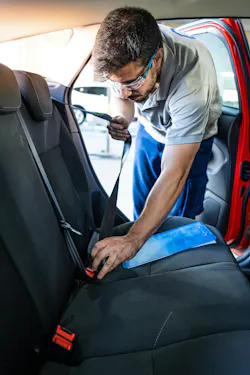
That typically includes steering columns and steering components, airbags and SRS systems, seat belts and retractors, seat mounting points, occupant detection systems, and related sensors and radars.
One of the most commonly missed items, Rosenbarker says, is seat weight sensor calibration.
“We find seat weight sensors out of calibration all the time,” he says. “It’s not going to throw a code. But that sensor determines whether an airbag deploys for a 60‑pound child or a 200‑pound adult. If it’s off, that’s a huge problem.”
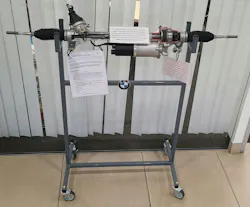
Steering columns are another frequent blind spot.
“You can drive a car with a collapsed steering column and never know it,” Rosenbarker says. “Everything works fine until the next severe collision, when it doesn’t collapse again like it’s designed to.”
Batenhorst emphasizes that many of these inspections require more than just looking at parts.
“Some inspections require diagnostics, measurements or physically removing components,” he says. “You can’t verify mounting surfaces or internal damage without doing the work.”
Both say the danger is that many failures won’t show themselves until the next crash, and by that point, it’s far too late to fix them.
The consequences of skipping inspections
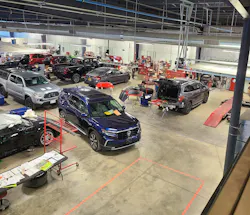
In the short term, skipping inspections can feel like a time-saver, which can seem to be a valuable trade-off at a time when shops have never been busier. As you continue to take those shortcuts, however, Rosenbarker says your shop is taking a huge — and unnecessary — gamble.
Rosenbarker has seen vehicles with unplugged airbags that never triggered a warning light. He’s seen bent seat belt mounting points and partially deployed components that would have gone unnoticed without OEM-required inspections.
“There’s this mindset of ‘there’s no light on the dash, so it’s fine,’” he says. “That’s crazy that we’re still having that conversation in 2026.”
Batenhorst says shops often roll the dice because they fear losing the job if insurers or customers refuse to pay.
“That’s a huge amount of risk,” he says. “You’re putting your name on a vehicle that’s going 70 miles an hour down the road. If something fails in the next accident, you own that.”
Disclaimers, he adds, offer little protection.
“Just because something is difficult or doesn’t get paid doesn’t give you the right to look the other way,” Batenhorst says. “That risk doesn’t disappear because you ignored it.”
Who’s paying?
Payment remains one of the biggest hurdles. Insurers frequently argue that safety inspections aren’t related to the loss, leaving shops to choose between eating the cost, charging the customer or skipping the job entirely.
Rosenbarker’s approach starts with documentation.
“Come to the table with your OEM procedures, your photos, your scans,” he says. “Do your homework, and get the customer involved. The insurer is not your only customer.”
When insurers deny payment, Mohawk Collision is often willing to bill the customer directly while supporting them with documentation to pursue reimbursement.
“We’ve seen customers get paid back through their agent, through supplements or even small claims court,” Rosenbarker says. “There’s no silver bullet, but the cost of not doing the inspection is far greater than the cost of doing it.”
Batenhorst agrees that setting expectations early is critical.
“We tell customers from the first conversation that safety inspections are part of the repair,” he says. “We share the repair plan, the OEM documentation and the results. That builds trust.”
Shops that get paid consistently, both say, treat inspections as non‑negotiable processes, not as optional line items.
'Be the steakhouse'
Rosenbarker says committing to OEM safety inspections isn’t easy. For his shop, that required a complete shift in business model.
Years ago, Mohawk Collision relied heavily on DRPs and high car counts. Today, the shop focuses on certifications and OEM procedures.
“We went from doing 180 cars a month to about 120,” he says, “and our sales went up. Gross profit jumped 14 points. Our staff is happier. We have fewer comebacks.”
By increasing repair severity through proper inspections and procedures, Rosenbarker says shops can reduce burnout and improve retention.
“You can do fewer cars, make more money and fix them correctly,” he says. “That’s the long game.”
Batenhorst frames it as knowing your value.
“I don’t want to be the cheapest guy in town,” he says. “I want to give the best value. Be the steakhouse, not the fast-food option.”
Raising the bar
At the end of the day, it’s hard to argue that performing safety inspections should be optional.
Yes, OEM language can be inconsistent. Yes, insurers push back. And yes, educating customers takes time. But neither Rosenbarker nor Batenhorst sees those challenges as an excuse.
“There’s too much risk of not doing it,” Batenhorst says. “Just because something’s hard doesn’t mean you get to ignore it.”
As vehicles grow more complex, the shops that survive and thrive will be the ones that fully commit to OEM repair standards and can clearly explain why those standards matter.
Because the real test of a repair doesn’t come when the customer picks up the car. It comes in the next collision.
About the Author
 Noah Brown
Noah Brown
Noah Brown is a freelance writer and former senior digital editor for 10 Missions Media, where he facilitated multimedia production several of the company's publications.