Future-Proofing Your Shop: Expert Insights on Facility Planning and Expansion
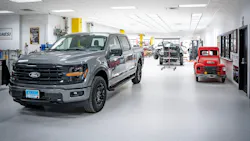
As automobile design and performance morphs and scales each year at F1 speed, collision repair shops must keep pace with the ever-evolving task of advanced repair. Does this mean shop owners must continually look to the future to determine what they will need in terms of the best physical space to execute repairs today?
To a degree. But they do not have to ride solo. And shop owners must realize that they know cars, while design professionals know building design.
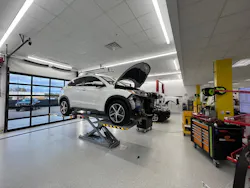
Automotive facility design professionals are trained to make sure shops have proper, flexible facilities design that accommodates growth and expansion, technological advancement, and the next-gen components necessary to repair cars today.
FenderBender spoke with one of these professionals, Ann Salazar, president of Avant Garde Interiors in Santa Clarita, California, an automotive collision repair design professional who opened her business in 2006 and has planned and designed shop facilities since 1994.
Avant Garde Interiors’ services include remodels of existing facilities, new construction, additions and expansions, and feasibility analysis to help decide what type of facility is possible — and optimal — in any given collision repair shop’s scenario.
Foresight ensures top performance
Salazar says the design process should begin with collaboration between a collision repair shop owner and a designer.
For her part, Salazar says the process looks like this: “I develop solutions that incorporate the client’s must-haves and goals, avoid common shop layout mistakes, meet design restrictions [according to] building codes, and deliver scaled master plans which set projects on the right path.”
While no two shops are identical in design and layout, the necessary components to consider for all shops remain somewhat fixed — from access for customers, tow truck accessibility, parts delivery, geographic locale and climate, lot size and shape, local codes, zoning and restrictions, site setbacks and easements, off-street parking calculations, building construction methods and firetruck access.
“As much as shop owners want to jump right into the excitement of designing a shop layout, site analysis and [a] feasibility study should be the first step,” Salazar advises.
That’s where master planning comes in. A strong master plan for any facility includes a vision for not only the new building or expansion currently under discussion, but also any construction that’s likely to be needed in the future.

“Proper space utilization will save time and money down the road, and it will keep production running with minimal downtime during construction and installation of equipment,” Salazar says.
Salazar gives this example of what happens when a shop jumps in and builds out their space before consulting a seasoned shop designer.
“One shop comes to mind where they went ahead and built the buildings first [before bringing an automotive shop-seasoned designer onboard],” Salazar shares. “The dimensions were not conducive to a shop layout and they had structural columns. They decided to go ahead and order the spray booth and equipment and go ahead and place it in the middle of the building.”
She adds, “There was nothing I could do [to help them at that stage] because the booth just blocked the whole shop flow. They had also already installed overhead doors, which determines how cars are going to come in and out from the beginning of the repair process to completion. They had already started the lighting installation, too, and you want the lighting to be over your work area. If you just randomly place it, there will be dark areas.”
Each individual shop’s best answers for design will depend on so many different variables unique to that shop.
In the renovation of a shop, a designer must figure out the best design approach that works with where utility rooms, water mains and power are situated within a facility. “You don’t want to place any of those near the wall you want to be extending and knocking [out] later for future expansion,” as Salazar puts it.
Another critical bonus: proper planning helps ensure that customers can get onto the property and into the shop when construction is underway. These elements cannot be randomly placed without impeding the shop’s ideal flow of work.
Strategic planning also helps curb construction costs.
As Salazar puts it, “[It] maximizes the use of every square footage in the facility for optimal workflow, [which also] ultimately contributes to a positive work environment, safety, and profitability in years to come — and even more importantly, customer satisfaction.”
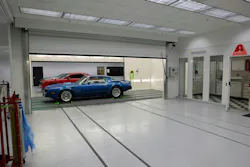
Proper design advances shop flexibility and speed
Since vehicle design and components change continually today, a collision repair shop’s design must be nimble to keep the lead.
While Salazar says her designs consider the individual needs of different kinds of shops — such as DRP, dealer, independent, and franchise — there are some must-include areas in nearly any type of collision repair facility.
One of these key areas is spray booth placement and configuration.
“[The booths need] prep stations that won’t need to be relocated for future expansion and that won’t cause bottlenecks,” Salazar says.
Another must-have is a Closed-Top Open-Front (CTOF) prep station that can easily convert for painting as demand increases.
Other smart design considerations include the flow of movement around the entire property, as well as structural components of the building such as roof pitch, columns, and beams that can readily change to facilitate future expansion, according to Salazar.
Elements such as frame racks/benches must also be considered.
“Their proper placement will depend on the [individual] site and the flow — how the tow truck may come in and unload the vehicle, because it’s usually undriveable. So, you want to place the frame rack close to where your parts storage is, because you’re going to be the disassembly there,” Salazar says.
For every part of the production process, shops will want to have elements placed in such a way that they have the shortest distance to travel for what technicians need, as well as ready access to parts, carts, and cart storage.
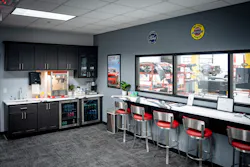
Prepping for the road into the future
To prepare for the near-term and long-term future, a shop owner’s chosen design partner can envision what the ideal facility will look like.
According to Salazar, simplified adaptability will be an absolute must for collision repair facilities. “[Designers and shop owners must consider] adding new, upgraded equipment with minimal disruption to production flow, and allowing the space needed to accommodate newer technologies and tool components,” she says.
In addition, in any locale, there will be new codes in local jurisdictions, new rules to ensure environmental sustainability, and potential increased demand for water, power, gas, and other resources.
While not a component that’s included in shop expansion on a large scale at present, Salazar says shop owners are slowly showing interest in ADAS calibration. She notes, “I’ve received many initial inquiries at the start of a project, but far fewer final designs ultimately included a designated ADAS room.”
Salazar says she’s also hearing shop owners express special design considerations such as manufacturer-certified collision centers, EV-certified facilities and aluminum repair.
Finding the ideal design partner
Word-of-mouth referrals remain the most reliable way to find the right design professional.
“Choose someone with a strong track record and experience in commercial and industrial structures — and if possible, visit some of the shops they’ve worked on,” Salazar advises.
Local trade organizations and paint suppliers can also provide solid recommendations.
“For large, complex projects, consider hiring an independent local liaison who has a good working relationship with the city,” she says. “They can help move your project through zoning or change-of-use issues and assist with gathering preliminary information on which permits will be required before building design begins.”
Just as shop owners understand that thorough job planning is a crucial part of the repair process and helps ensure a smooth, profitable repair, they must recognize that planning a facility's expansion, upgrade, or new build is much the same.
“This concept aligns with investing the time to develop a well-thought-out shop layout plan [that] addresses key issues early on, from conceptual ideas to design development, building permitting, installation and occupancy,” Salazar closes.
The end goal: to maximize the use of every square foot as seamlessly as possible for the professionals performing advanced repairs in your shop, and the customers waiting to get back on the road forward.
About the Author
 Carol Badaracco Padgett
Carol Badaracco Padgett
Carol Badaracco Padgett is an Atlanta-based writer and FenderBender freelance contributor who covers the automotive industry, film and television, architectural design, and other topics for media outlets nationwide. A FOLIO: Eddie Award-winning editor, writer, and copywriter, she is a graduate of the University of Missouri School of Journalism and holds a Master of Arts in communication from Mizzou’s College of Arts & Science.