
Electric vehicles have become a lightning rod topic in the automotive aftermarket, and for good reason.
In the early 2020s, OEMs loudly declared an all-electric future. GM declared in 2021 that it would strive to hit 100 percent EV sales by 2035. Stellantis made a big show of ending production of its ICE muscle cars in favor of an electrified version, and EV startups such as Rivian and Lucid became household names.
In the last year or two, though, those same OEMs have taken major steps back on those claims, and recent EV sales data show a complex adoption curve. Cox Automotive reports that sales of new EVs stalled at around 10% of total U.S. new-vehicle sales in Q3 of 2025 before sliding back under 6% the following quarter. After years of steady EV sales growth, changing political winds and diminished incentives have forced automakers to slow down investments.
EVs aren’t going anywhere. They may not be growing at the rate people expected a few years ago, but they’re not disappearing, either. — Kyle Bradshaw, director of fixed operations at K&M Collision in Hickory, North Carolina
For shop owners already juggling labor shortages, rising repair complexity and tightening margins, it’s tempting to look at those numbers and decide an electrified future is no longer guaranteed.
That would be a mistake.
“EVs aren’t going anywhere,” says Kyle Bradshaw, director of fixed operations at K&M Collision in Hickory, North Carolina. “They may not be growing at the rate people expected a few years ago, but they’re not disappearing, either.”
The real challenge for collision shops isn’t predicting exactly how fast EV adoption will grow. Whether it happens in the next year or the next decade, EVs are going to continue to gain market share.
Instead, the real challenge is deciding how to prepare without overextending their businesses.
What’s your shop type?
Craig Van Batenburg, CEO of the Automotive Career Development Center, has spent decades teaching technicians how to adapt to technological change. From his perspective, collision shops generally fall into one of three categories when it comes to EVs.
The first group is all-in. These shops pursue OEM certifications, invest in training and tooling and actively market themselves to EV owners. For them, EVs represent an opportunity to attract a typically well-educated, higher-income customer base, a base that their competitors aren’t eager to serve.
The second group is cautious but attentive. They understand the direction of the market, keep an eye on local EV volume and prepare to move when the numbers make sense.
The third group wants nothing to do with EVs at all and are content to remain an ICE-only shop.
What Van Batenburg warns against is the gray area between those groups.
“If you’re going to get in, stay in,” he says. “Tiptoeing is how shops lose money.”
Partial investments without proper training, OEM access, or a plan can quickly turn EV repairs into profit drains. High-voltage systems, aluminum structures, and software dependencies don’t leave much room for improvisation.
“If you don’t want to do it at all, that’s fine,” Van Batenburg says. “There will be gas and diesel vehicles to work on for decades. But if you’re going to touch EVs, you need to commit.”
Geography still drives opportunity
In most cases, where a shop is located is still going to be the biggest factor in EV adoption.
K&M Collision operates in North Carolina. EVs aren’t flooding the local market there in the same way they are in California, but they’re present enough that ignoring them isn’t an option.
“For us, EVs are part of a broader mix,” Bradshaw says. “We work on higher-end luxury vehicles, and EVs naturally fit into that.”
Rather than relying solely on local demand, K&M has used OEM certifications and specialized tooling to expand its reach.
“Instead of a 30-minute radius, we’re pulling customers from three or four hours away,” Bradshaw says.
That approach won’t work everywhere, but in markets where EVs are plentiful, adding that repair capability is a viable option to expand a shop’s market footprint.
For smaller shops with less demand, Van Batenburg points to mobile diagnostic specialists as a practical way to dip a toe into EV repairs without overcommitting.
“A good mobile diagnostic tech can bridge that gap,” he says. “They bring the expertise and tooling, and your technicians can learn by working alongside them.”
It’s not a permanent solution, but it allows shops to capture EV work and build confidence while also evaluating demand before making larger investments.
Editor’s note: Ensure OEM procedures for safely working on EVs, including disabling batteries, are followed at all times.
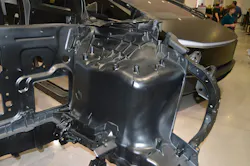
EVs are accelerating structural change
One of the biggest misconceptions about EVs is that the battery is the only thing that matters.
“In reality, the high-voltage system is just one piece,” Bradshaw says. “What really impacts collision repair is how these vehicles are built.”
Newer build trends such as using rivet-bonded construction that relies extensively on aluminum and mixed-material structures are increasingly common. And while those build trends are common in EVs, OEMs are increasingly using those for their modern lineups.
“The structural repair requirements aren’t going away,” Bradshaw says. “Even shops that don’t plan to specialize in EVs still need to be prepared for how vehicles are being designed.”
In that sense, EVs are less of a disruption and more of an accelerator. They’re pushing the entire industry toward more complex repairs, which means shops need to be ready for more in-depth procedures and higher expectations for training.
The OEM determines how the vehicle is repaired. Their procedures, their tooling, their training — that’s what gives our technicians confidence. — Kyle Bradshaw
Preparing for the future
Bradshaw says the best way to prepare your shop for the future, regardless of if you intend to pursue EV repairs, is through OEM certifications.
“The OEM determines how the vehicle is repaired. Their procedures, their tooling, their training — that’s what gives our technicians confidence,” he says. “(Getting certified) is extremely important.”
Certification isn’t just about access to work; it’s about safety and consistency. Modern vehicles, both electrified and not, leave little margin for error during repairs. Ensuring every step of a repair procedure has been done correctly has never been more important than it is today.
At K&M Collision, decisions about which OEM programs to pursue are based on business analysis, not emotion.
“We look at units in operation, competition in the area, and whether the volume makes sense,” Bradshaw says.
For smaller shops, that level of investment may not be realistic right away, but that doesn’t mean EVs should be off-limits permanently.
For Bradshaw, EV readiness isn’t fundamentally different from any other major shift the industry has faced.
“It’s the continual pursuit of education and investment,” he says. “That applies to EVs, ADAS, structural repair — everything.”
Shops that stopped investing in training a decade ago are already struggling. EVs simply make that gap more visible.
“I fully expect the technology to continue to advance,” Bradshaw says. “And shops that keep learning will be in a much better position, regardless of how fast EV adoption grows.”
EVs may surge, stall, and surge again. Incentives will come and go. OEM strategies will shift. But EVs have already reached a level of market penetration that makes them impossible to ignore.
For collision shops, success won’t come from chasing every trend, nor will it come from dismissing EVs outright. It will come from making deliberate, informed decisions based on local markets, long-term goals, and a clear understanding of what it takes to repair modern vehicles profitably.
About the Author
 Noah Brown
Noah Brown
Noah Brown is a freelance writer and former senior digital editor for 10 Missions Media, where he facilitated multimedia production several of the company's publications.