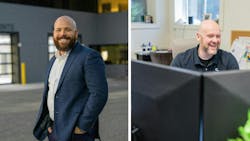
“It was definitely the most stressful time in my life,” says Drew Bryant.
“It’s just a very steep learning curve to deal with all of those things at the same time,” says Darryl Liechti.
But looking back now at their decision, to strike out on their own and leave behind stable careers to pursue shop ownership? Neither one would hesitate to do it again.
“Entrepreneurship, and this business ownership, has probably been the brightest point in my career so far,” Liechti says.
That doesn’t necessarily mean they’d do everything the same way. In fact, the benefit of hindsight reveals plenty of lessons learned, some the easy way, some the hard way. But it was certainly a leap worth taking — and for anyone looking to make a similar jump, or even for those with years of shop ownership under their belts, their experience illustrates what makes leadership so challenging yet so rewarding.
When to Leap
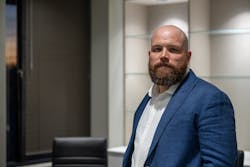
Spoiler alert: There’s no one-size-fits-all answer for when the time is right to jump into shop ownership. For anyone who has raised children, Bryant has an analogy which makes a lot of sense. “It’s like having a kid,” says Bryant, owner of DB Orlando Collision. “No matter how much we want, we’re never prepared, right? And then you have one, and anybody that has two, it’s like, I got it down, I’m going to be ready for the second. And the second comes, and it’s like, you start all over again, right? So there’s never really a ‘right time.’ It was just a matter of jumping.”
Any gearhead is familiar with cars & coffee, but Bryant’s career has been more coffee than cars. As a corporate trainer at the time for Panera Bread, Bryant was a collision repair customer who, after receiving less than stellar service, started to think he could do better. He “went down a rabbit hole” learning the industry and at one point took a month off from his job to put in full-time hours researching collision repair. A few months later, he opened a 400-square-foot shop.
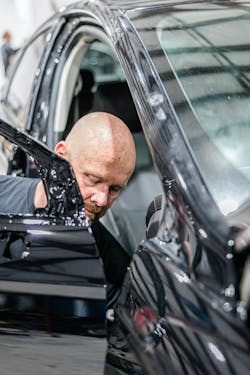
Liechti’s path was different. A car guy from a young age with a father who did body work, Liechti went to UTI and learned all the ropes working at a shop in Texas. He eventually ended up back home in Virginia, and while working as a team leader at a large body shop, he started doing side work for friends and family. The demand became overwhelming, and that was his signal that the time was right.
“I had a great career — was working for a great company — it really had everything I wanted there,” says Liechti, owner of Collision Correction in Williamsburg, Virginia. “But I was missing the one thing I thought was going to satisfy me in my quest, and that was shop ownership. So, I made the leap, and the rest is history.”
Know What It Should Look Like
Though Bryant and Liechti came to shop ownership from very different backgrounds, importantly, both knew what they didn’t know. Just because Liechti knew more about collision repair as a technician didn’t necessarily mean being a shop owner was going to be any easier. But once he had that goal in mind, he took steps to learn what he needed to be successful as an owner.
One stroke of seemingly bad luck, an on-the-job injury that kept him off his feet, turned into an opportunity. Rather than sitting at home, Liechti asked if he could work in the office. There, he learned more about shop operations, customer service, dealing with insurance companies, and so on. It wasn’t enough to be an expert, but it was a great introduction to those aspects of running the business.
“There was a lot more I needed to learn from that point, but I felt a little bit more comfortable,” Liechti says. “I don’t think you're ever really ready to make the jump. You kind of have to push yourself into being uncomfortable, stepping outside your comfort zone. And they say that there’s no comfort in growth.”
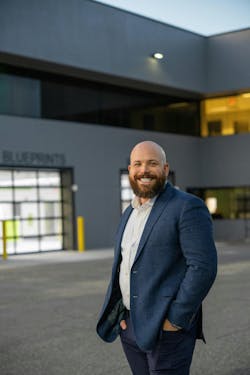
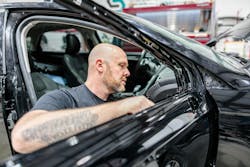
In the beginning, you may be playing most of the roles — if not all of them. But the goal is to gradually erase your name from as many of those roles as possible. Because you can’t devote fractions of your time to jobs that demand 100% attention.
“Think about everything, start to finish,” Liechti says. “Put yourself in the shoes of a customer throughout the repair process, put yourself in the shoes of a technician throughout the repair process, and then think about it as a manager or from an owner’s perspective. Think about all the things you possibly can and then talk to somebody else about it, maybe an industry friend, or industry mentor, and run those ideas by them.”
Liechti knew he wanted his shop to focus on customer service, so early on, he established SOPs based on how they intake and deliver vehicles and how to communicate with the customer throughout the process. That was also part of his decision to run a DRP-free shop, putting up fewer barriers in support of the consumer.
“We did that very purposefully,” Liechti says. “We did that so that we can advocate on behalf of our customers and make sure that we’re able to take care of our community and our technicians and staff as a result.”
Bryant feels that not being a technician was an advantage for him, because he never had the instinct that he had the sole responsibility to fix problems himself. But he could find the right person to solve a problem — or develop a better process to ensure the problem doesn’t resurface. Bryant spent a lot of time setting goals and thinking about what he wanted his business to be.
“Be able to answer the question of what you want it to look like,” Bryant says. “Sit down with a piece of paper, grab a pen, and the hell with money, the hell with what you think you can accomplish, identify what role you want to play.”
Looking Back to Move Forward
Asked if they had regrets or things they wish they had done differently in their nascent days of shop ownership, both Bryant and Liechti said yes — but also that those learning experiences still happen all the time.
“It’s an ever-moving target,” says Bryant. “It’s an ever-bouncing ball.”
“I learn new things every day,” Liechti says. “And I try to stay on top of everything within the industry, because our industry is evolving at such a rapid rate.”
You don’t have to get it perfect right out of the gate, because there is going to be so much growth and change that is built into the industry anyway. As Bryant said, there may be no such thing as ever being literally 100% ready for business ownership. But if you go in with clear ideas, an openness to learning from mistakes, and open communication with employees and customers alike, you’ll set yourself up for the best chance at success.
“I don't think I ever had myself convinced that I was 100% ready,” Liechti says. “I could always talk myself out of it. And the best thing is that I did it.”
About the Author
 Todd Kortemeier
Todd Kortemeier
Todd Kortemeier is former editor of FenderBender magazine and started writing as a contributor in 2024.