OEM Summit: Are You Inspecting Steering Components?
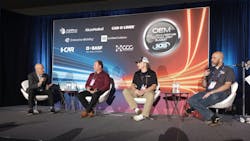
Collapsible steering columns are nothing new; they have been mandatory in U.S. vehicles since 1968. What’s changed is that many OEMs now require steering column removal, inspection, and measurement after a collision. The first panel discussion of the Society of Collision Repair Specialists' OEM Summit highlighted this critical safety procedure — along with steering gear inspections — during the recent SEMA Show.
Mike Anderson of Collision Advice moderated the discussion and shared that about 41% of shops are getting reimbursed for steering columns. However, the more concerning statistic to him was that 30-40% of shops haven’t asked.
“If they’ve never asked, it leads me to believe they’re probably not doing it,” Anderson said. “What’s the value of a life? What’s the price of a life? The federal government mandated [collapsible] steering columns for a reason – to save lives.”
Anderson said Collision Advice conducted a study with a Subaru dealership out of Washington state and found that 26% of the inspected Subaru steering columns collapsed. Panelist Gerry Rosenbarker, collision manager at Mohawk Collision Center in Schenectady, New York, said that in his experience, about 27% of vehicles required replacement about eight years ago.
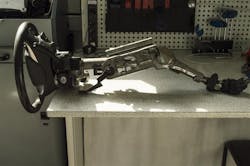
“If it's a substantial hit, you can almost guarantee there's probably going to be a problem with the column,” he said. “The killer of the whole thing is you can be driving that car with a collapsed column, and you can't tell. You have absolutely no idea until it doesn't function properly in the next accident.”
Tyler Foote, a technician at Mohawk Collision Center, said most steering columns he needs to replace are because they’re too short.
Rosenbarker also said they’ve had experiences in the past where a brand-new column wasn’t within the correct values and specifications.
“There was this period of time when it was happening frequently, and I think the quality control process got tightened up,” he said. “But there was a time when he had to go through a lot of extra steps to make sure things were okay.”
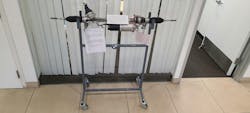
Steering gear inspections are also critical. Panelist Andrew Batenhorst, body shop manager for Pacific BMW Collision Center in Glendale, California, keeps a steering gear from a 2020 BMW X7 in his showroom to demonstrate what happens in an accident.
“The way this steering gear is made, there are two different electric motors that are belt-driven inside the casing, and they have very, very precisely machined teeth on the gears,” Batenhorst explained. “These steering gears are not designed to take a shock load laterally without chipping the teeth off. And when the teeth get chipped, you end up getting a very notchy feeling in the steering gear, and the motors can't operate correctly. The problem is that none of that is visible from the outside. That is precisely why BMW’s guidelines [require it].”
It is crucial to know the OEM requirements for steering components during a repair. Anderson said that, for example, Subaru has nine pages of documentation on inspecting and replacing the steering column. He added that BMW requires steering box replacement work for safety reasons. And if the customer and insurance company refuse the work for cost reasons, the party responsible for the repair cost must countersign a memorandum to that effect.
“BMW actually has a statement that says, if the carrier doesn't want to pay for it or the customer refuses to pay for it, then the shop has to have the consumer sign this document,” Anderson said.
He advised attendees to go to the I-CAR website and click on Technical Information & Services. Selecting the Repairability Technical Support Portal and searching for steering columns should provide all the documentation that I-CAR has from OEMs regarding steering column inspections.
Batenhorst said one of his toughest battles is getting the memorandum Anderson mentioned signed by adjustors. He built his model steering gear to effectively illustrate to third-party payers and consumers why the steering gear needs to be replaced.
“I’ve replaced hundreds of steering racks in my career after all the BMWs I’ve fixed. It drove me to build this because of how frustrated I’d get,” he said. “I have the disclaimer ready to go in my office because that’s how often I see it. There is a place for the insurance adjuster to sign. I give that to them every time. I’ve yet to have an adjuster agree to sign that document.”
Batenhorst’s advice is to educate the consumer after disassembly and diagnosis is complete. Talk to them about what needs to be done, why it needs to be done, and provide the repair procedures that require inspections.
“[Tell them] this is all in your best interest. This is us doing our part to protect you, to give you the peace of mind when your car is [repaired],” he said. “Then we go ahead and submit that to the insurance. And when the insurance comes back and says, ‘No, we're not paying for that,’ we've built that rapport with [the customer] to start to turn that tide, and they're more willing to go make that phone call or send an e-mail and get some feedback from the adjuster directly as to why this isn't being paid for.”
Related CollisionCast: Safety Inspections and Collision Vision
About the Author
 Peter Spotts
Peter Spotts
Associate Editor
Peter Spotts is the associate editor of FenderBender and ABRN. He brings six years of experience working in the newspaper industry and four years editing in Tech. He has a bachelor's degree in journalism from Western New England University with a minor in integrated marketing communications and an MBA. A sci-fi/fantasy fan, his current 2010 Honda Civic is nicknamed Eskel, after the character from the Witcher book series, for the scratch marks on its hood.
Don't miss Peter's next article. Sign up for FenderBender Today's Collision Repair News here.