Trapp: Creating a Strategic Plan for 2026

Ben Franklin once said, “Success is the residue of planning,” and that is the aim of a per company / location strategic plan. Strategic Planning is an initiative-taking process to provide a roadmap toward achievement of the plan. Within this article we will discuss that planning process and the types of things often found in successful repairer’s plans. Annually, I moderate the group of customers who utilize this process, and I hope to share some insights which may help you.
Strategic Planning Goal:
The end goal of a strategic plan is to set and achieve goals for the organization, such as a sales budget, gross profit goals, staffing plans, capital expenditure plans, overhead expense budgets, and cash flow planning. Setting these goals, followed by using a monthly scoreboard to track progress, provides a roadmap to their achievement, with roles being assigned and timelines for projects to be completed to support the plan.
Who you should involve:
It is important for the leadership team to meet in advance to project the overall sales and profit goals for the organization and to prioritize high-level projects they feel will support the organization’s overall wellbeing.
Next, you would want to select a date and location to moderate the planning session for one weekend a year. It is important to pay the hourly staff and valuable to provide nice meals, accommodation, and gifts for your salaried staff to acknowledge how much you appreciate the investment of their time into the planning session. Invite your entire central services / HQ team, as well as key members of each location’s team (the GM and at least one other influential staff member).
At the start of the meeting, it is helpful to provide a general overview of the strategic planning process and the local and national industry trends you are facing. Next, it’s valuable to review the company’s vision, mission, and values so they are deeply rooted in the culture. If you do not have them in place, it is a solid use of time to agree on these things, as they guide the organization's decisions if you truly live by them… Below is an example for you to use as a guide:
Purpose: Everyone wins when we invest in our team members!
Mission: To be the auto repair center of choice for consumers first, and a trusted network of choice for fleet, leasing and insurance customers.
Vision: To provide high-quality invisible repairs, in a timely manner.
Values:
- Maintain an unwavering commitment to following OE repair procedures to ensure quality repairs.
- Retain and develop our team members.
- Earning customer loyalty by earning positive reviews and repeat business.
- Embrace innovation.
- Have the courage to always to the “right” things.
Once these are reviewed, it is valuable to remind them that we have multiple internal and external customers, all with varied needs. Overall, it is important to reinforce that we work for the customer first, and the other customers must be considered when making decisions:
- Consumer (Primary)
- OEM programs
- OEM dealership management team
- Insurance partners
- Fleet or leasing partners.
- Vendor partners
Once those beliefs are reinforced, it is valuable to review the previous year’s performance overall and per location to celebrate the past successes and show appreciation for extra energy invested by the staff to enable those results.
Then it is valuable to review the “Results Pyramid”:
Leading indicators define the activities necessary to achieve the lagging KPI’s we have budgeted for:
- Results = Lagging indicators
A. Example: Net promoter score (on-time delivery)
2. Objective = Leading indicators
A. Example: Repair cycle time
3. Activities
A. Implementation of CCC Production Planning tool
Often, a fresh review of the roles of the central services team is helpful. Provide an organizational chart and then a brief description of the role of the central services team that can be helpful in guiding the location team as to whom to reach out to with various concerns.
It is then important for the leadership team to provide insights into how the sales budget and the profit goals were realized and to allow for discussion on the assumptions that were made by each location/market. Further, a review of the high-level projects, what central services / HQ plans to do to support them, and again ask for input on what additional things the central services/leadership team can do to support them. Below are some examples of these activities to support:
People
- HR - Fill vacancies in a timely manner (ongoing)
- HR - Publish per role rewards / recognition program (Q2)
- HR - Create a quarterly and annual recognition process (Q4)
- COO - Implement “pulse meetings” monthly (Q1)
- COO / Lead Trainer - Refine the management trainee and apprentice programs (Q4)
- COO / Lead Trainer – Document SOPs in the form of per role training and prepare for acquisition(s) (Q3)
- CEO / CFO – Seek out strategic acquisition opportunities or brownfield opportunities for growth (Q4)
Process
- CFO - Finalize strategic plan (Q1)
- CFO - Refine chart of accounts to match the performance group standard and close files seeking to match sales and cost to get accurate gross profit (Q1)
- CFO / COO - Roll out internal RO processes to make CCC more closely match the P & L (Q1)
- COO / CFO- Monthly “fireside chat” with manager explaining their month end results (Q1)
- Central Parts Lead - Standardize the parts ordering process, with focus on “profit matching” (Q2)
- Central Parts Lead - Standardize the parts receiving process (Q3)
- COO / Central Review Lead - Develop pre-closing checklist refinements per insurer and prior to central review (Q4)
Innovation
- Marketing - CRM our past customers using Body Shop Booster (Q1)
- COO / Training Lead- Implement refinements in assignment call follow up to solicit images and then to perform CCC One Jumpstart estimates prior to the vehicle arriving for the advanced inspection (Q2)
- Marketing / Location GM - Earn more OE certifications on vehicles most sold in the market and focus on expanding EV knowledge (Ongoing)
- Central Parts Lead - Evaluate and test centralized parts purchasing (Q4)
- COO / Training Lead - Implement CCC Production Planner in all locations (Q3)
Tools and Technology
- Marketing – Refine the Linked in and social media messages to solicit more traffic and reputation.com to ensure positivity.
- Marketing – Update all locations web site content (Q3) with real-time vehicle status being a goal.
- CFO / GM - Create a 3-year capital expenditure plan per location (Q1)
- COO / Training Lead - Implement glue pulling in all locations with at least 2 technicians certified (Q2)
- COO / Training Lead - Re-implement plastic repairs with the Estimators aware of how to price and at least 2 technicians trained to perform these repairs (Q3)
- COO / Central Review Lead - Implement a call center for central review of all files prior to uploading them to insurers or fleets (Q4)
- Marketing / CSR’s - Improve accuracy of customer capture rate and sales sourcing (quarterly review)
- COO / Maintenance Lead or GM - 5S each location and create a visual management environment (Q4)
The goal of this strategic plan is to give the store time to meet as a group to get per local team input on the process and to provide a realistic plan to drive the results sought with the aligned support of the central services / HQ team. Therefore, the weekend planning session merely provides a first draft which the GM takes back to their repair center to work with their staff on similar exercise to guy buy in for the goals and the projects necessary to drive success.
High-Level Company Goals
Once you have established a high-level goal, as a group, it is valuable to go category by category planning the activities to support the KPI’s the team is projecting.
Company Goals:
- Sales Budget for 2026 is $35,000,000
A. This includes collision repair, mechanical and ADAS and non-real estate.
2. Gross Profit budget is 45% (% of sales)
A. Rental or courtesy vehicle budget is .5% of sales or less.
B. Bad debt write off is .4% or less.
3. Overhead expense budget is 31% (% of sales)
4. Operating profit budget is 14% (% of sales)
5. Net promoter score of 75% or better
6. Expand into 1 additional location.
7. Pass 100% of annual OEM certification audits.
The strategic planning document would next have a detailed budget (detailed in a previous article) per location rolling up to the totals reflected above…
Areas of Focus
Once you have established a high-level goal, as a group, it is valuable to go category by category planning the activities to support the KPI’s the team is projecting.
Here are the “Areas of Focus” many repairers have used in their strategic plan.
- Achieving the projected traffic and sales goals per location
- Estimatics refinements to achieve the sales mix and TLH per RO goals.
- Per department gross profit goals
- Production planning goals
- Staffing plan per location, capital expenditure budget and overhead expense budget
- Quality and customer satisfaction assurance plan
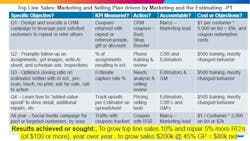
We have detailed out the marketing and selling plan in the slide below as an example. Within each area of focus, it is important to define the objective, the KPI, to measure its results, the action necessary, who is accountable, and finally, the cost or any objections you may run up against.
Key component: Don’t overlook the line highlighted in yellow. Herein we valorize the return on the investment in time and resources to implement these actions in this area of focus. This reminds us of WHY we are asking for these additional actions to be completed in the timeline that was agreed upon.
Publishing the Strategic Plan
While publishing the plan seems to be a formality, it is not. It is a particularly important roadmap to provide insights as to why, what, and how the company does to achieve its goals. Repairers often provide employees with copies of the plans or make them available in the break room for them to review and to understand the path that has been laid out.
Conducting “Pulse Meetings”
We recommend that repairers maintain a daily scorecard (an article is forthcoming on this) to track the progress towards the goals weekly within the repair center. The pulse meetings are conducted on the 10th, 20th, and last week of the month to take a pulse of all locations, to see if they can load level or share insights to help one another get on track. These meetings also allow the GMs to meet with central services to request any support they might need to stay on or get back on track towards the overall goals.
Conclusion
Success is a residual of planning, but hopefully we have reinforced, that team member input, realistic goal setting, “pulse meetings” to review status, and providing resources to support the plan are crucial for its long-term success. With all these elements in place, your strategic plan should provide a roadmap for success in 2026!
About the Author
 Steve Trapp
Steve Trapp
Steve Trapp is an internationally known consultant and speaker. His family operates a collision repair center in Wisconsin. He earned a degree in economics education and a minor in accounting from the University of Wisconsin.
After college, he worked for 3M in sales and marketing roles with the innovative 3M ARM$ training and software sales. He worked as a consultant for AutocheX doing financial consulting for a few years before joining AkzoNobel, where he started the industry’s first value-added program. While there, he started the industry’s first paint company-sponsored 20 groups and wrote numerous training programs with third-party experts on finance, marketing, selling, leadership, and other topics.
He later joined DuPont/Axalta, where he worked with Mike Anderson to manage their 20 groups and industry seminars. While at Axalta, he managed the North American Strategic Accounts SAM team and later the entire EMEA Strategic Accounts team. He followed that as senior consultant for LEAP, a global consulting firm that has presented in 10 countries and now again works for a major paint company.