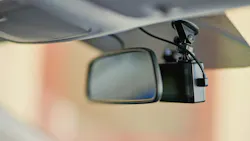
As vehicles continue their evolution into rolling computers, collision repair shops are facing a new challenge. Dash cams and other vehicle data collection tools are creating legal and operational concerns that many shops haven't fully addressed.
Sean Preston, founder and managing attorney of Coverall Law, says that while dash cams used to be a novelty a decade ago, they’ve become increasingly common today. To make matters more complicated, too, many modern vehicles come equipped with on-board recording capabilities that extend far beyond a windshield-mounted camera.
“I was throwing a football around with my 7-year-old out behind our offices at Coverall Law and ended up hitting a Tesla,” Preston says. “Those vehicles commonly have a feature that records different events that happen in their immediate proximity. And so as I was making sure we didn't scuff it up — it wasn’t a hard hit — I found myself apologizing to a completely unoccupied Tesla.”
While that may be a funny story by itself, it brings up a very serious topic: What happens when one of those vehicles and its many recording systems comes into your shop?
As vehicles become increasingly technologically advanced and the amount of data that they’re able to capture grows exponentially, Preston says it’s essential for shops to have a policy about dash cams and other recording equipment.
“There's a lot of liability that goes into working on a vehicle, driving the vehicles, making sure that everything is repaired up to procedure,” he says, “and we don't expect consumers to fully understand all our procedures. Because of that, I just see so many little problems that come up when those cameras are rolling throughout there.”
The Problem
First and foremost, the most obvious concern surrounding dash cams in your shop is privacy.
If a customer drops off a vehicle with an active dash cam or onboard recording system, that device may continue capturing video, audio and other data throughout the repair process. Suddenly, employees who never agreed to be recorded could find themselves on camera.
"It's just not appropriate to have that recorded the entire time that the vehicle is in there," Preston says. "You have other customers' vehicles. You have your own employees. Private conversations and daily operations could all be documented without your knowledge.
The issue becomes even more complicated when recording systems offer live-view functionality. Some customers can remotely access their vehicle's cameras through mobile apps, giving them a real-time window into the shop floor.
That creates both privacy and liability concerns. Even when nothing improper occurs, footage can create misunderstandings. Video clips viewed without context can lead customers to draw inaccurate conclusions about the repair process.
For example, a vehicle sitting untouched for three days could have a perfectly reasonable explanation. But a customer monitoring footage remotely may not see it that way.
As state privacy laws continue evolving, and as more vehicles collect and store personal information, the risks associated with unmanaged recording devices and vehicle data will only continue to grow.
The Solution
Fortunately, Preston says the solution to these problems isn’t complicated. Coverall Law recommends a three-part approach built around protection, process and payment.
The first step is ensuring that a shop's repair authorization documents include language addressing vehicle technology and recording devices.
Under many state laws, repairers need customer authorization before performing work on a vehicle. Preston believes that authorization should extend beyond repairs alone.
"We want to make sure you're covered for being able to disconnect that camera and that recording," he says.
Rather than creating a separate stand-alone dash cam agreement, Preston generally recommends incorporating the language into existing repair authorization forms.
"The issue that comes with a separate agreement is now you've got seven different agreements, 13 pages, and your customer feels like they're taking out a second mortgage on their house," Preston says. “We want as smooth a process as possible."
The second step involves creating a clear internal procedure. Documentation alone isn't enough if employees aren't consistently following a process.
Preston recommends that shops routinely disable aftermarket dash cams and related recording systems whenever appropriate during the repair process. Just as technicians disconnect batteries, remove trim components or perform other necessary operations, handling recording devices should become part of a standardized workflow.
More importantly, staff should understand exactly how to discuss the policy with customers.
"No surprises," Preston says. "Customers don't want surprises."
Rather than burying the information in fine print, Preston encourages estimator and front-office staff to proactively explain the policy during vehicle intake. A simple conversation can prevent future misunderstandings.
Preston recommends developing a consistent script and training employees to use it every time.
"Review it with your staff," he says. "Do a quick role play, even if you feel like a dork doing it."
Consistency becomes particularly important if a dispute ever arises.
"If there's ever an issue where somebody was mad or something did have to go in front of court,” Preston says, “you need to be protected by the documentation and the contract, but also by your policies and procedures."
The third component is ensuring shops are compensated for the work involved.
Disconnecting and managing on-board technology requires time and labor. Preston compares it to other operations shops routinely bill for.
"Anything that you've got to do or undo on a vehicle that you wouldn't have had to do if the vehicle didn't come in,” Preston says, “those are the kind of things that you need to be compensated for."
The Aftermath
When shops implement these procedures, the most immediate benefit is clarity. Customers understand from day one what will happen to their vehicle and why.
Having crystal clear paperwork and procedures doesn’t mean all customer complaints will disappear, but that consistency can be invaluable when responding to customer complaints, insurance disputes or potential legal challenges.
"The good news is you've got absolute access to the file," Preston says. "If you document everything you do and have a written agreement with a customer, you’ll be able to reliably lean on your processes as a defense."
The Takeaway
Dash cams and onboard recording systems are only going to get more popular as video and audio recording devices become cheaper and more reliable. That means collision repairers need to treat them like any other repair-related process.
For Preston, the formula is straightforward: Start by ensuring repair authorizations address vehicle data and recording systems, establish a standard procedure for handling those devices during repairs and communicate the policy upfront so customers understand what to expect.
Finally, and most importantly, own the customer relationship.
"When you're intaking that customer, be upfront," Preston says. "'If you have any questions, we are here to help.'"
In an industry already navigating evolving privacy expectations and growing legal exposure, proactive communication and thorough documentation will be the simplest tools shops have available.
About the Author
 Noah Brown
Noah Brown is a freelance writer and former senior digital editor for 10 Missions Media, where he facilitated multimedia production several of the company's publications.