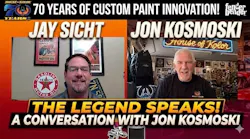
From Basement to Industry Leader: The Story of House of Kolor’s Founder Jon Kosmoski

Learn about the breakthroughs in paint technology, including organic pigments and encapsulation processes, that established House of Kolor as a symbol of vibrant, high-quality automotive finishes.

Key Highlights

  • Jon Kosmoski founded House of Kolor in 1956, pioneering organic pigment formulations and custom finishes for automotive painting.
  • His passion for creating the best materials led to industry innovations like kandies, kameleons, and encapsulation processes that made advanced finishes accessible.
  • Despite selling to Sherwin-Williams, Koz remains a passionate advocate, emphasizing the love for transforming raw steel into works of art through custom paint.
  • The company's breakthrough urethane base coats and vibrant colors revolutionized the custom paint industry in the 1980s.
  • Kosmoski’s story highlights how passion, innovation, and a love for the craft can turn a small basement operation into an industry-defining brand.

Jon Kosmoski founded House of Kolor in 1956 as the original "kustom" paint brand, introducing the industry's first organic pigment formulations, "kandies," "kameleons," and more trusted by professional painters and car builders.

Those who know me know I'm a hot rodder and custom car enthusiast, and I got to sit down recently with "Koz" to talk about 70 years of custom paint and how he built it into the brand that defines custom finishes. Although House of Kolor is now owned by Sherwin-Williams, Koz remains a highly visible — and passionate — spokesman for the brand. And like many success stories, his business success story started by accident.

He painted helmets and 600 sets of motorcyle tins one winter in his mother's basement. Understandably so, she tired of the fumes, so he rented a stall at his friend's body shop. Business grew from there, including painting motorycles with custom finishes for a local Honda motorcycle dealer. Selling supplies to fellow painters was not his original business plan.

"My inspiration was I wanted the best stuff for me. I never intended to sell a quart of it to anyone."

But he started winning Best Paint awards in local car shows and painters came to him wanting to buy his custom formulas. It was around 1962 that he became an official manufacturer and hired a chemist to help him perfect his formulas, including bucking the industry standard of using inorganic pigments. At a higher cost, organic pigments could give Kosmoski the bright, vivid, and highly saturated colors he sought.

Later, he worked to develop the breakthrough encapsulation process that made flake and pearl base coat application accessible to a wider range of painters after seeing the finished product in the early '80s at a show.

"The next year, I came out with the urethanes," he says. "That was a boon moment for this company, when we could offer kandies, and we could offer basecoats. You used to have to base a car on one day and let it dry overnight, come in the next morning to put the kandy on by noon, and then wait a couple hours before you cleared it. Because if you didn't all of that solvent and all of that material would start to mottle the base."

It was evident in our discussion that Koz still has the fire in the belly that led him to forgo automotive mechanical repair for car building and custom painting.

"The painting became such a love. You take a raw piece of steel, whether it be motorcycle parts or a car — or whatever it is — and make a thing of beauty out of it. Let me tell you something — that does not get old. And that passion lives on today in all the painters out there. They want to be the best, they want it to look the best, and they want to use the best materials that can be made. And that was my goal."

About the Author

Jay Sicht

Jay Sicht

Editor-in-Chief, FenderBender and ABRN

Jay Sicht is editor-in-chief of FenderBender and ABRN. He has worked in the automotive aftermarket for more than 30 years, including in a number of sales and technical support roles in paint/parts distribution and service/repair. He has a bachelor's degree in journalism from the University of Central Missouri with a minor in aviation, and as a writer and editor, he has covered all segments of the automotive aftermarket for more than 22 of those years, including formerly serving as editor-in-chief of Motor Age and Aftermarket Business World. Connect with him on LinkedIn.

Don't miss Jay's next article or podcast. Sign up for FenderBender Today's Collision Repair News and ABRN eNews here.


Sign up for our eNewsletters
Get the latest news and updates