Toby Chess talks OSHA citations

Three days after my last article, “Protecting workers from toxic filler dust and isocyanates,” was published, I was conducting a welding certification test at an OEM certified collision center. The shop had a clear stall for me to park my truck and I backed in. As I was about to get out, I noticed the wall next to my truck.
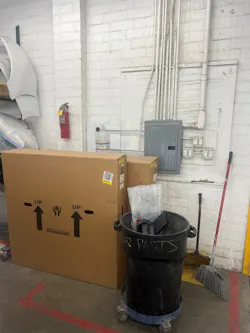
The facility is well organized and exceptionally clean, so what is wrong in the picture? Plenty. Let’s look at all the possible OSHA violations.
First is the fire extinguisher. There is no signage; it is blocked and does not have an up-to-date inspection tag.
- 1910.157(c)(1): The employer shall provide portable fire extinguishers and shall mount, locate and identify them so that they are readily accessible to employees without subjecting the employees to possible injury
- 1910.157(c)(4): The employer shall assure that portable fire extinguishers are maintained in a fully charged and operable condition and kept in their designated places at all times except during use
OSHA Compliance Rules
- Clear Access: Extinguishers must never be blocked by equipment, merchandise, supplies, or trash.
- Immediate Visibility: They must be unobstructed and easy to see.
- Clearance Space: Safety guidelines generally expect an unobstructed pathway with adequate working room around the device.
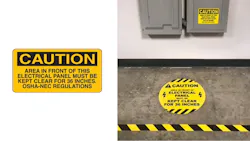
Under OSHA standards 29 CFR 1910.303 and 29 CFR 1926.40, electrical panels must maintain a clear workspace of at least 36 inches in depth and 30 inches in width to ensure safe access and operation. OSHA has no specific rule that the floor must be marked, and, if you read the OSHA standard, you would be advised to mark the floor with paint or barrier tape.
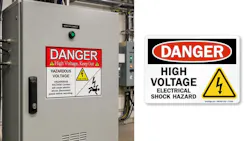
- 1910.303(h)(5)(iii)(B): Permanent and conspicuous warning signs shall be provided, reading substantially as follows: "DANGER - HIGH VOLTAGE"
For less than $100 your shop can be compliant or you can react when multiple citations are issued at over $16,000 per citation. Your choice. I am glad that you would rather spend $100 than $16,000, so I want to add some more OSHA violations that I see on a regular basis. I would like you to look at the picture first and see if you can spot the violation before reading it.
Example 1
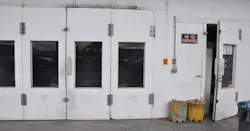
Example 1 is the spray booth and surrounding area.
- 1926.152(d)(2): At least one portable fire extinguisher having a rating of not less than 20-B units shall be located not less than 25 feet, nor more than 75 feet, from any flammable liquid storage area located outside
- CFR 1910.157: common fire extinguisher violations include blocked access, missing monthly or annual inspections, wrong extinguisher types for specific hazards, lack of employee training, and improper mounting heights. Penalties for serious violations can exceed $16,000 per citation.
- 29 CFR 1910.151(c) employers must provide suitable facilities for quick drenching or flushing of the eyes and body within the work area if employees are exposed to injurious corrosive materials. Moreover, OSHA standard 29 CFR 1910.151(c) requires unobstructed access to emergency eyewash stations within 10 seconds or 55 feet of a corrosive hazard.
- Eye wash stations need to be inspected on a regular basis and an inspection tag updated upon inspection. A sign needs to be installed identifying “eye wash station”.
- OSHA reg 29 CFR 1920.145 states the Mandatory PPE Signs:
- Respirator Required: Alerts workers that tight-fitting or supplied-air respirators are non-negotiable during operation.
- Eye& Face Protection: Mandates goggles or full-face shields against chemical splashes and overspray.
- Protective Clothing:Instructs personnel to wear chemical-resistant suits or overalls.
- Gloves Required: Specifies hand protection suitable for handling organic solvents and coatings
Example 2
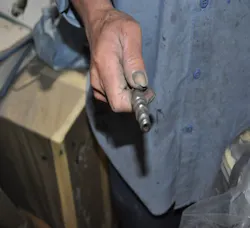
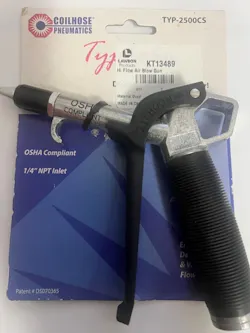
Example 2. 26 CFR1910.242(b) states “compressed air shall not be used for cleaning purposes except where reduced to less than 30 PSI and then only with effective chip guarding and personal protective equipment.” This is an illegal blower. This is an OSHA compliant blower.
Example 3
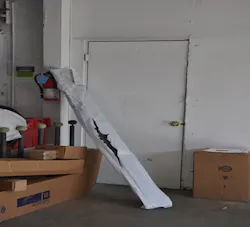
Example 3. Blocked exit door. OSHA reg 1910.37(a)(3) states exit routes must be free and unobstructed.
Example 4
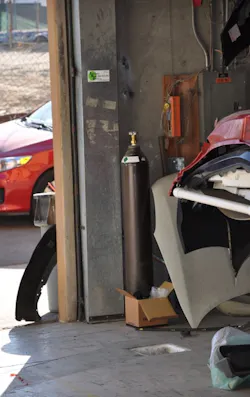
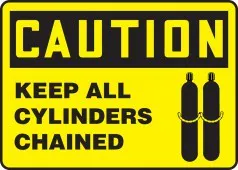
Example 4. Unchained, unmarked and no safety cap on a welding tank.
- OSHA reg 1910.253(b)(2)(iv) states valve protection caps, where the cylinder is designed to accept a cap, shall always be in place, hand-tight, except when cylinders are in use or connected for use.
- 1910.253(b)(5)(ii)(D): Unless cylinders are secured on a special truck, regulators shall be removed and valve-protection caps, when provided for, shall be put in place before cylinders are moved.
- 1926.350(a)(9): Compressed gas cylinders shall be secured (chained) in an upright position at all times except, if necessary, for short periods of time while cylinders are actually being hoisted or carried.
Example 5
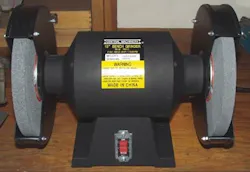
Example 5. No safety guards on grinder.
- 1910.215(b)(3): Bench and floor stands. The angular exposure of the grinding wheel periphery and sides for safety guards used on machines known as bench and floor stands should not exceed 90 deg. or one-fourth of the periphery.
Example 6
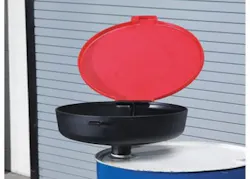
Example 6. Lid open on a flammable liquid.
- 926.152(f)(1): Category 1, 2, or 3 flammable liquids shall be kept in closed containers when not actually in use.
Example 7
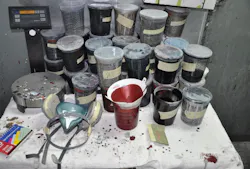
Example 7. Respirator not in closed container when not in use and missing workplace labels on paint containers.
- 1910.134(h): Maintenance and care of respirators. This paragraph requires the employer to provide for the cleaning and disinfecting, storage, inspection, and repair of respirators used by employees.
- 1910.134(h)(2)(i): All respirators shall be stored to protect them from damage, contamination, dust, sunlight, extreme temperatures, excessive moisture, and damaging chemicals, and they shall be packed or stored to prevent deformation of the face piece and exhalation valve.
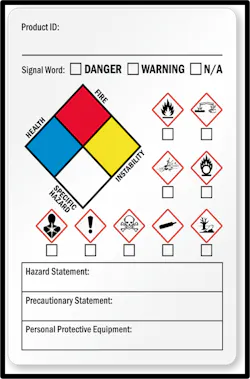
- 29 CFR 1910.1200: Smaller or secondary containers do not need a label only if the chemical is for immediate use by the person who performed the transfer and is used up during that same work shift. Otherwise, it must be labeled.
Example 8
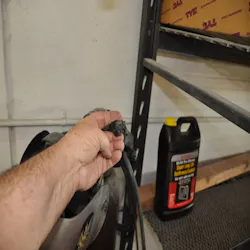
Example 8. Missing ground on machinery or extension cord.
- 910.334(a)(2)(ii): If there is a defect or evidence of damage that might expose an employee to injury, the defective or damaged item shall be removed from service, and no employee may use it until repairs and tests necessary to render the equipment safe have been made. Last time I checked, the citation was $1,500 per missing ground.
Example 9
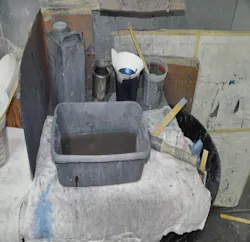
Example 9. See Example 6 for OSHA reg.
Example 10
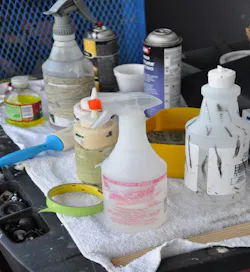
Example 10. Missing workplace labels.
- 29 CFR 1910.1200: smaller secondary containers require labels with the product identifier and general hazard warnings (words, pictures, or GHS symbols). However, labels are exempt if the chemical is for the immediate, single-shift use of the worker who performed the transfer.
Example 11
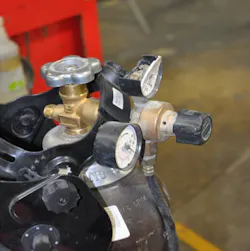
Example 11. Broken Welding tank gauge.
- 1926.350(h): Regulators and gauges. Oxygen and fuel gas pressure regulators, including their related gauges, shall be in proper working order while in use.
Example 12
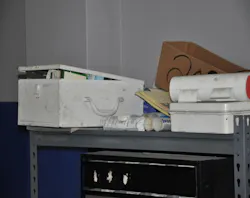
Example 12. First Aid Kit is not attached to the wall, missing inspection tag and signage. OSHA does not have a particular reg, but enforces American National Standards Institution (ANSI) regs. For example, ANSI state that a body shop needs a Class B First Aid Kit and needs to follow OSHA general rules on inspection and signage.
I have many more examples of violations, but giving these small samples can get you started on producing a safer environment. The changes on these examples is minuscule compared to one OSHA citation, lawsuit, or a trip to a hospital or urgent care.
There are a number of sources for signage (Dura Label, SafteySign.com, Emedico, Kent Automotive, and Amazon). Some states have a courtesy walk thru, and there are companies will come out and inspect your shop for a fee. Southern California Collision Equipment (855-999-SCCE) can help you identify some of the major violations and corrections, at no cost to you, at this time. Team Safety (866-7629350) has an electronic version of their “Compliance Check List”. Give them a call to help you get started. Don’t wait until that accident happens, be proactive and think safety.
About the Author
 Toby Chess
Toby Chess
A Hall of Eagles recipient, Toby Chess is known throughout the collision repair industry for his training for I-CAR and SCRS, and technical presentations at CIC meetings. He estimates he's taught more than 7,000 hands-on I-CAR welding classes, plus 15,000 other live classes in multiple states.
An advocate for body shops and their consumers, Toby has been awarded the SCRS Lifetime Achievement and Industry Achievement Awards, Collision Industry Individual Service Award, Humanitarian Award, and the ABRN Leadership award.