Welding Instructor Works to Build the Next Generation
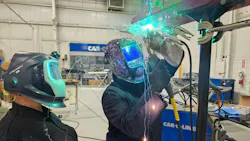
Collision Repair offers a rewarding and engaging career path that many might not consider or see themselves in when deciding what they want to do. Jaime Shewbridge, an I-CAR Welding and Hands-on Skills Development Instructor, is one of the many people who have begun working in the industry by chance and stayed.
When she was preparing to go to college, Shewbridge wanted to be a computer programmer. She got a job working at a body shop doing data entry. As she worked her way up and got more responsibility ordering parts and working with customers, she was taught how to write estimates and eventually introduced to her first experience repairing a vehicle.
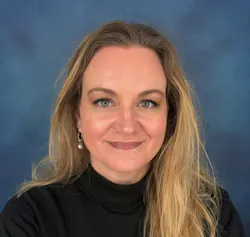
“I kind of fell into the industry, honestly. It was certainly not my plan to be what I am today,” she said. “[One day,] one of the older techs from the shop came in and he said, ‘Can you come out here and look?’
So, I walked outside with him and he had this huge frame machine with a big rig on there with [frame] gauges on there. I didn't know what they meant at the time, but he said, I, for whatever reason, can't see the front gauges. Can you just walk down these steps and tell me if the pins are lined up?”
She confirmed they did, although at the time she didn’t know what she was viewing.
“That was the first time I was out there walking around, [and] I just thought it was awesome. So, I started hanging out in the shop more and the manager taught me how to write estimates, and I became the assistant manager.”
That experience was the catalyst for a lifelong journey into collision repair. From the front office to estimating to insurance to the shop floor to instructor, Shewbridge has experienced everything the industry has to offer and wants to raise awareness for the opportunities it can offer, especially for women, at younger levels. When her daughter expressed interest in pursuing a career as a painter after helping Shewbridge with SkillsUSA competitions in Baltimore and Maryland, she encountered resistance at school.
“She went to her counselor to try to get her schedule changed so she could go into the program and the counselor said to her, 'You have a 4.25 GPA — you're on a college trajectory — you do not belong in a Vo-Tech,'” Shewbridge said. “There were girls in her class, and a couple of them are still in the field…What I see from the kids that come through my welding test, that they're new to the industry and they're young and they're in some type of apprenticeship program. They would respond to seeing cool things that our industry does.”
Not only does the industry have a variety of career paths, but it’s also an industry that is actively looking for more people to help as shops nationwide struggle with a lack of technicians.
“If you think about driving down a highway and passing a body shop, when's the last time you didn't see a 'help wanted' sign out front?” Shewbridge asked. “A lot of people will say to me, ‘Why would you encourage your children to get into this industry?’ Why wouldn't I? She will be gainfully employed for her entire working lifetime if she just does those few things, and she'll make a great living. The industry's been very good to me.”
Shewbridge began her I-CAR instructor career in 1999 and returned in 2013 after a break. She currently is a welding/hands-on skills development instructor serving the Maryland area. She’s earned I-CAR’s highest honors, including the Founder’s Ring in 2003, Lon Baudoux Instructor of the Year Award in 2020, and was the first woman to receive the Johnny Dickerson Welding Award in 2021, making her the first instructor to have been awarded all three of I-CAR's highest honors in I-CAR History. She is also a member of I-CAR’s National Instructor’s Advisory Committee.
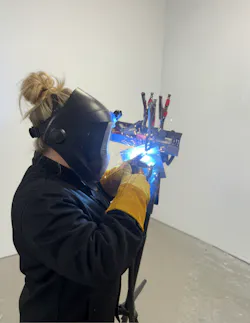
As a passionate advocate for the industry and education, Shewbridge highlighted a crucial component of welding during National Welding Month in April: test welds. She finds many people who come through her class aren’t doing them, and she makes sure that, by the time they leave, they understand why it’s a vital practice.
“Test welds save lives, period. I don't know how to get that message across any better than we do when we do the welding certification,” she said. “I know once they come through the program, they really realize how important it is. I don't know how many of them continue to do it when I'm not standing there, but I do know when they leave, they understand the importance.”
She said one of the main pain points for people not doing test welds is not getting paid for the work, but it’s a crucial practice to protect your shop, yourself, and your customer.
“[I’d say] you don't get paid to do that because you don't ask, most likely, because lots of people get paid to do that,” she said. “But you don't get paid when you're in jail either, and that's where you could be if you don't do your test welds, because people could die. And that's a real possibility if you don't do this stuff right.”
The final message she has for young technicians out there is to embrace any and all training opportunities with an open mind and positive mindset. Don’t view it as a something that’s being forced to take up your time outside work hours; it’s a chance to improve and gain skills that will last a lifetime.
“I tell all the younger techs, whatever training they'll pay for you to go to, take it,” she said. “Just put a smile on your face, say, ‘Yes, sir, can I go for another one after this?’, and do whatever they want you to do. Because it's free, and it's for you, and it stays with you forever. Learn everything you can.”
In November, Shewbridge will be at the SEMA Show teaching both MIG Welding Basics and MIG Welding Advanced Features on behalf of I-CAR. She hopes to continue leading by example and inspiring others to join the industry that changed her life.
“I thought there was no way I belong here. But if there’s someone who sees I did it, then she will think she can do that too,” Shewbridge said. “We need more young people to see you don’t need to be the stereotypical body tech to be a good part of the industry.”
About the Author
 Peter Spotts
Peter Spotts
Associate Editor
Peter Spotts is the associate editor of FenderBender and ABRN. He brings six years of experience working in the newspaper industry and four years editing in Tech. He has a bachelor's degree in journalism from Western New England University with a minor in integrated marketing communications and an MBA. A sci-fi/fantasy fan, his current 2010 Honda Civic is nicknamed Eskel, after the character from the Witcher book series, for the scratch marks on its hood.
Don't miss Peter's next article. Sign up for FenderBender Today's Collision Repair News here.