Strategic Insights for MSOs: Preparing for Industry Shifts and Private Equity Investments
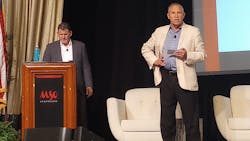
Economic jitters sparked by President Trump’s tariff policies made for fewer MSO transactions this year. That did not surprise Focus Advisors’ John Walcher and David Roberts, who presented an MSO & Private Equity Report during the MSO Symposium in Las Vegas on Nov. 3. More than 450 shop owners and industry professionals packed the Brasilia Ballroom in the Rio Hotel & Casino.
Roberts said the economic climate caused by tariffs created an air of uncertainty among consumers and MSOs alike.
“We know that uncertainty is something that causes people to delay or not make decisions. They just wait, and we are experiencing that,” Roberts said. “The number of transactions in the industry is down significantly.”
That said, days before the Symposium the Boyd Group announced it is acquiring Joe Hudson’s Collision Centers. The $1.3 billion deal adds 258 locations in the southeast U.S. to Boyd Group’s network, bringing its total to 1,273.Walcher pointed out the collision industry is not very consolidated yet – the “Big Five”: Caliber Collision, Boyd Group/Gerber, Crash Champions, Classic Collision, and Joe Hudson's, hold just a 36% market share despite perceptions that it might be more.
To illustrate the illusion of market share, he pointed out how Lowe’s and Home Depot have a 30% market share and CVS and Walgreens hold 40% in their respective industries.
“We get asked all the time, what is the state of consolidation? How close are we? How much more do we have to go?” Walcher said. “I think the lesson here for us in part is that in some industries -- smaller industries -- consolidation can happen significantly, but when you look at the broader industries, like home products with Home Depot and Lowe's, we're not going to see that as much.”
Private equity interest in the industry is ramping up as well. Focus Advisors’ presentation noted they’ve had more than 50 inbound inquiries from private equity firms this year, and there is a large pool of private equity capital looking for targets. 2025 featured four major private equity events:
- Driving Force Collision (backed by TRP) acquired Tom Masano Auto Group
- Trive Capital invested in Chilton Auto Body
- Bestige Holdings invested in Collision Leaders
- ONCAP invested in CSN, which acquired 16 shops
“There are huge pools of capital that are out there to support the continuing consolidation of this and a lot of other industries,” Roberts said. “They like industries where there are regular sources of payment…so they like institutions that pay them, [such as] insurance companies and government and auto insurers. So, that provides us this ongoing stream of revenues into an industry that can be optimized by the application of strategy and capital.”
Joe Hudson’s Collision Center is “a perfect example of private equity success in the industry,” Roberts said. Carousel Capital bought it in 2014; Roberts estimated the sale was $65 million for 23 shops. In 2019, Carousel Capital sold 114 shops for $700 million to TSG Consumer. Six years later, Boyd Group is buying 258 shops for $1.3 billion. Overall, Joe Hudson’s value increased $1.125 billion in 11 years.
“They bought what was then 114 shops. They went through a very difficult time of COVID-19 and finally went back to market…with 258 shops,” Roberts said. “They originally paid around $700 million, is what we understand…but they got a whole lot more money.”
Ultimately, these are signs that the collision industry is maturing, according to Roberts. The largest consolidators are transitioning from rapid expansion to capital rationalization and margin optimization. Institutional investors will focus on earnings and be more selective with mergers and acquisitions.
“We think that that [larger folks in the industry] are going to diversify and probably diversify a lot more actively over the next few years,” Roberts said. “It also means there is less competition in some regions of the country. Joe Hudson’s is pretty much waterfront property all across the Southeast of Texas.”
Roberts and Walcher concluded the presentation discussing the industry downturn. Roberts said it’s not a recession, but it’s the third downturn he’s been through. What’s different this time is they’re seeing steeper dynamic changes, faster increases in total cost of repair, rising insurance premiums, more rapid and widespread technological demands, and fewer repair opportunities.
“The bottom line is there are fewer repair opportunities per mile driven. Is this downturn permanent or is it cyclical?” he asked. “We think some things are cyclical, and we think others are much more permanent. “
Operators are adjusting to these conditions by creating tighter relationships with referral sources and DRPs, diversifying, and bringing more sublets in-house. They are cutting costs, getting rid of bottom performers, working on fleets, and adding more certifications.
Jason Zander, owner of Zander Group, acquired three shops during the current downturn in North Carolina. He bought near-totals, repaired and opened a used car sales operation on excess land, and made targeted acquisitions in tax-advantaged “opportunity zones.” His effective leadership also earned him CARSTAR’s Franchisee of the Year award.
“It's a good example that even in a downturn, there are opportunities,” Roberts said. “If you've got capital, and you've got good management, and you've got a plan, then a downturn is a great time to expand.”
Looking ahead at the next five years, Focus Advisors expect AI to continue to enhance evaluations, communications, and efficiency. Large consolidators should grow and diversify; second-tier private-sponsored consolidators should continue acquisitions or merge with other significant MSOs, and independent MSOs should grow primarily by acquisition.
Roberts and Walcher’s message to operators on what to do now is to create a strategy and execution plan. Focus on certifications, refocus on insurer relationships, adopt new technology, improve cycle times, and map out where the business is going to scale.
“Upgrade your management, adopt the new tech; don’t wait. Don’t say I want to see how it works out. You’ll make some mistakes, but you’ve got to be on board with that,” Roberts said. “You’ve got to have a plan for who you want to acquire or where you want to go.”
About the Author

Peter Spotts
Associate Editor
Peter Spotts is the associate editor of FenderBender and ABRN. He brings six years of experience working in the newspaper industry and four years editing in Tech. He has a bachelor's degree in journalism from Western New England University with a minor in integrated marketing communications and an MBA. A sci-fi/fantasy fan, his current 2010 Honda Civic is nicknamed Eskel, after the character from the Witcher book series, for the scratch marks on its hood.
Don't miss Peter's next article. Sign up for FenderBender Today's Collision Repair News here.