After the crash: Assessing an EV as a technician
Key Highlights
- Always treat collision-damaged EVs with caution, especially if the battery pack has been compromised or exposed to coolant intrusion.
- Perform thorough exterior inspections and check coolant levels before powering up the vehicle to identify potential internal damage.
- Use OEM service procedures and diagnostic tools to monitor battery temperature, voltage, and fault codes, trending data over time for signs of instability.
- Maintain proper quarantine protocols, including safe distancing and ventilation, to prevent fire hazards from venting batteries or thermal runaway.
- In case of venting or signs of thermal runaway, do not attempt to extinguish the fire with a standard extinguisher; instead, evacuate and call fire professionals trained in lithium-ion battery fires.
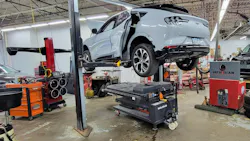
In May of 2011, the National Highway Traffic Safety Administration (NHTSA) ran a side-pole crash test on a Chevy Volt at a test facility located in Wisconsin. After the test, it was moved to a back lot and left there. About three weeks later, it caught fire and took several nearby vehicles with it.
The impact had ruptured a coolant line, and coolant had gotten into the pack. That coolant is conductive at the voltages a charged pack carries, and GM and its contractor pointed to the potential for dendritic growth, conductive filaments building inside the cells and shorting them over time. The coolant intrusion was itself a possible cause of thermal runaway, but it wasn’t identified at the time of the test, so the vehicle sat for weeks with a charged, compromised pack and the problem built until the pack went into runaway.
That tells you most of what you’re dealing with when an EV comes in from a serious collision; the hazard doesn’t always make itself obvious. Thermal runaway after a collision is a low-frequency event, and you can work on a lot of these vehicles and never see one, but when it happens, the consequence is a technician getting hurt or killed if proper precautions and checks aren’t performed. That is why the safe approach is to treat each of these vehicles the same careful way from the moment it arrives, because a consistent process is what keeps a tech safe and protects life and property.
A tech should be trained to work on EVs before handling one of these at all; nothing here substitutes for that, and the high-voltage and chemical hazards aren’t something an untrained tech can always recognize. A vehicle earns this handling in two cases: a collision severe enough to worry about the pack’s stability — even with no visible damage, since the battery is part of the structure that took the hit — or direct damage to the pack, which should have you on alert right away.
Your safety doesn’t come from stopping a runaway, because once a pack is headed that way, there is usually no stopping it. It comes from how you handle the vehicle: isolating it, keeping your distance, watching it, and taking the stored energy down where you safely can to lower the risk.
The detection advice that gets passed around doesn’t fit a shop
There’s information circulating about catching a runaway event early, some of it from fire-service training, and it doesn’t hold up in a shop setting.
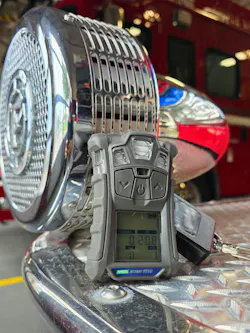
The one I hear often is monitoring for carbon monoxide (CO), based on the idea that a pack heading into trouble gives off CO, and watching for it buys early warning. The problem is that a collision shop already has CO coming from several places: running internal combustion engines or a furnace or shop heater that has fallen out of repair. A CO detector is often too blunt of an instrument to identify the source. It tells you CO is present and roughly how much, but the reading can’t separate a battery from the exhaust or the heater. On top of that, the detector most shops have isn’t sensitive or fast enough to give the early warning the advice promises, the way a multi-gas air monitor in trained hands might. Reading an air monitor correctly and acting on its information is a skill of its own, one that a tech generally won’t have experience with. CO monitoring fits the fire service, where responders are right at the vehicle with the right gear and the training to use it, none of which describes a tech in a body shop.
The tool a shop is more likely to have is a thermal imager, and it may be able to identify a pack starting to heat up. But the caveats are heavy enough that you can’t lean on it. Depending on how the pack is built, heat in the cells may take a while to reach the surface where the camera reads it, so by the time it shows, you may be further along than the image suggests. Reading it correctly also takes training. In the fire service, firefighters have locked onto the center spot temperature and missed higher readings elsewhere in the frame, a discipline issue an untrained tech also faces. Getting a reading means being near the vehicle, the last place you want to be if it goes, with no gear protecting you there, nothing for thermal protection, nothing for your lungs if it vents.
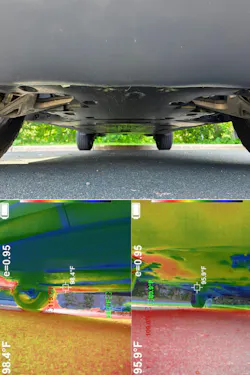
If you use a thermal imager, keep reads short, look at the whole frame, not just the spot temp, and listen. A pack in trouble will potentially make noise before anything shows on the camera. Hissing or popping doesn’t always mean the battery pack has vented, but it’s a clear warning that something is going wrong inside, and the move is to evacuate the area right away. On the camera itself, the most important thing is that a clean image doesn’t mean the vehicle is safe, because covers and pack construction can hide what’s happening inside. Every reading is a snapshot of something potentially still developing, and a measurement today can’t account for what the pack does next week.
What you can check
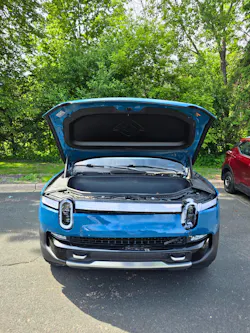
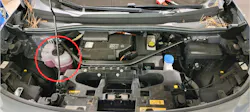
Start with an exterior inspection before you power anything up. Check the front coolers for damage and look for fluid leaks that say the vehicle may not be able to regulate pack temperature. Don’t forget to check the coolant bottle. It’s easy to overlook, and it keys off the failure that burned the Volt. If the bottle is empty and you can’t find an external leak to account for where the coolant went, assume it went into the pack. Coolant inside the pack is a path to a short and a fire, so a dry bottle with no external leak raises your concern rather than lowers it.
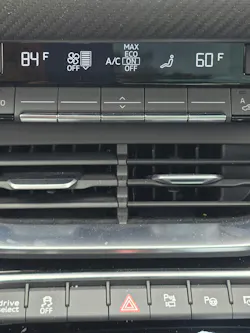
Reading anything electronic, though, depends on the low-voltage (LV) system being alive, and after a crash that isn’t a given. If the airbags went off, the pyro-fuse likely fired with them and isolated the high-voltage (HV) system, which drops your shock risk but can take the 12-volt system down with it as it is no longer being supported. With the low side dead, nothing comes up; the cluster won’t light and a scan tool has nothing to talk to. It is extremely important to follow OEM service procedures when supporting the LV. It is also worth mentioning that isolating the HV system doesn’t necessarily remove the potential of thermal runaway if a cell is damaged.
With the LV side up, the cluster may be giving you thermal system or high-voltage warnings that point right at the pack. The next step is to hook up a scan tool and pull codes. Look for anything that flags the battery management system, a module or battery fault, or a thermal problem within the battery pack.
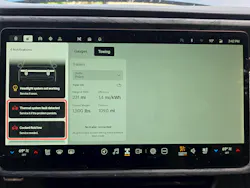
From there, go to live data, and see if there are PIDs related to temperature and/or battery voltages. For temperature, a pack that’s warm but holding is different from one that’s climbing. A pack that is climbing in temperature is potentially an emergency. When it comes to module voltage, some imbalance is normal. What to watch for is a module that drops and won’t recover; an unrecoverable drop is the sign of a short, and a shorting module is a source of heat. The key to this data is to trend it over time and make sure the information is documented so that you can clearly see changes that may be occurring.
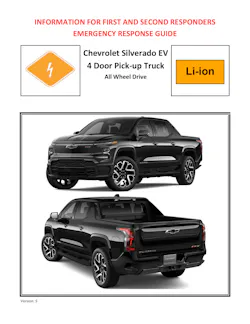
The emergency response guide (ERG) for that vehicle is worth having in hand. It’s written mostly for first responders, so not all of it is aimed at you, but it can have guidance on when to disconnect the HV battery based on the damage, isolation distance, and hold time. It’s not the only source; it is also important to refer to the OEM service information, too, both for handling a collision-damaged vehicle and for the info related to any codes you pulled. When you’re past what is covered by those sources of information or past your training, contact the manufacturer or a dealer service center for additional guidance.
The quarantine is the part that keeps you safe
All that feeds how you isolate and hold the vehicle, and that works regardless of what the tools showed.
Distance comes first. NHTSA’s guidance is not to store a severely damaged lithium-ion vehicle inside a structure or within 50 feet of any structure, vehicle, or combustibles. Most shops don’t have 50 feet of open space, which is the real-world problem with the recommended distance. If you use a structure for isolation, it must be non-combustible and ventilated. A venting pack puts out flammable gas, and in a sealed or poorly vented space, that gas builds until something ignites it. Then you have a deflagration.
Then you hold the vehicle. Twenty-four hours is often cited, but it’s a floor, not a finish line. What ends the quarantine, for me, is the evidence. If I haven’t found damage compromising the pack and everything I’ve logged and trended shows no sign of instability, I’m comfortable calling it good.
Where it can be done safely, take energy out of the pack. The air transport regulations cap lithium-ion at around 30 percent state of charge to ship, specifically because lowering the charge reduces thermal runaway potential. As of 2026, that limit reaches battery-powered vehicles shipped by air, where it used to apply only to loose batteries. The same logic applies to a vehicle in quarantine: bring the HV pack down toward 30 percent if you safely can, and you’ve taken energy out of the hazard. The caveat is “safely.” Actively discharging a pack, which you think may be damaged, isn’t always wise or possible, and it puts you back at the vehicle. It’s a call you make case by case.
If there is a runaway event, do not try to fight it
One more thing, and it runs against instinct. If you see the signs of a pack going into runaway, or hear that venting sound, the reaction might be to grab a fire extinguisher. With a battery pack involved, that’s wrong, and it can get you hurt.
A dry chemical extinguisher might knock down the fire for a second, but a pack in runaway is generating its own heat as cells fail one after another inside the enclosure. And burning lithium-ion cells create their own oxygen, so smothering it does nothing and the fire will come right back. A fire blanket has the same problem and a worse one. It’s meant to contain the spread, not stop the pack, and to place it you’d walk up to a venting, off-gassing battery with no thermal or respiratory protection. Even the fire department mostly cools and contains these rather than extinguishes. If the people who do this for a living are managing it rather than beating it, a tech has no business engaging it.
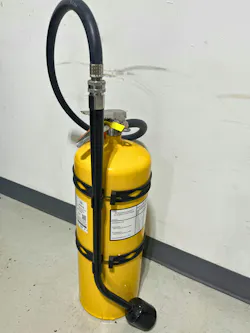
If the vehicle catches fire and that involves the battery pack, don’t attempt to push it out of the building. Get yourself and everyone else out, and stay upwind of the smoke, because the smoke is a hazard on its own. Lithium-ion combustion puts out a lot of toxic materials, including hydrogen fluoride, and hydrogen fluoride that’s inhaled turns into hydrofluoric acid in the moisture in your lungs, a serious medical problem that goes well beyond ordinary smoke irritation. That’s why staying out of the plume matters as much as staying away from the flame. Then call the fire department, because they’re the only ones with what it takes to deal with it.
Train for what you’re using, and know your limits
Underneath all of this is training. A tech should be trained in EVs before taking this on, and it goes for the tools too. Whether it’s the thermal imager, the scan tool, or a gas monitor someone hands you, it’s only an asset if you’re trained on it. The other piece is knowing your limits, so that when a vehicle is past what you can safely handle, you stop and bring in the manufacturer or the fire department.
None of this stands still, either. Chemistry and pack design keep changing, and what’s a concern now may not be later. Manufacturers continue to improve monitoring strategies, and through data collection advances in prognostics, early detection of runaway potential could allow for intervention before it happens.
Which brings it back to that Volt: it came through the crash test, sat charged with coolant in the pack, and failed three weeks after the test, burning next to several other vehicles. You’ll likely never see a battery pack go into runaway in your career. Still, technician safety begins with handling the vehicle safely, and that starts with identifying the damage that’s a concern, fluid leaks, dash alerts and warnings, the DTCs behind them, and finally the vehicle’s live data.
About the Author
 Paul Bostel
Paul Bostel
Director of Advanced Vehicle Technology
Paul Bostel is a seasoned leader with a rare blend of expertise in both advanced automotive technology and fire service operations. With over 20 years in the automotive industry, he is recognized as one of fewer than 2,300 ASE World Class-certified technicians — a distinction that underscores his mastery in diagnosing and repairing complex vehicle systems, with a specialized focus on ADAS. Paul is director of Advanced Vehicle Technology for Quality Collision Group, where he applies his analytical precision and strategic mindset to elevate operational performance and repair standards.
In parallel with his automotive career, Paul has proudly served the Apple Valley Fire Department for over nine years and holds the rank of captain, demonstrating his strong leadership, commitment to community service, and ability to manage high-pressure environments. His career is defined by innovation, efficiency, and a continuous drive to raise industry standards across every role he takes on.