Why battery support is critical during vehicle scans, programming, and ADAS calibrations
Key Highlights
- Vehicle systems in diagnostic mode operate with increased electrical loads, making external battery support essential for voltage stability.
- OEMs specify narrow voltage ranges (around 13.9V) during programming; deviations can cause data corruption or module damage.
- High current demands, especially from European vehicles like BMW and Mercedes-Benz, require support units capable of 70-100 amps.
- Dedicated battery support units are designed for diagnostic environments, offering low ripple, rapid response, and precise voltage regulation, unlike traditional chargers.

As modern vehicles become increasingly software-driven, the importance of proper battery support during diagnostic scans, module programming, and ADAS calibrations can no longer be overstated. What was once a quick scan tool connection is now a complex electronic procedure involving dozens of control modules, constant network communication, and extended ignition-on time. In this environment, battery voltage stability is not just best practice; it is essential to protect vehicle electronics and ensure successful service outcomes.
The hidden electrical load of modern vehicles
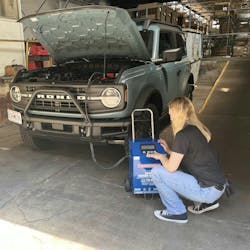
When a vehicle is placed in diagnostic mode or prepared for ADAS calibration, it often operates in a state very different from normal driving. The ignition may remain on for long periods while safety systems, cameras, radar modules, power steering, brake controllers, infotainment systems, and body modules remain active simultaneously. Cooling fans may cycle on and off, and network traffic across CAN, LIN, and Ethernet systems increases dramatically.
All of this places a sustained electrical load on the battery. Even a healthy battery can experience a rapid voltage drop under these conditions, especially if the vehicle is not running. Without external battery support, voltage instability becomes likely, and that is where problems begin.

Why voltage stability matters
Most OEMs specify a narrow voltage range during programming and calibration events, generally centered around the mid-13-volt range. Voltage that drops too low can cause modules to shut down mid-process, while voltage that spikes too high can trigger programming faults or abort procedures entirely. Either scenario can corrupt data being written to a control module. (Although the common reflash voltage setting is 13.9V, depending on vehicle brand the range can be between 13.5V to 14.4V, each OE requires an exact voltage setting or the reflash will not take) when considering the purchase of a clean power supply it might be wise to consider one with adjustable voltage settings capabilities.
In the worst cases, insufficient or unstable voltage can permanently damage an electronic control unit, rendering it inoperable — commonly referred to as a “bricked” module. Replacing these modules can cost thousands of dollars and may require dealer-only access for setup and coding.
Amperage: The often-overlooked requirement
While voltage specifications are widely discussed, amperage capacity is where many service operations run into trouble. It is not enough for a power supply to reach the correct voltage if it cannot sustain the current demanded by the vehicle.
For many Asian and domestic vehicles, a support unit capable of approximately 60 amps is typically sufficient. However, certain manufacturers — particularly European brands — place significantly higher demands on the electrical system during programming and calibration. Vehicles from BMW and Mercedes-Benz, for example, often require power support capable of 100 amps or more to remain within safe operating margins.
These higher current requirements reflect heavier module loads, more complex network architectures, and stricter OEM protections designed to prevent data corruption during software updates.
Battery support units vs. traditional chargers
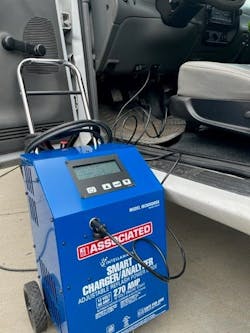
A common misconception is that any battery charger can serve as adequate support during scans and calibrations. Traditional chargers are designed to replenish battery capacity, not to act as a stable power source for sensitive electronics.
Dedicated battery support Units (BSUs) or service power supplies are engineered specifically for diagnostic and programming environments. They provide tightly regulated voltage, rapid response to load changes, and low electrical ripple — qualities that are critical when working with ADAS sensors and modern vehicle networks.
Many OEM procedures explicitly require placing the support unit into a “power supply mode,” ensuring the vehicle receives consistent electrical power independent of battery condition.
ADAS calibration raises the stakes
ADAS calibration amplifies the need for proper battery support. These procedures often require the vehicle to remain powered for extended periods while sensors are initialized, measured, and synchronized. Any interruption— whether from voltage sag or current limitation — can force recalibration or invalidate results.
Additionally, ADAS systems rely on precise electronic signals. Electrical noise or ripple introduced by inadequate power equipment can interfere with sensor communication, leading to calibration failures that are difficult to diagnose.
Practical guidelines for shops
While exact specifications vary by manufacturer, some practical guidelines emerge across OEMs:
- Most vehicles require a stable voltage centered around 13.9V during programming and calibration.
- A current capacity of at least 60 amps should be considered a baseline for modern vehicles.
- European platforms and high-content vehicles often demand 70–100 amps to safely support all active systems.
- Voltage must remain stable throughout the entire procedure — brief drops below acceptable thresholds can cause failure.
Technicians should always consult OEM service information, but having a capable battery support unit in place ensures those specifications can be met consistently.
Protecting vehicles, shops, and technicians
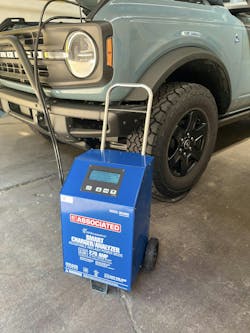
Proper battery support is not just about avoiding failed scans; it is about risk management. A single voltage-related module failure can erase the profit from dozens of successful repairs. More importantly, it can damage customer trust and expose the shop to unnecessary liability.
As vehicles continue to evolve, battery support equipment should be viewed as foundational infrastructure, not an optional accessory. Just as alignment racks and scan tools have become indispensable, so too has reliable, high-capacity battery support.
Conclusion
Modern diagnostics, programming, and ADAS calibrations demand clean, stable, and adequately sized electrical power. Relying on the vehicle battery alone — or on undersized charging equipment — introduces unnecessary risk during some of the most sensitive procedures performed in today’s service bays.
By understanding OEM voltage and current expectations and investing in proper battery support, shops can improve repair success rates, protect expensive electronic modules, and confidently service the advanced vehicles their customers rely on every day.
About the Author
 Kim Cottle
Kim Cottle
President
Kim Cottle brings more than 18 years of automotive aftermarket experience focused on battery service, charging technology, and equipment leadership. She joined Associated Equipment Corp. in 2007 as vice president of Operations and was named president and CEO in 2012, leading the company’s strategy, product development, and industry engagement as a U.S.-based manufacturer of professional battery service equipment.
Kim is an active industry leader, serving as immediate past chair of the Auto Care Association’s Tool & Equipment Committee and participating in Women in Auto Care and AMRA/MAP. She was elected to the Equipment & Tool Institute (ETI) board of directors in 2024 and also serves on PTEN’s Advisory Board. Her work focuses on advancing battery diagnostics, charging systems, and professional service standards across OEM and aftermarket channels.