The Rise of Commercial Fleet Work: A Strategic Imperative for Collision Centers
Key Highlights
- Commercial fleets are expanding at 10.2% to 15% annually, driven by growth in last-mile delivery networks for companies like Amazon and Kroger.
- Fleet vehicles have higher accident rates (~20%) compared to passenger cars (~5%), ensuring consistent repair volume for collision centers.
- Speed and operational readiness, including dedicated lanes and pre-staged parts, are critical for meeting fleet cycle time expectations of 24-72 hours.
- Specialized repairs for electric vehicles, including high-voltage safety protocols and ADAS calibration, are increasingly important as electrification accelerates.
- Mobile repair services and expanded facility capacity can provide a competitive edge in serving fleet clients efficiently.

The Case for Commercial Fleets
Commercial fleet work is no longer an emerging opportunity; it has become one of the most reliable, high frequency revenue streams in the collision repair industry. Commercial fleets are expanding at an annual rate of 10.2% to 15%, driven largely by explosive growth in the small package delivery segment. Retailers like Amazon and Kroger and carriers such as DHL and OnTrac continue to scale their last‑mile networks, adding thousands of vehicles to the road each year. Every new route adds vehicles, and every vehicle adds collision exposure.
Fleet vehicles operate in dense traffic, on tight schedules, and across high‑mileage routes. These conditions naturally elevate accident frequency. Commercial fleets experience an accident rate of approximately 20%, compared to approximately 5% for passenger vehicles. For collision repair centers, this represents predictable, recurring repair volume that traditional retail work cannot match.
Fleet vehicles are tools, not assets. They generate revenue only when they are moving. Downtime creates a cascade of operational losses: missed delivery windows, idle drivers, failed service level agreements, and customer dissatisfaction. Many fleet units are also purpose‑built, such as high‑roof vans, step vans, refrigerated units, and increasingly, electric delivery vans. These configurations make rental substitution difficult or impossible. A collision repair center that can return vehicles to service quickly becomes indispensable.
The Important Considerations
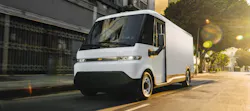
Understanding the modern fleet vehicle mix is essential. Today’s fleets rely heavily on high‑roof cargo vans like the Ford Transit, Ram ProMaster, and Mercedes Sprinter. Step vans from companies like Utilimaster and Morgan Olson remain staples in parcel delivery. Electrification is accelerating as well, with platforms like the Rivian EDV and Chevrolet BrightDrop (formerly BrightDrop Zevo) entering large‑scale deployment. These vehicles introduce new repair challenges with larger dimensions, ADAS systems, composite materials, and EV‑specific safety protocols, all of which require specialized equipment and training.
EV fleet collision repair deserves special attention. High‑voltage isolation procedures, battery safety zones, and OEM‑specific repair guidelines are now part of the repair landscape. Rental replacements for EV delivery vans are extremely limited, increasing pressure on cycle time. Shops that invest early in EV capability will secure long‑term fleet contracts as electrification expands.
Cycle time is the currency of fleet work. Fleet managers think in hours, not days. Light‑severity repairs are often expected within 24–72 hours. Meeting these expectations requires dedicated fleet repair lanes, rapid triage processes, pre‑staged parts for common fleet models, and adjusted SOPs focused on uptime. A collision repair center that can reliably deliver fast‑turn repairs becomes a preferred vendor.
Fleet contract structures are more formal than many shops realize. Preferred vendor agreements, volume‑based pricing tiers, consolidated monthly billing, and KPI reporting are standard. Fleets often track cycle time, severity mix, repeat repairs, and communication responsiveness. Understanding these mechanics positions a shop to negotiate effectively and deliver consistently.
Special Considerations
Creativity is becoming a competitive advantage. Mechanical service providers have already embraced mobile repair, meeting fleets at their depots to minimize downtime. Collision centers should evaluate whether mobile collision repair is feasible for light‑severity work such as mirror replacements, lamp assemblies, minor bumper repairs, cosmetic panel work, and decal replacement. While mobile collision repair is not yet mainstream, early adopters will own the market.
Operational readiness determines whether a shop can truly capitalize on fleet work. A collision repair center must assess its frame rack capacity for extended wheelbases, spray booth size for high‑roof vans, ADAS calibration capability, parking and staging space for multiple fleet drop‑offs, after‑hours intake options, and whether a dedicated fleet estimator is needed. For shops exploring mobile repair, a properly outfitted service van becomes part of the equation.
Fleet work is often misunderstood as “low margin,” but the economics tell a different story. Customer acquisition costs are lower, repair frequency is higher, annual volume is predictable, marketing spending is reduced, and faster cycle times increase throughput. Fleet work is a strategic profit center, not a discount program.
Consider a simple example: a regional delivery fleet with 120 vans averages roughly 24 collision events per year. Depending on severity mix, a single shop can capture $250K – $600K in annual revenue from one fleet relationship. Multiply that by several fleets, and the strategic value becomes clear.
As consolidation reshapes the collision landscape, commercial fleet work stands out as one of the few remaining high‑frequency, high‑predictability revenue streams available to independent and MSO operators. The shops that invest in speed, equipment, EV readiness, and mobile capability will secure long‑term contracts that competitors cannot easily replicate.
Related Reading
 Fleet of delivery vans
About the Author
 Ted Williams
Ted Williams
Collision Industry Strategist and Consultant
Ted Williams is a collision repair industry strategist and consultant with decades of experience working globally across OEMs, dealerships, MSOs, and independent repair centers. His work focuses on collision lifecycle ownership, customer retention, and sustainable growth models aligned with trust and repair quality.