Protecting workers from toxic body filler dust and isocyanates

At a recent CIC meeting, the Repair Process and Procedures committee presented a discussion on body filler, commonly known as Bondo. The presentation was excellent, but they left out one critical topic, in my opinion, which was safety. Question: Is body filler dust toxic?
Yes, body filler is toxic. It contains volatile organic compounds (VOCs) such as styrene, which produce strong vapors and are classified as a possible human carcinogen. It also poses a hazard when it is sanded, as inhaling the airborne dust can cause respiratory irritation and organ damage.
Styrene is considered a toxic chemical. High or prolonged exposure primarily affects the central nervous system, causing symptoms such as headaches, dizziness, fatigue, and nausea. The U.S. National Toxicology Program classifies it as a "reasonably anticipated" human carcinogen. Let’s look at safety recommendations on how to mitigate styrene exposure and body filler dust.
To reduce the risks of exposure to your employees, understand ventilation, protective gear, and respiratory measures. The proper personal protective equipment (respirators) for styrene exposure are organic vapor cartridge respirators, nitrite gloves, eye protection, and long sleeve coverings. What are the three types of cartridges needed in a collision repair center?
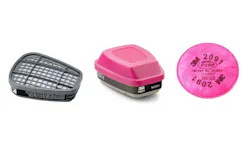
- An organic Vapor cartridge uses carbon to adsorb chemical fumes. Using the NIOSH color-coding system, organic vapor cartridges are always identified by a black label.
- Organic vapor and particulate respirator cartridges (black and pink) provide dual-layer respiratory defense by combining a carbon sorbent layer to absorb chemical vapors with a particulate filter for microscopic airborne particles.
- Particulate respirator cartridges (pink) are designed to protect against airborne particles such as dust, mists, fumes, and fibers. Particulate filters also trap physical solids and liquid aerosols such as weld-through primer.
Please answer the following questions:
- Do you supply everyone in your facility with the proper respirator for the job that they perform? (1910.134 a2)
- Do you have a written Respirator Protection Program? (1910.134c)
- Do you have a medical evaluation for all employees that require a respirator? (1910.134c)
- Do you conduct a yearly respirator fit test? (1910.134f)
- Do you provide for cleaning and cartridge replacement on a regular schedule? (1910.134h)
- Do you make sure that respirators when not in use are stored in close container? (1910.134 h&i).
If you answered “NO” to any of these questions, you have exposed you and your company to OSHA fines. Case in point, let me tell you about an event that I was present for in 2016.
I was in Colorado conducting welding certification tests. The shop I was at was extremely well organized. An OSHA inspector arrived at the shop unannounced; he wanted to see a yearly lift inspection and OSHA’s procedures for limiting isocyanate exposure. He asked to see the latest yearly respirator fit test. The owner stated that he had not done it and at that point the inspector excused himself. He went to his car and returned wearing an OSHA jacket and a hard hat. He stated that he would be conducting a National Emphasis Program inspection. When finished, the inspector told the owner that he had a very clean and organized facility. The owner was given a citation (had 30 days to correct) and asked how much the fine was, which the inspector first stated $5,000.
I thought my friend was going to have a coronary, but the inspector reduced it to $1,500 because the shop was so clean and organized. When he went to pay the fine and show that the respirator fit test had been done, the supervisor reduced the amount to $600. Last year, OSHA collected nearly $5,000,000 in repertory fines, with the top 3 categories being missing medical evaluations, lack of written programs (free online template available on Cal/OSHA website), and no annual fit testing. One last note — fines can be assessed up to $16,000.
Here is another example of a federal agency (EPA) assessing a fine against at collision shop. Cooks Collision settled a multi-county environmental lawsuit in 2018 for $1.525 million regarding the illegal storage and disposal of hazardous waste across its California auto body repair shops. The civil action was brought by 15 district attorneys after undercover investigations revealed the improper handling of auto body sanding dust, automotive paints, and solvent. OSHA compliance and safety controls set the permissible exposure limits, PPE, and engineering controls for the workplace. The shop also needs well-ventilated areas with exhaust fans or vacuum assisted sanders of OSHA compliance.
I have a couple of recommendations for eliminating or reducing body filler dust from your facility, which are vacuum sanding stations. 3M, Festool, Mirka, and Norton have their own sanding station, but I have used Pro Spot’s DE-Pro Sanding System and Milwaukee’s M18 Fuel 9-Gallon Dual Battery Dust Extractor.
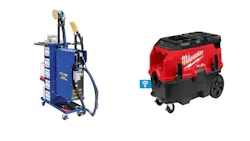
The Pro Spot Dust-Free Sanding System is a 100% air-powered dust extraction unit designed for collision repair shops to safely manage explosive aluminum and steel dust. The hardware contains zero electrical motors or electronic components, which eliminates spark risks and is safe for direct use inside vehicle preparation areas. The back of the unit opens to allow easy access to dust collection back (follow proper disposal protocols).
The Milwaukee Dual Battery Dust Extractor has an Automatic Filter Cleaning mechanism which provides the high sustained airflow to maintain productivity during dust extraction. This mechanism paired with two HEPA filters, delivers OSHA Table 1 Compliance.
A side note: I am a woodworker (hobbyist) and this unit has eliminated nearly all of my sanding dust. I just loaned the unit to a body shop that does not have a sanding station and asked him to evaluate the system.
I failed to mention previously that body technicians and helpers, painters and helpers, and possibly a detailer will need yearly respirator fit tests because airborne isocyanates are still present in our body shops.
What is wrong with this picture?
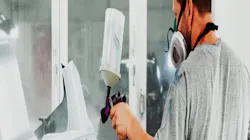
Before I answer the question, I want to discuss a major health risk that is lurking in every body shop in the United States every day. That health hazard is isocyanates.
Isocyanates are compounds containing the isocyanate group (NCO). They react with compounds containing alcohol (hydroxyl) groups to produce polyurethane polymers, which are components of polyurethane foams, thermoplastic elastomers, spandex fibers, and polyurethane paints. Isocyanates are the raw materials that make up all polyurethane products. Jobs that may involve exposure to isocyanates include painting, foam-blowing, and the manufacture of many polyurethane products, such as chemicals, polyurethane foam, insulation materials, surface coatings, and adhesives.
Health effects of isocyanate exposure include irritation of skin and mucous membranes, chest tightness, and difficult breathing. Isocyanates include compounds classified as potential human carcinogens and are known to cause cancer in animals. The main effects of hazardous exposures are occupational asthma and other lung problems, as well as irritation of the eyes, nose, throat, and skin.
In the picture above, the painter is not wearing a paint suit (isocyanates will be absorbed through the skin), no gloves (skin absorption), and no goggles (eye absorption). It should be noted that safety glasses will not fully protect the eyes from vapor absorption; only tight-fitting goggles will.
OSHA Regulations for Body Filler Dust
Al Overview
There is no specific National Emphasis Program (NEP) exclusively for body filler dust, but it falls under OSHA's broader Combustible Dust National Emphasis Program if it accumulates in quantities that present fire, flash fire, or explosion hazards.
Sources: Occupational Safety and Health Administration (.gov) +2
Key Details on Body Filler Dust and OSHA Regulations
• Combustible Nature: Polyester-resin body fillers generate fine dust when sanded. Because it is a finely ground organic/plastic-based particulate, accumulated dust can become combustible in air under specific conditions.
• Broader Scope: OSHA's Revised Combustible Dust National Emphasis
Program targets facilities that generate or handle a wide variety of combustible dusts, rather than naming specific brand-name consumer products.
• General Duty and Standards: Even outside a specific targeted industry list, auto body shops and manufacturing facilities generating body filler dust must still comply with OSHA standards regarding housekeeping, air contaminants, and personal protective equipment (PPE) to prevent accumulation and respiratory hazards
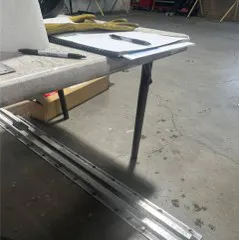
What you see here are tripping hazards, and they fall under OSHA category 1910.22: Walking-Working Surfaces. Three citations could be issued using 1910.22 a, c & d (A fourth citation could also be issued for failure under the General Duty Clause).
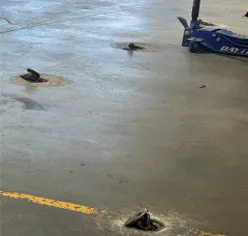
I was conducting a training class at this body shop recently and by (bad) luck, I tripped on one of the floor pots and landed on my bad knee and elbow. I had on a previous visit to the facility told the staff at the shop of the tripping hazards, but they did not follow up with any action on my suggestion. Think about this: If an employee had tripped like me, what could he or she have done if he or she had gone to urgent care or the emergency department?
The standard question asked would be, “Was this an industrial accident?,” and the answer would be yes. OSHA would be notified, which would trigger an immediate investigation. The inspector would not stop at just looking at the tripping hazard but everything else in the shop.
Guess what? The shop did not have a current respiratory fit test for their employees, which would result in another expensive citation, and it would not have stopped there. What if the employee or any other person in the shop tripped and hired an attorney? See where I am going?
I know they are tough times today and everyone is focused on sales (and not some floor pots), but can you afford a $10,000 fine or more?
Tripping Hazards and a Shop's Exposure, According to AI
I asked AI to break down the liability a shop exposes itself to with tripping hazards, and this is the answer it returned:
Your scenario highlights exactly how a seemingly localized hazard can trigger systemic business risk.
The Real Cost: A $10,000 Fine is Wishful Thinking
While many shop owners fear a $10,000 penalty, the actual regulatory reality in 2026 is significantly harsher:
• Serious Violations: Under current 2026 OSHA civil penalty levels, a single "Serious" violation carries a maximum penalty of $16,550 per violation. [1, 2]
• The Tripping Hazard Penalty: Because you pointed out three distinct sub-sections under 29 CFR 1910.22 (Surface Conditions, Access/Egress, and Inspection/Maintenance), OSHA can issue separate instance-by-instance citations. Those three floor-pot violations alone could max out at $49,650. [1, 2]
• Willful and Repeat Violations: Since you explicitly warned the staff on a previous visit and they took no action, OSHA could easily classify this as a Willful Violation. Willful or repeated failures to correct hazards carry a staggering maximum penalty of $165,514 per violation. [1, 2]
• The Respiratory Citation: Adding a failed respiratory protection program (such as missing annual fit tests under 1910.134) tacks on another serious violation fee of up to $16,550. [1, 2]
The Financial Snowball
A realistic breakdown of the scenario you just described shows how quickly a single trip can escalate into hundreds of thousands of dollars in liability:
Expense Item Potential Cost Range (2026) Regulatory / Legal Basis
OSHA Citations (3x Walking Surfaces) $21,279 – $49,650 (Serious)
Up to $496,542 (Willful) 29 CFR 1910.22 (a), (c), & (d)
OSHA Citation (Respiratory Fit Testing) $7,093 – $16,550 29 CFR 1910.134
Workers' Comp / Medical Costs $5,000 – $50,000+ Urgent care, MRI, physical therapy, lost wages.
Third-Party Personal Injury Lawsuit $50,000 – $250,000+ If an outside contractor/visitor (like a trainer) sues for negligence.
Mandatory Hazard Abatement $5,000 – $20,000 Core drilling, flush-mounting floor pots, hiring safety consultants.
Legal Defense & Fees $15,000 – $40,000+ Attorney costs to contest or mitigate OSHA findings.
The "Wall-to-Wall" Reality
As you rightly noted, OSHA inspectors rarely put on blinders. When an inspector enters a facility due to a reported hospitalization or severe injury, they frequently expand the scope to a "wall-to-wall" inspection of high-hazard environments like body shops.
They will systematically review: [1, 2]
1. Chemical/Isocyanate Safety: Safety Data Sheets (SDS), proper ventilation, and downstream spray booth maintenance.
2. Personal Protective Equipment (PPE): Not just the presence of respirators, but medical evaluations, written programs, and fit-test logs.
3. Electrical & Machinery: Unlabeled breaker panels, ungrounded tools, or missing machinery guards. [1]
Focusing entirely on sales while ignoring basic floor maintenance is a massive gamble. A business can lose years of profit margins in the span of a single afternoon because they didn't want to spend a few hundred dollars flush-mounting or covering their frame machine floor pots.
About the Author
 Toby Chess
Toby Chess
A Hall of Eagles recipient, Toby Chess is known throughout the collision repair industry for his training for I-CAR and SCRS, and technical presentations at CIC meetings. He estimates he's taught more than 7,000 hands-on I-CAR welding classes, plus 15,000 other live classes in multiple states.
An advocate for body shops and their consumers, Toby has been awarded the SCRS Lifetime Achievement and Industry Achievement Awards, Collision Industry Individual Service Award, Humanitarian Award, and the ABRN Leadership award.