Anderson: Why You’re Probably Not Charging for Enough Mechanical Labor Hours

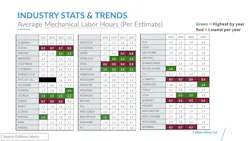
At Collision Advice, we recently finished compiling new data on average severity by state and average body, refinish, frame, and mechanical labor hours per estimate. Our data is based on all insurance claims — both DRP and non-DRP — and pulled from multiple sources. That’s important, because a lot of industry data you see is limited to only DRP assignments. Ours isn’t.
When we reviewed average mechanical labor hours per estimate by state, we saw a low of 0.7 and a high of just two hours. That’s very concerning to me. Not because mechanical labor is a “profit center,” but because those numbers don’t align with what safe and proper repairs actually require.
OEM Repair Procedures
If we’re following OEM procedures — as we’re morally and professionally obligated to — average mechanical labor should be much closer to four to six hours per estimate. Let's look at a typical collision repair job.
Start with scanning. Whether you’re performing a pre-scan, in-process scan, or post-scan, OEMs require battery support before scanning the vehicle. Hooking up battery support is a mechanical labor operation.
Now let’s talk about battery disconnect and reconnect procedures. Every OEM has them, and they’re not optional. One manufacturer may require two follow-up procedures once the battery is reconnected. Another requires nine. These steps often involve resets, calibrations, or relearns, and they’re mechanical operations as well.
Welding brings another layer of mechanical labor that often goes undocumented. OEMs require electronics within a certain distance of the weld area — anywhere from 12 to 21 inches, depending on the manufacturer — to be removed prior to welding. That can include airbags, airbag sensors, speakers, or other electronic components. Removing and reinstalling those components is mechanical labor, plain and simple.
Then there’s pre-alignment. In today’s repair environment, it’s not uncommon — nor inappropriate — to perform a pre-alignment to diagnose potential suspension or structural issues before we write a complete damage analysis. That alignment check is mechanical labor. Even with alignments themselves, there’s a misunderstanding in the industry. A collision alignment is not the same as a maintenance alignment. OEM procedures often include “not included” operations that estimating platforms don’t automatically account for. One Asian manufacturer, for example, requires crossmember adjustments to address torque steer. That work isn’t included in book time.
You also have tire runout checks. Working with K&M Collision, and a shoutout to Michael and Kyle Bradshaw and their family and team, they found that roughly 25–30% of vehicles checked had flat-spotted tires. A runout test is required to identify that issue — and yes, that’s mechanical labor.
ADAS adds even more. After calibrations, OEMs often require test drives under specific conditions — certain speeds, distances, or even road types — to confirm systems function properly. Those verification drives are mechanical operations.
Safey Inspections
And let’s not forget safety inspections. On some General Motors vehicles, a complete post-collision safety inspection can total up to 22 labor hours, with roughly 12 of those being mechanical. Seatbelt inspections alone fall under that category.
I hear the same pushback when I talk about this. Some shop owners or operators say body and mechanical labor rates are the same in their state, so they don’t itemize. That’s the exception, not the rule. Others say they sublet ADAS calibrations for a flat fee. Fine, but I doubt you’re subletting electronics R&I for welding or battery support for scanning. Even if you sublet safety inspections or ADAS calibrations, there is still significant mechanical work required on nearly every collision repair.
This isn’t about charging more. It’s about doing the job correctly. OEM repair procedures are the blueprint for safe and proper repairs. If we truly follow them — and document them — our mechanical labor hours will naturally increase. Profitability may be a byproduct, but it’s not the goal.
The goal is simple: fix the vehicle the right way. And if we’re doing that, 0.7 or even two hours of mechanical labor per estimate just doesn’t add up.
About the Author
 Mike Anderson
Mike Anderson
Mike Anderson is president of Collision Advice and provides training and consulting for all collision repair stakeholders. He leverages his life experiences, OEM certification training, and former multi-shop ownership with multiple OEM certifications to deliver high-quality and customized services that meet the needs and challenges of the collision industry.
Collision Advice offers assistance in accounting, marketing, estimating, management, production, cycle time, scanning, calibrations, parts processes, customer service, and more. The company also conducts training for many OEMs, such as Toyota, Lexus, Porsche, Nissan, Infiniti, Volvo, Subaru, BMW, and others.
Additionally, Mike facilitates 20 groups for collision repair shops, both independent and dealership-owned, called the Spartan 300, and publishes a state of the industry quarterly report with over 200 slides of data from various sources. His mission is to help collision repair professionals improve their performance, profitability, and customer experience.
Reach him at [email protected].