Enhancing Trust in ADAS Repairs: Frameworks, Processes, and Industry Collaboration
ADAS technology continues to add complex, increased repair demands for shops. Constantly moving parts and pieces creates confusion as shops try to determine what to do with estimatics, diagnostics, and OEM repair information.
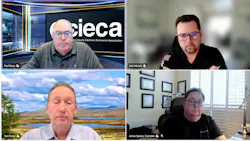
Revv Director of Strategic Partnerships Joel Adcock, Collision Career Institute SVP and Partner Dan Dutra, and Tractable Head of Automotive — AI James Spears spoke about how the industry can create greater consistency around how ADAS is performed during CIECA’s June 18 webinar “ADAS Calibration Issues, Challenges and Opportunities.”
“A lot of people really don't understand what they should be doing and how they should follow a process,” Dutra said. “As these systems become more prevalent, the industry has an opportunity, and I would argue a responsibility, to align around a common framework that supports confidence in the repair process.”
Dutra discussed a framework of four pillars – process, environment, training, and equipment. Combined, the four pillars can achieve the goal of trust. ADAS calibrations that aren’t performed with a consistent, documented process will lead to a lack of confidence in the safety of the repair. It makes it difficult for repairs, insurers, OEMs, and consumers to understand what work was performed, how it was performed, and if manufacturer requirements were met.
“The outcome we're really pursuing is trust — trust that the vehicle was repaired properly; trust that the safety systems will perform as intended; trust that everyone involved in the repair process is working towards the same objective,” Dutra said. “We're not talking about standards for the sake of standards. We're talking about creating greater trust, greater transparency, and greater confidence that the technologies designed to protect people continue to do exactly that after the vehicle is repaired.”

Revv has found shops struggle the most when it comes to workflow, Adcock said. There are plenty of programs and technologies that help shops perform ADAS work, but identifying which calibrations need to be done, where to submit for approvals, and where to schedule service with a sublet can cause problems.
“A lot of shops trying to get their arms around whether or not they can do ADAS in-house and trying to understand all the different pieces that are connected with that,” Adcock said. “We've got to completely shift our mindset on continuing to improve and really embracing a lot of that technology because it is going to continue to get thrown at us as far as like what the OEMs are producing…I think the challenge for shops is now we need to develop a new SOP, a new workflow, or enhance our current workflows because we're going to continue to get further away if we're not really embracing a lot of this new technology.”
As vehicles enter the shop, Adcock listed the questions that need to be considered:
- Can we do this in-house?
- Do we need to sublet?
- What does coordination look like?
- What’s the communication like?
- What’s the timeline?
He shared the misconceptions he commonly sees around ADAS today, including the difference between a scan vs. calibration and not performing calibrations based on pre-scan results.
“A scan's more on the diagnostic side, where the calibration is the execution of the actual, making sure the camera or radar is pointing in the right direction,” he said. “I think the biggest one is still that if there's no fault code, there's no light on the dashboard, there's no sign of any sort of trouble, that there's no calibration needed and I can tell you… that the majority of your calibrations are going to show up outside of a pre-scan. So, diagnostics is really one piece of the puzzle, but it's not really the entire decision-making process.”
Dutra said they need to educate shops to follow a process from point A to Z that creates safe repair using OEM-recommended procedures to provide documentation and transparency in the repair process. Spears said organizations like CIECA can take the lead tackling these challenges.
“We need to really understand how to remove those periods of uncertainty for people in the process,” Spears said. “But what we're really looking for now is how do we attach this transparency, this documentation, to a file?...Dan was talking about that we can produce some type of evidence that the right thing was done for the customer and that way, we've removed any of these periods of uncertainty; the tech knew they did the right thing and the customer’s very well assured that their car is back to OE conditions.”
Dutra emphasized that it’s not about proving who is right or wrong; it’s about giving consumers confidence that systems designed to protect them are restored properly and will work as intended.
“We need to put people over profit,” he said. “The profits will follow if we're doing the right thing. Every one of us in this industry plays a role in returning vehicles to the consumers after a collision. Increasingly, we're not just repairing vehicles…We're restoring technologies that help people avoid crashes, reduce injuries, and in many cases saves lives. That responsibility belongs to all of us.”
About the Author
 Peter Spotts
Peter Spotts
Associate Editor
Peter Spotts is the associate editor of FenderBender and ABRN. He brings six years of experience working in the newspaper industry and four years editing in Tech. He has a bachelor's degree in journalism from Western New England University with a minor in integrated marketing communications and an MBA. A sci-fi/fantasy fan, his current 2010 Honda Civic is nicknamed Eskel, after the character from the Witcher book series, for the scratch marks on its hood.
Don't miss Peter's next article. Sign up for FenderBender Today's Collision Repair News here.