Key Highlights
- Early adopters see robotics as a way to address staffing shortages, improve quality, and increase shop capacity, with a typical ROI of 1.5 to 2.5 years.
- Scanning vehicles for data is a key step, with each scan enhancing the system's database, though it currently takes 45 minutes to an hour per vehicle.
- While robots assist with panel and clear coat painting, refinement in blending capabilities is ongoing to handle more nuanced tasks and improve overall performance.
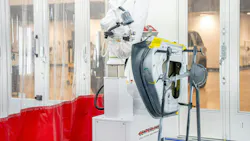
When John Picciano first heard from a China-based developer of robotic painting arms seeking a U.S. importer, he told them he wasn’t interested.
“I fix cars for a living,” says Picciano, owner of Flower Hill Auto Body, an independent MSO with locations across New York’s Long Island. “I have enough on my plate.”
He wasn’t saying no to the technology, however. And when it turned out his friend John Chiafair, as vice president of Centerline Collision Equipment, would be distributing the product, he leaned in. A self-described early adopter, Picciano wasn’t going to be left behind as a potentially revolutionary technology overtook the industry. And he isn’t alone. Chiafair says that all the system’s early adopters share some things in common.
“They wanted to get in because they identified that this is coming for our industry and were also realizing that they could be along for the ride as it rapidly improves and increases its capabilities,” Chiafair says.
In April, FenderBender featured several perspectives on technology and how shop owners and operators are integrating and planning for the future. While many of these tools are AI- and software-based, robotics, specifically painting arms, represent a new frontier in shop hardware. In this issue, we take a closer look at what that technology really looks like inside a shop.
The Basic Idea
One of those you heard from in April was Shane Hollas, owner of a Maaco shop in Rockwall, Texas. Like Picciano, Hollas is an early adopter, with an engineering background that gives him a critical eye for how a technology will be applied in a shop and a shop owner’s eye for the niche it’s going to fill in his business. Hollas believes robotics are the future of collision repair, able to assist with many of the problems facing the industry, and distributes them through his company, Black Wolf Technology.
“I got into the robot stuff three years ago because of a need to find the balance of the deliverable that needs to happen, according to OE procedures, the shortage of staffing, and cost control and production, so it’s kind of all of these things,” Hollas says.
The system distributed by Centerline and installed in Picciano’s shop is called PaintGo, developed in China by a company called ONEW. The PaintGo system was designed to the same standards as the robotic arms which paint new vehicles on an assembly line. It operates with the same precision and efficiency, creating consistent results for the jobs it is assigned to do. The key difference from an assembly line robot is instead of the repetition of painting the same kinds of cars in the same way over and over, PaintGo “reprograms the spray paths and parameters in real time for every individual repair order,” Chiafair says.
The user interface is designed to be as simple as the touch of a button. With a 3D model of a car, a technician can highlight an area on the vehicle, then the system will create transitions and blending zones around that space, with the user able to make adjustments as needed. All you have to do is press “go.”
In the Field
Picciano mentioned he’s an early adopter, so it’s no wonder he was one of the first Rivian owners in his area. One of the big advantages of connected vehicles is the ability to send upgrades via software, but early Rivian models like Picciano’s did not have the hardware necessary to upgrade when full self-driving came out.
“The exact same scenario is a concern of mine, and should be a concern of every early adopter,” Picciano says. “Is the hardware going to support the future software?”
That is certainly the goal with PaintGo, as updates are generally software-based. Customers “own the advancements,” Chiafair says. “They do not miss out on them by getting in too early.” That’s because the hardware is essentially settled; robotic painters have been around for decades. Where PaintGo develops from here is mainly in getting better at what it does.
PaintGo needs to have scanned the exterior of a make and model of vehicle to have sufficient data to perform a paint job. Once that make and model is scanned, it’s in the database forever. But as a new system, these days it makes many first-time scans. Scanning is a lengthy process, says Picciano, taking 45 minutes to an hour, plus the time to upload it into the cloud and be processed into the system to be utilized. But each time that happens, it enhances the network and provides more data for use. Body shops, Chiafair says, see more than 400 new car models each year, so the more data, the better.
Another focus of improvements is on blending; Chiafair says that there has been an ongoing learning process in terms of the different standards of repairs in the United States compared to overseas. The user interface has been redesigned to allow for more customization while blending, an update which is expected to roll out in the next couple months.
“[This update] will really change it to where they can use it as a workhorse in their shop, and it’ll be producing very well for them,” Chiafair says.
Panel painting is a real strength of the system, Picciano reports. It also applies clearcoats admirably, whether you’re trying to match a factory orange peel or virtually none at all. Further refinement of PaintGo’s blending ability would help transform it into that “workhorse” that is able to take on more nuanced tasks.
Things to Consider
Picciano likens his PaintGo system to a “painter’s assistant,” in that it augments what the painters are doing rather than fully taking over anything. For the time being, it probably makes the most sense for customers who have multiple paint booths, so that they can set the robot on a task in one and painters and keep production moving in the other one. Chiafair reports that for shops with enough production to command multiple booths, the cost of entry should be doable.
“Figuring for labor reduction, reduction in reworks for paint jobs, and potential increased paint revenue, because we’re seeing that this could potentially benefit customers by giving additional hours, additional capacity, the ROI we’re looking at is a year and a half to two and a half years,” Chiafair says. “So, shorter than the term of the loan if they want to finance the equipment.”
As far as operating costs, customers pay an annual subscription fee, which covers access to the data, software, and 24/7 tech support. Maintenance costs are expected to be minimal, changing out things like hoses and fittings each year. It uses the same spray guns any human would use, which just have to be changed out for any material change.
The long-term impact of robotics on collision repair is still unknown. But it is clear that even today, robots are helping shops. They may not be able to do every job or even most jobs, but Picciano would rather be a part of that process of refinement rather than getting on board too late.
“Kind of the way I look at it is, by the time everyone else gets on, for me, it’s been there, done that,” Picciano says. “It’s all already part of our system, and we’re already on to the next thing.”
About the Author
 Todd Kortemeier
Todd Kortemeier
Todd Kortemeier is former editor of FenderBender magazine and started writing as a contributor in 2024.