Are AI and Robotics in Your Shop's Future?
With the advancement of technology, shop owners these days may be feeling a bit like Sheriff Ed Tom Bell in the 2007 film “No Country for Old Men.” The old sheriff, in the face of a threat unlike any he’s seen before, seeks out his uncle and retired lawman, Ellis, for advice.
“You can’t stop what’s coming,” Ellis tells him. “It ain’t all waiting on you. That’s vanity.”
But if you don’t want to take an old, fictional, Texas sheriff’s word for it, how about the word of another Texan? Shane Hollas is the owner of a Maaco location in Rockwall, Texas. His message is essentially the same, but more specific to what we’re talking about.
“Technology’s coming,” says Hollas, “no matter if somebody wants it or not. And those that will embrace technology will be successful in the future, and those that don’t are going to either be out of business or trying to play catch up.”
That technology that is most prominently coming for shops — and all other industries, as well as daily life in general — in 2026 is AI. AI has wide-ranging applications in collision repair, from customer service to blueprinting. But it’s far from the only piece of tech that shop owners are thinking about integrating into their businesses. Whatever the technology, these decisions are never easy. Change can be scary, but is always necessary, as shop owners and tech innovators can both attest to.
Welcoming the Robot Overlords
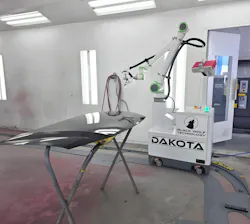
Hollas knows of what he speaks. In addition to being a shop owner, he has a technology and engineering background, and even founded his own tech-forward automotive supplier, Black Wolf Technology. Black Wolf’s flagship product, at least for now, is a robotic painting arm. Looking very similar to the kinds of robotic arms you see on automobile assembly lines, this one brings many of the same positives: automated precision, better efficiency, and fewer errors.
Right off the bat, let’s address one of the biggest concerns with new technology: Is this going to replace employees? And, is even the threat of being replaced enough to unsettle the harmony of the shop environment? To the first question, the short answer is no, your shop cannot be fully automated by a Jetsons-like fleet of robots — not yet, anyway. Hollas looks at technology as augmenting the work that humans do, which leads into addressing the second question. It’s important to communicate the benefits of new technology and the ways in which it makes everyone’s life easier.
“The robotic technology and a lot of these technologies, they’re allowing the human to get more done in a more accurate way with a better quality of life,” says Hollas. “And to me, that’s one of the big goals. If I can use technology to get a better deliverable and happier customer with also a happier employee, because I've improved their quality of life, I think that’s what technology is there to do.”
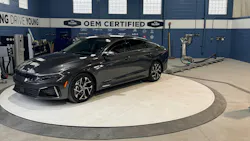
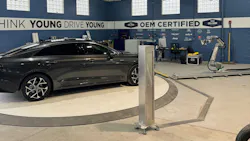
Ogden, Utah's Young Collision Center is also utilizing the power of robotics, in their case an automated ADAS calibration system from Kinetic. Calibrations are notoriously tricky and subject to many variables, which this automated solution largely eliminates through a level of precision that humans can’t replicate. Collision Director Chris Hudson says that the positives of the system were apparent to employees right away, but communication and training were still paramount to making sure everyone is on the same page.
“Body men, one of the things they’re thinking about is cycle time,” Hudson says. They’re thinking about, ‘OK, I’ve got to sub this out, how long is it going to be gone, I still need to put this on,’ or vice versa. The fact that we have it in house and it’s done within minutes as opposed to days has been an incredibly positive reaction, because obviously they can turn faster work.”
This video from Kinetic demonstrates the technology used by Young Collision Center in Ogden, Utah.
Building a More Efficient Business
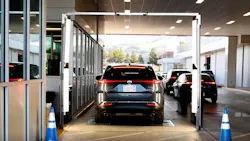
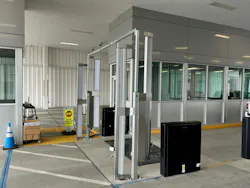
Tractable is a London-based firm specializing in AI solutions for repairers, insurers, recyclers, and more. Tractable offers software solutions, such as AI-enhanced photo estimating, and recently unveiled a hardware product called LumaScanner at last year’s SEMA show. Installed in a service drive, LumaScanner can quickly identify panel-level damage, saving time while also generating valuable leads.
On the software side, Tractable’s Head of Automotive Jimmy Spears says that automating this part of your business is a sure way to enhance customer satisfaction. He gives an example of Kirmac Collision & Autoglass in Canada, which uses the Tractable software to offer instant AI-powered estimates from photos. It’s essentially a step up from photo estimates which have been around for years, but giving the customer an instant, detailed estimate, at any time of the day.
“We’re able to get it back to the consumer in two minutes,” Spears says. “What we’ve found is that it’s not the first shop that a consumer goes to, or it’s not even the DRP that the insurance company assigns or where they agreed to go, it’s the one that gets back to the consumer that is the one that’s getting the job.”
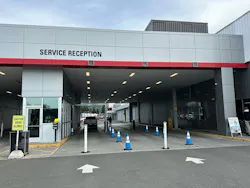
Jesse Parks is collision director at Freeman Collision Center in Santa Rosa, California, and has a LumaScanner installed in the service drive of Freeman Toyota. He says that not only is the system providing mostly accurate estimates in 90 seconds, it’s providing a consistent experience every time for the customer and also offering them a starting point for wherever they are at in the claims process. “It gives us the first crack at the relationship, so that we’re already the first trusted authority that they’re talking to,” Parks says.
Much like the concerns about robotic technology, both Parks and Spears emphasized that these solutions don’t so much replace employees as they rebalance the workload around the shop and shift responsibilities in ways that can be very positive. Spears says that it can mean that less technician time is taken up by admin roles and can be spent in the back of the shop. Parks explains that, with any new technology or major shift in shop operations, you want to sell the problem that you’re trying to solve, rather than starting with the solution.
“We’re looking at parts of your job that are less critical, where a much less skilled person or software can produce this first result when the car comes in the shop,” Parks says. “You now have more time to actually write a car and work on what’s in the shop, so we can really cook down the turkey.”
Envisioning the Kind of Business You Want
It might be easy for someone like Hollas to see the future, someone who is ensconced in both the cutting edge of technology and also the state of collision repair. But utilizing technology is, at its most basic level, the same as finding the solution to any business need. In Hollas’ case, a robotic painter was developed to solve a problem, not just because it was a cool new toy. And that’s been unchanged for generations, as evidenced by a quote often attributed to Henry Ford.
“When somebody asked Henry Ford, ‘What kind of market research and stuff did you do,’ he said, ‘We didn't talk to anybody,’” says Hollas. “He said, ‘We just made a car. If we would have talked to the market, they would have told us we need to make faster horses.’”
Hudson and Parks also emphasized that their shops want to be at the cutting edge of technology. What that means for every individual business is obviously different — not everyone can invest in automated AI and robotics. But it is important to not shy away from solutions which might represent a paradigm shift in the way you do business.
There is a popular sentiment within collision repair that “how we’ve always done it” isn’t a good enough reason for doing anything. And there is nothing more rooted in the past than not embracing technology. Do you want to be a business that is always looking ahead, or one that is staying put?
“We sit down as a management team and we really look hard at where we want to go,” Hudson says. “What’s our three-, five-, 10-year plan, and what technology is going to help us to get there? Are we spending money because it’s a cool toy, or we spending money because we can actually get a return on investment on it?”
Kinetic Vision is an automated imaging product designed for auto collision businesses to assess entire vehicles for comprehensive collision damage, including structural damage, and get objective and accurate repair estimates in minutes.
Investing in new technology does not mean giving yourself or your business over to automation, either. Think about statistics or analytics in sports. Numbers do not tell the whole story. Teams still invest vast amounts of time and money in scouting to see if on-field performance matches on-paper potential.
Technology helps provide more information and a clearer picture. That’s information that can help bridge the gap between insurer and shop. The more data there is on repairs, the more objective that estimating becomes. Technology will never solve all the world’s problems. But it can be a step toward better repairs, bigger profits, and happier customers.
“The more information is available, the more people can access it, the more they embrace the ability to access information,” Hollas says. “They’ll be able to use it to make cars go through their shop faster and repaired safely.”
About the Author
 Todd Kortemeier
Todd Kortemeier
Todd Kortemeier is former editor of FenderBender magazine and started writing as a contributor in 2024.