Building the Pipeline: How CREF Is Strengthening Collision Repair’s Future Workforce
For the past 35 years, the Collision Repair Education Foundation has worked largely behind the scenes, quietly keeping collision repair education alive, and often under difficult circumstances. But as the technician shortage deepens, technology transforms vehicles into rolling computers, and skilled trades re-enter the national conversation, CREF’s role has never been more visible — or more critical.
At the center of that effort is CREF Executive Director Brandon Eckenrode, who has spent nearly 25 years advocating for workforce development and education in the collision repair industry. From revitalizing shuttered school programs to modernizing how in-kind donations reach classrooms, Eckenrode’s career mirrors the foundation’s evolution, and the industry’s ongoing fight to secure its future labor force.

From Curriculum to Philanthropy
When CREF was founded by volunteers in 1991, its mission was more narrowly focused. Industry volunteers recognized early on that schools lacked a standardized, industry-recognized curriculum to prepare students for collision repair careers. Working closely with I-CAR, the foundation served primarily as a conduit for curriculum distribution.
“Back then, there wasn’t a set, standardized curriculum that high schools and post-secondary programs were using to prepare students for industry employment,” Eckenrode says.
That shifted in 2009, Eckenrode says, when both organizations recognized a need for clarity and focus. I-CAR assumed full responsibility for curriculum development and distribution, while CREF began pivoting into a philanthropic organization dedicated to financial and material support and later connecting students to employers through career fairs and other events.
That pivot changed everything.
Doing More with Less
One of the most sobering realities CREF confronts daily is how severely underfunded many collision repair programs are. Budgets that barely cover basic supplies are common, even as the industry expects graduates to enter the workforce job-ready.
He recalls Jeff Wilson, a Houston-area high school instructor who ran a 150-student program on less than $5,000 annually. Tragically, Wilson later lost his life in Houston-area flooding last year, but his story remains emblematic of the challenge.
“This industry has expectations of students graduating properly trained and ready for entry-level employment,” Eckenrode says. “But instructors are working with what they have available to them. That’s why this support is so critical.”
That gap between expectation and funding is where CREF steps in.
Grants, Makeovers, and Measuring Impact
In 2009, as CREF embraced its philanthropic identity, it launched what became known as “makeover grants.” Inspired loosely by the Extreme Makeover television format, these awards were designed to bring immediate, visible change to struggling programs, and generate industry awareness in the process.
“We wanted to make a big splash,” Eckenrode says.
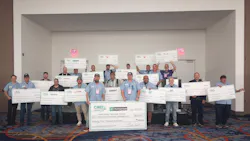
Those grants eventually evolved into what CREF now calls Benchmark Grants, part of a broader, year-round funding strategy. The scale has grown dramatically. At last year’s SEMA Show, CREF awarded more than $700,000 in grants, on top of scholarships and other support. Since 2009, the foundation has facilitated more than $150 million in total support, the vast majority of it from in-kind donations.
From safety equipment to tools, lifts, and vehicles, these contributions don’t just keep programs alive; they professionalize them.
“When students walk into a classroom that looks modern and well-equipped, it changes how they see the career,” Eckenrode says.
Connecting Education to Employment
Funding alone, however, doesn’t solve the workforce shortage. Recognizing this, around 2014 CREF began facilitating career fairs, events designed to connect students directly with employers.
“We’re connected to the schools, and we’re connected to industry partners,” Eckenrode says. “It made sense to bring those two together.”
Held everywhere from school gyms to auto show floors, these events often become turning points for students, who have even received job offers on the spot.
“You see that light go off,” Eckenrode says. “Students realize there are companies ready to hire them, and career paths they never knew existed.”
Over time, those career fairs expanded beyond collision repair, reflecting industry feedback that good attitude and work ethic often matter more than specialization. CREF now hosts broader “transportation student career fairs,” welcoming employers from multiple technical fields.
A Career Highlight — and a Life-Changing Moment
Among Eckenrode’s many career memories, one stands apart.
In 2017, at the I-CAR annual conference, CREF awarded the Lon Baudoux Memorial Scholarship to a student named Destiny Potter. She believed she was being recognized for the $1,000 scholarship and was asked to speak on stage about its impact.
Then came the surprise.
“I had a dry erase board next to me, and with a couple board members, I said, everybody in the audience knows the difficulty of paying back student debt. We showed her what her total student debt was going to look like as she graduated,” Eckenrode recalls. “And then we handed her a dry eraser.”
On stage, in front of the audience, Potter erased her student debt, paid in full by the foundation.
“She’s still in the industry today,” Eckenrode says. “That’s one I’ll never forget.”
Shuttered Programs — and Comebacks
The technician shortage has led many schools to reevaluate expensive collision repair programs, with closures often looming. But Eckenrode has also seen the opposite: shuttered programs reopening when the industry shows up.
One standout example is Rock Valley College in Rockford, Illinois. The program had been closed for years when the school explored expansion of its technical facilities. CREF, local instructors, and industry partners put out what Eckenrode calls the “bat signal.”
“The advisory board meeting was standing room only,” he says. “The school told us it was the largest advisory board meeting they’d ever had.”
The result: the program reopened, moved into a brand-new downtown facility, and expanded capacity from eight students to as many as 30.
“That only happens when the industry takes ownership at the local level,” Eckenrode says.
Modern Tools for Modern Problems
As CREF’s influence grew, so did the logistical challenges of managing in-kind donations. To address that, the foundation recently launched an online Donation Exchange platform.
Historically, facilitating a donation could take weeks. Now, it can take hours.
“It brings technology into the process,” Eckenrode says. “Donors can designate where their donation goes, and instructors can see what’s available and select what they need.”
The platform has already attracted new partners and made long-standing relationships more efficient, all while getting equipment into classrooms faster.
Reframing the Trade — and Starting Earlier
One of Eckenrode’s biggest concerns is visibility. As skilled trades re-enter the national spotlight, collision repair is still too often left out of the conversation.
“When people talk about trades, they mention plumbers, electricians, welders,” he says. “Very rarely do they say ‘collision repair.’”
That omission matters, especially as students are being asked to identify career paths earlier than ever.
“We’ve heard from school counselors that students are being asked to pick career paths in junior high,” Eckenrode says. “That means we need to be part of that conversation earlier.”
CREF has responded with elementary outreach efforts, shop tours, and STEM kits developed through a grant from the General Motors Foundation to introduce young students to the technology behind modern vehicles.
An Industry Responsibility
Despite all CREF does, Eckenrode is clear that the responsibility doesn’t rest with the foundation alone.
“If you’re a business and there’s a local program in your area, you should be participating, volunteering, and engaged with that local school,” he says. “Advisory boards, school partnerships, showing up — it all matters.”
Because collision repair programs are expensive, they are frequently evaluated by administrators. Visible industry support can mean the difference between survival and closure.
“There’s ownership on the industry to make sure these programs succeed,” Eckenrode says. “Just as much as what we’re trying to do to help them with other areas.”
More on CREF's 35th Anniversary: What CREF Means to Me
At a Glance:
CREF's Lifetime Figures:
- More than $6 Million in Benchmark Awards
- More than $3 Million in scholarships
CREF's 2025 Activities:
Benchmark Awards:
- $726,500 in Benchmark awards
- Distributed to 104 schools serving more than 5,300 students
Scholarships:
- $181,900 in CREF Scholarships benefiting 149 students
- $275,000 in total tuition assistance and tool awards
- 163 total students benefiting from the program
- 43% of recipients are female
- 46% of recipients identify as minorities
- 46% year-over-year increase in applications
In-Kind Support:
- Nearly 10,000 students received cost-free access to estimating software
- Over $280,000 of product donations were distributed to 64 registered schools through the new Donation Exchange Platform
Career Fairs & Uniforms:
- Provided uniforms to more than 1,000 students
- Career fairs connected more than 1,000 students from 31 schools with 51 participating employers
About the Author
 Jay Sicht
Jay Sicht
Editor-in-Chief, FenderBender and ABRN
Jay Sicht is editor-in-chief of FenderBender and ABRN. He has worked in the automotive aftermarket for more than 30 years, including in a number of sales and technical support roles in paint/parts distribution and service/repair. He has a bachelor's degree in journalism from the University of Central Missouri with a minor in aviation, and as a writer and editor, he has covered all segments of the automotive aftermarket for more than 22 of those years, including formerly serving as editor-in-chief of Motor Age and Aftermarket Business World. Connect with him on LinkedIn.
Don't miss Jay's next article or podcast. Sign up for FenderBender Today's Collision Repair News and ABRN eNews here.