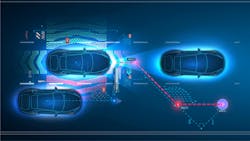
Depending on their role, most FenderBender readers are familiar with advanced driver assistance systems and their increasing need for calibration. But systems continue to evolve. New details continue to emerge, such as recent testing showing that with time and mileage, they can gradually become uncalibrated.
Technical education and the industry’s understanding of ADAS continues to grow. Although your more technically minded technicians or repair planners may be experts, how do you train the rest of your staff? And how do you educate your customer or an insurance company employee about how these systems work? The Collision Career Institute has developed an online course that breaks ADAS down to its essence.
“What's so important is creating the understanding and awareness what ADAS is, how important it is, that people understand it and address it properly,” says Dan Dutra, a collision repair industry veteran who admits it’s been difficult to slow down since he “semi-retired” after selling the MSO he co-owned in Hawaii, Sigs Collision Centers, in 2021.
These days, he is part owner of Precision Automotive Calibration Experts, a multi-location ADAS service provider in Tennessee. Fellow collision repair industry veteran Erick Bickett is also a partner in PACE, and together with yet another industry veteran, Charles Robertson, the trio founded the Collision Career Institute, which made news the week of the SEMA Show for its workforce intelligence to apply data-driven culture and workstyle analytics to drive workforce development. Roberston is CCI president.
“We coined this term, ‘workforce intelligence.’ It's focused on helping create an intelligent and a motivated workforce that helps solve that problem that the industry has and make it easier for shops to find the right people, to qualify the right people. And that's part what I-CAR has contracted with us to do on the front end of their Registered Apprenticeship Program that’s being funded by the Department of Labor.
“They are cultural surveys for the shops. So you understand the culture that you've got inside your organization, and it comes with the complete feedback and readout and with recommendations of what you can do to improve this or address this, et cetera. It's a pretty phenomenal tool.”
The genesis of the ADAS Essentials Awareness course
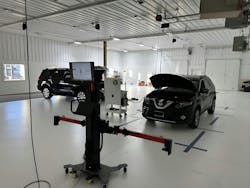
The ADAS Essentials Awareness course was an outgrowth of a need at PACE to educate collision repair shop owners and operators about ADAS and make them aware of the calibration processes PACE uses in a simple-to-understand format. Although it’s designed to be simple for novices, even those with a firm grasp of ADAS can learn from it, such as this author did about sensor fusion characteristics.
“Anybody who touches ADAS, I think, would learn and gain benefit from it,” Dutra says. “But one of the big things is for an estimator, what I've seen estimators do is even if they understand a little bit on ADAS, they don't understand enough to push back on an insurer when the insurer is pushing back on them.”
We've created the training so that it gives you such a solid foundation, without having to get too technical, that you can exude that kind of confidence that you can at least engage in a conversation so you can tell the insurer, ‘No, wait a minute. That’s not true, and here's why we need to do this.' - Dan Dutra, partner, CCI
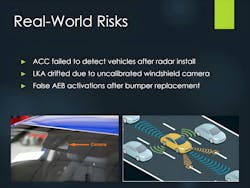
The 2-1/2-hour course uses the Canvas online learning platform, so students can learn at their own pace. Its interactive lessons offer engaging visuals, real-world examples, and situational learning checks to appeal to the novice learner, but also to those who may have a grasp on most aspects of ADAS but could use a refresher.
The CCI course empowers shop personnel when they’re challenged by an insurer about why a calibration operation is needed, Dutra says. With a surface-level knowledge of ADAS operation, the estimator/repair planner may not understand why certain ADAS calibration operations are necessary.
“We've created the training so that it gives you such a solid foundation, without having to get too technical, that you can exude that kind of confidence that you can at least engage in a conversation so you can tell the insurer, ‘No, wait a minute. That’s not true, and here's why we need to do this.”
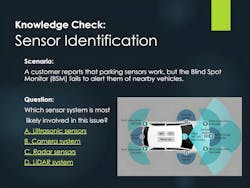
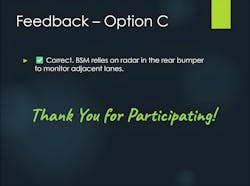
The learning activities are branched to allow the student to practice making calibration decisions to get immediate feedback. Quizzes at the end of each of the five modules check learning progress, followed by a final exam.
Videos and slides dive into each sensor type to help explain how they interact as a system, and after each module, there is a discussion tab that includes a case study where course-takers can offer their insight and methodology
There are even downloadable tools, such as an interview guide for ADAS calibration providers and a quick checklist for choosing the right provider if you’re not doing all ADAS calibration in-house.
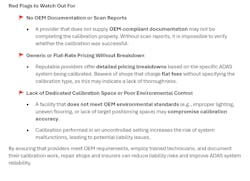
Beyond instructing on system operation, Dutra said the group wanted to ensure the course was designed to engage the learner emotionally, to consider the liability and other consequences of not restoring ADAS functionality.
“There's an image of the guy scanning a car with the wife or with the lady with her son sitting on her lap in the car while she's addressing it,” Dutra says. “A lot of thought that went into connecting this to the responsibility that your people are trusting you in this collision repair facility. You're a part of this in making sure that this vehicle is safe.
“You have to understand what you're dealing with now. This is not just painting a fender and blending a door. This is not just replacing a bumper or replacing a rail; this is a different animal. And I think it's fairly effective.”
Check out the 70-second video introduction to the course below.
And for a limited time, FenderBender readers can try the $195 course at no charge by scanning the QR code above or going to https://catalog.collisioncareerinstitute.com/courses/auto-305-adas-essentials-v4.
Use the code PROMOHI26.
A case study in ADAS confusion
When this author’s wife’s previous vehicle, a 2019 Volkswagen Tiguan, was just a year old, it needed a new windshield, courtesy of a rock falling off an approaching dump truck’s bed. Knowing this vehicle had a number of ADAS features, I was preoccupied with the thought it needed calibration after the windshield was replaced. After all, the rearview mirror didn’t have a simple slim mount on the windshield’s shoe, so it must have a forward camera, right? The glass shop insisted this model did not require calibration, but I was not convinced, and I was not with the vehicle to examine it.
I flipped through the online owner’s manual for guidance on how it may be equipped, but it was no help. I may have even consulted non-OEM repair information; I don’t recall. I discovered later that her then-vehicle had a radar hidden in the grille, while other similar but higher-optioned vehicles did have a forward camera mounted to the windshield.
And as my example shows, just because one vehicle is ADAS-equipped, it doesn’t mean the next one of the same make, model, and year that rolls into your bay is equipped the same. Because the calibration requirements for them are different, the calibration performed, and what is charged on the ticket, needs to be specific to that vehicle, and completely and confidently communicated on the repair plan and to the insurer. The ADAS Essentials course is one way your staff can be equipped to do so.
About the Author
 Jay Sicht
Jay Sicht
Editor-in-Chief, FenderBender and ABRN
Jay Sicht is editor-in-chief of FenderBender and ABRN. He has worked in the automotive aftermarket for more than 30 years, including in a number of sales and technical support roles in paint/parts distribution and service/repair. He has a bachelor's degree in journalism from the University of Central Missouri with a minor in aviation, and as a writer and editor, he has covered all segments of the automotive aftermarket for more than 22 of those years, including formerly serving as editor-in-chief of Motor Age and Aftermarket Business World. Connect with him on LinkedIn.
Don't miss Jay's next article or podcast. Sign up for FenderBender Today's Collision Repair News and ABRN eNews here.