The Future of Collision Repair: Key Trends and Deal Activity in 2025
Key Highlights
- 2025 was characterized by industry slowdown due to economic uncertainty, weather impacts, and technological headwinds, leading to cautious market behavior.
- The landmark merger of Gerber Collision and Joe Hudson’s marked a significant shift, creating a regional leader and signaling potential for future large-scale consolidations.
- M&A deal timelines extended as buyers conducted more rigorous due diligence, with valuations impacted by declining EBITDA and revenue softness.
- Private equity firms maintained strong interest, shifting focus toward smaller operators and platforms, reflecting confidence in long-term industry fundamentals.
- Tesla’s expansion to 60 locations exemplifies OEM efforts to control repair processes, creating tension with independent shops and influencing industry standards.
Editor's note: Focus Advisors released its “Year in Review 2025: Slowdown, and Then a Blockbuster.” It is printed here in its entirety.
January 2025 seemed full of promise, with revenues appearing to rebound from 2024. Operators were excited, expecting a return to growth mode. But February brought a series of headwinds that persisted for much of the year. From continued increases in total-loss frequency to the whipsaw impact of tariff rates on parts costs to a mild winter with fewer hail events, the industry internalized uncertainty about both the present and the future. Month after month, quarter after quarter, operators kept expecting a positive turn. Few operators realized positive gains in a disappointing revenue year.
M&A activity, except for some of the mid-sized consolidators, was likewise slow. Many prospective sellers stayed on the sidelines. Many buyers were interested but some sat back. Valuations declined along with EBITDA. The Big 5 slowed down as well.
And then, in early November, a blockbuster event – Boyd Group/Gerber announced its merger with Joe Hudson’s Collision Centers. A spectacular event in an otherwise disappointing year for M&A.
Slowdown: Secular or Cyclical?
The collision repair industry was slow in 2025. Uncertainty abounded. Looking back, everyone — from operators to suppliers to investors to insurers — was trying to answer one fundamental question: Was the slowdown a cyclical response to current conditions or a true secular shift requiring a broad reset of strategy and expectations?
2025 performance varied widely by operator based on market positioning, DRP relationships, OEM certifications, and operational efficiency. Shops and MSOs that maintained or grew volumes generally did so by capturing market share in a smaller pie — not by riding a rising tide. For operators, the environment demanded tighter cost management and more realistic valuation expectations. For buyers and consolidators, it required greater scrutiny and selectivity, while dealing their own slowdown-induced challenges.
A key underlying issue has been confidence in the future — across the industry, the national economy, and amid rapid technological change. Persistent uncertainty in the collision repair industry has made it difficult for operators and investors to determine whether demand softness in 2024 and 2025 was permanent (secular) or a passing series of events (cyclical) that will eventually normalize. The industry in 2025 reflected cyclical weakness and secular headwinds operating simultaneously.
Understanding these fundamental drivers matters because it shapes expectations for 2026 and beyond. Improved economic confidence could slow the aging car parc, reduce the uninsured rate and encourage claims filing. A return to more typical weather patterns could help improve revenues. But the secular pressures — ADAS technology, total-loss frequency, and TCOR — are not reversing.
For operators and investors, the critical question is which of these factors represent temporary disruptions versus permanent shifts — and how investment and operating plans should evolve in response.
MSO Transactions: A Defining Year for Scale
2025 was a year with significantly fewer MSO acquisitions than prior years – with one huge exception. Boyd Group/Gerber acquired Joe Hudson’s Collision Centers.
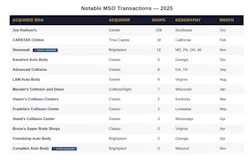
The Gerber – Joe Hudson Transaction
Boyd Group’s Gerber Collision’s acquisition of Joe Hudson’s Collision Centers was the defining transaction of 2025. The combination of the second- and fifth-largest operators (by store count) created a 1,301-shop North American enterprise, placing the deal alongside prior inflection-point transactions such as Caliber/ABRA and Crash Champions/Service King.
Beyond scale, the acquisition materially accelerated Gerber’s growth trajectory and coincided with Boyd Group’s listing on the New York Stock Exchange — improving access to capital, liquidity, and acquisition currency. While integration risk is meaningful given the size of the combination, the transaction signaled that large-scale combinations remain achievable in the current environment.
The shift from five to four was not just numerical — it was geographical. By absorbing Joe Hudson’s dense Southeast footprint, Gerber became the clear regional leader in the area. This acquisition materially altered market concentration, with the merger positioning Gerber as the region’s leading, contiguous platform.
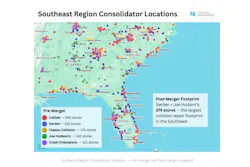
Major Consolidator Acquisitions
Gerber’s November transaction, however, also altered the competitive landscape overnight — and the long-standing “Big Five” consolidated into a “Big Four.” The Gerber–Joe Hudson’s merger represents the first large-scale consolidation move in several years and may signal the potential for additional large-scale transactions ahead.
With the exception of Gerber’s massive 258-store acquisition of Joe Hudson’s, overall consolidator expansion slowed in 2025.
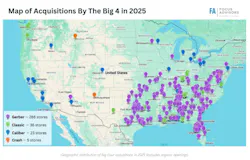
Although Classic Collision continued its expansion with five MSO acquisitions totaling 28 shops, total acquisitions among the top Consolidators was very slow relative to prior years. Prior to its blockbuster acquisition of Joe Hudson’s, Gerber acquired only 53 stores, mostly single shops. Caliber added only 23 shops while Crash slowed to only 8 net new shops.
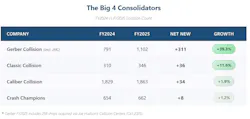
The following map illustrates the geographic footprint of those acquisitions — excluding brownfield and greenfield openings, and closures — across the Big Four in 2025.
The Accelerators
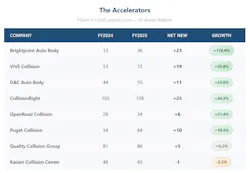
Several mid-sized PE-backed platforms — and one privately-owned MSO — showed a wide range of growth trajectories in 2025. Brightpoint drove meaningful expansion of 23 shops including a large addition of 16 Stonewall/Maaco assets, positioning itself as arguably the most aggressive of the Accelerators this year. VIVE sustained steady growth following its recapitalization, with a continued emphasis on Mid-Atlantic and Northeastern markets. CollisionRight added 25 shops while G&C added 13 in Northern California. Puget added 11 more shops, primarily in the Northwest. OpenRoad paused during a CEO transition before resuming activity with a significant year-end acquisition of Frank’s in Houston, Texas.
That activity was counterbalanced by more measured growth elsewhere. Quality Collision Group saw minimal expansion, while Kaizen, following its acquisition by Kinderhook, operated at a slower pace amid a management reset. Collectively, these dynamics underscore the divergence among mid-sized platforms — some accelerating aggressively, others recalibrating.
Private Equity: Sustained Interest, Shifting Strategies
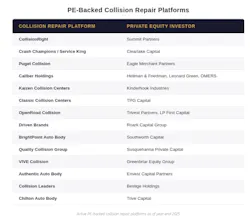
Private equity interest in collision repair remained strong in 2025, despite broader market uncertainty, reinforcing a key thesis – that the industry’s core fundamentals remain intact. In the US, three new PE firms entered the sector during the year, joining the existing roster of 14 PE investors seeking exposure to the industry’s defensive characteristics and consolidation opportunities. For firms with patient capital and experienced management teams, the current environment continues to offer meaningful growth potential.
The year was marked by continued capital deployment into existing platforms, though the nature of that capital shifted. Where 2024 saw a wave of large-scale recapitalizations and refinancings totaling over $9 billion, 2025 was characterized by more measured add-on acquisitions and fewer platform entries – most notably Trive’s entry with its acquisition of Chilton’s 19 shops in California.
A meaningful shift occurred in PE firms’ platform acquisition targets. Historically focused on entering the industry with established MSOs with $30+ million in revenue and proven multi-location track records, several firms moved downstream in 2025, pursuing entrepreneurial operators with as few as 1–3 locations as well as platforms with smaller shops. This reflects both the scarcity of larger platform opportunities and growing confidence that the right management teams can scale even nascent operations rapidly.
With 14 PE-backed consolidators now actively acquiring and multiple firms searching for new platforms, the collision repair M&A market benefits from buyer competition that — despite operating headwinds — continues to support excellent valuations for high-quality assets. We expect at least three additional PE entrants in 2026. As consolidators regain momentum and incremental capital is deployed into the sector, we expect robust buyer interest with multiple bidders for premier assets.
Tesla’s Widening Footprint
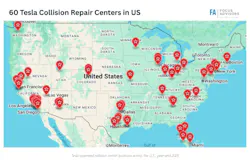
Tesla continued expanding its nationwide shop network in 2025. The company now operates 60 U.S. locations, up from 49 a year ago. These sites function as both collision centers and delivery and service hubs, and the growth signals how serious Tesla is about controlling more of the repair process for its vehicles.
These facilities are typically larger and more capital-intensive than traditional single-location shops, often running multiple shifts with a focus on throughput and standardization. The goal is tighter control over both the repair process and the customer experience.
This hybrid network, with standardized SOPs and corporate back-office functions, operates somewhere between a large-scale MSO and a dealer network with common ownership of collision shops. It currently more closely resembles the collision networks of Penske or AutoNation. Rather than participating in multiple insurer DRPs, its primary referral sources are Tesla’s captive insurance and tight owner communications (including First Notice of Loss directly from the vehicle), which strongly influence shop selection.
With hundreds of Tesla-certified shops nationwide, owners are often influenced in their decisions by expected repair times, local and online reputations, as well as their own insurers’ DRP networks.
Tesla’s expansion has created tension among independent certified shops that have invested heavily in equipment and training to earn Tesla certifications. Moreover, this strategy echoes a broader industry theme: OEMs are increasingly seeking to control repair capacity, certifications, and parts availability, reshaping assumptions about which shops will have access to OE parts, data, and calibration capabilities.
M&A Deal Dynamics: More Caution, Longer Timelines
2025 saw transaction periods extended as buyers conducted more rigorous due diligence on acquisition targets. With relatively few standout “premium” MSOs on the market, buyers spent more time evaluating good-but-not-perfect opportunities. When the fit wasn’t obvious, they dug deeper, and smaller operational cracks became reasons for buyers to hesitate.
Some deals stalled late in the process. In some cases, updated financial analysis showed that recent performance did not support deal expectations. When projected EBITDA didn’t hold up in Quality of Earnings examinations, some buyers either walked away or offered revised valuations. Landlord and environmental concerns late in the due diligence phase also contributed to the longer closing cycles.
Seller Behavior: Waiting for Better Numbers
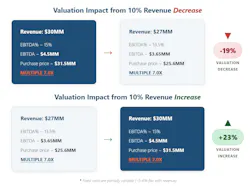
Many operators who planned to explore a sale in 2025 chose to wait. Lower claim counts and a higher mix of total losses pressured revenue, adjusted EBITDA declined, and valuations followed. Interestingly, market multiples remained relatively stable. While total valuations fell because performance slipped, buyers applied the same multiples of EBITDA as in prior years.
The math is straightforward: at a 7.0x multiple, a 10% revenue decline can translate into nearly a 20% drop in enterprise value. Small changes in EBITDA can have outsized impacts on total consideration.
The year saw fewer extreme multiple outliers and a narrower band of valuations across deals. The overall narrowing of multiples reflects more discipline by acquirers who have established their acquisition metrics and are largely sticking with them. The variability among acquirers continues, however, depending upon market penetration, consolidator needs for new market-entry platforms and growth commitments.
While acquirers will most likely maintain the same valuation metrics in 2026, total activity is expected to increase. Moreover, the expected stabilizing of operator performance in 2026 sets up a more predictable exit environment in the year ahead. Many of the owners who paused in 2025 are likely to revisit a sale once their trailing numbers reflect a more stable run-rate. Acquirors will be able to examine trailing twelve months of revenue and EBITDA with more confidence in both performance and projections.
Revenue Drivers vs. Acquisition Drivers
The industry’s core revenue drivers are expected to remain the same in 2026. Structural factors will continue to evolve in less favorable directions indicating long term pressures on volume while more cyclical factors will ebb and flow based on current conditions of the economy, insurance rates, weather and deductibles.
The car parc will continue to age as new car sales continue to fall below peak production level pre-COVID, yielding relatively fewer repairable vehicles among older vehicles. Increases in calibration requirements and stricter OEM repair standards will continue to drive higher TCOR. Modest increases in vehicle miles traveled in 2025 are expected to continue in 2026 amidst continued economic uncertainty. The mild winter weather and fewer hail events of 2025 that negatively impacted the overall claims counts may or may not reoccur in 2026.
Acquisition activity continues to be driven by both macro and micro forces. At the macro level, investors increasingly view collision repair as a dependable source of EBITDA even in uncertain economic times — and that conviction holds even at lower volumes, particularly as margins improve with scale. At the micro level, high-performing MSOs continue to gain market share even as industry revenues slow.
The relentless growth goals of consolidators and growing MSOs fueled by readily available capital continue to drive the acquisition of MSOs and highly productive individual shops. As regional and local MSOs continue their own growth, sellers find options beyond the consolidators and PE-backed acquirors.
Looking to 2026: Increased Supply and Demand Will Drive More Transactions
While operating performance in the coming year may continue to be challenging, we expect an increase in acquisitions among both consolidators, private equity firms and regional privately-owned MSOs.
Based on Focus Advisors’ proprietary deal flow, more sellers appear ready to transact, which will increase supply. Many smaller operators will come to market as they conclude that their volumes are not returning or that their growth opportunities are limited. For those potential sellers who paused last year, we anticipate many to return to the market as they see investor interest increasing.
Consolidators still have ample capital. Private equity firms continue to search for platforms and add-ons. And now, even more are looking to invest in firms that are less susceptible to AI dislocation. Even though underwriting standards will remain rigorous, we expect total transactions to increase over 2025.
If you’re a collision repair operator weighing your options — whether that’s a near-term transaction, a growth strategy, or simply understanding how current market dynamics affect your valuation — we welcome the conversation. Our team advises owners across the full spectrum of deal sizes and stages.
Email David Roberts at [email protected].