Overall Length of Rental Declines in Q4 2025

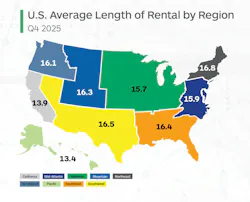
Overall length of rentals (LOR) for collision related rentals decreased to 15.9 days in Q4 2025, 0.6-day decrease from Q4 2024, according to Enterprise’s Q4 2025 LOR Report.
The decline was more modest than Q4 2024 or 2023, which were 1.3 and 1.0 days respectively. According to the report, the decline in LOR can be attributed to several factors including historically high average levels worked each week by industry production employees, parts availability, and an increase of ADAS calibrations performed in-house to help speed up repairs.
“Perhaps also helping speed repairs: The CRASH Network survey also found that the percentage of shops with employees doing ADAS calibrations in-house has continued to grow,” said John Yoswick, editor of the weekly CRASH Network newsletter. “Nearly 3 in 10 shops (29 percent) said doing the work themselves in-house is the most common method they use, up from 22 percent in 2024.”
Ryan Mandell, VP of strategy and market intelligence at Mitchell International, said the percentage of parts dollars attributed to aftermarket, recycled, or remanufactured parts rose from 39.2% last year to 40.9% in Q4 2025.
“PartsTrader’s data shows a two-day decline in median delivery days for all part types,” said Greg Horn, chief of Industry Relations at PartsTrader. “As OEM parts comprise the largest portion of parts on a repair estimate, OEM-only median delivery days were just over one day lower than Q4 2024, aligning with the reduction in LOR from Enterprise.”
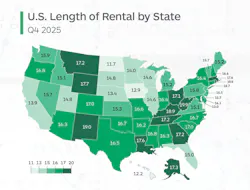
Rhode Island and West Virginia recorded the highest overall LOR at 19.9 days, followed by New Mexico at 19.0 days and Kentucky at 18.9 days. North Dakota had the lowest LOR at 11.7 days, with Hawaii (12.2 days) and Iowa (12.9 days) next-lowest. The District of Columbia had the highest increase compared to Q4 2024, with their results of 13.0 days marking a 1.4-day increase. Nebraska had the highest overall decrease, with 13.4 days representing a 2.7-day decline, closely followed by Colorado with a 2.6-day decline,17.0 days total. Seven additional states declined more than a full day, with 15 other states seeing a decline of at least a half-day.
Drivable
In Q4 2025, drivable LOR was 14.8 days, a 0.5-day decline from Q4 2024.
Rhode Island had the highest drivable LOR at 18.8 days, followed by New Mexico (17.6 days), Kentucky (17.3 days) and West Virginia (17.1 days). North Dakota had the lowest drivable LOR at 10.2 days, followed by Hawaii (11.0 days), the District of Columbia (11.4 days) and Iowa (11.6 days). Wyoming had the highest increase, with their 16.7 days up 1.7 days from Q4 2024. Montana (+1.2days) and Kentucky (+1.0 days) had the next-highest increases. Seven additional states, plus DC, all recorded higher drivable LOR.
Nebraska had the highest drivable LOR decrease, with 12.5 days representing a 2.8-day decline. Closely following was Colorado (16.1), with drivable LOR down 2.6 days. Florida (14.0 days) was the next lowest, down 1.9 days with Oklahoma (15.7 days) and Arizona (15.9 days) both down 1.7 days in Q425.
Non-Drivable
Non-drivable LOR was 21.4 days in Q4 2025, a 0.8-day decline from Q4 2024.
West Virginia had the highest non-drivable LOR at 28.3 days, followed by New Mexico (26.2 days), Alaska (25.4 days) and Wyoming (25.2 days). Iowa had the lowest non-drivable LOR at 18.0 days, followed by Minnesota (18.9 days) and California (19.1 days). The District of Columbia (21.4 days) had the largest increase in non-drivable LOR, up 4.4 days compared to Q4 2024, which dwarfed the 1.1-day increase seen in North Dakota (20.0 days). Only four other states (WY, VT, KY, MS) had non-drivable increases, while New Hampshire’s results were flat.
Colorado (22.8 days) had the largest decrease compared to Q4 2024, down 3.1 days. They were followed by Nebraska (19.3 days) and Alaska (25.4 days), each down 2.8 days. Twelve other states saw non-drivable decreases greater than a full day, with an additional 29 seeing a decrease of up to 0.9 days.
Summary
While LOR continues to decrease from post-pandemic highs, ongoing market and economic conditions could impact future results.
Enterprise remains committed to partnering with insurers, repairers, and suppliers to address the many factors influencing repair timelines and LOR. Through foundational support provided by the Enterprise Mobility Foundation, Enterprise is spearheading the Collision Engineering Career Alliance, designed to address the technician shortage and meet growing demand for highly skilled professionals in the collision repair industry.
To download the full report, click here.