Johnston: Introducing The Legal Alignment
Key Highlights
- The collision repair industry faces increasing legal and regulatory challenges that require shops to understand and leverage legal strategies.
- Lawsuits like the State Farm total loss case expose insurer manipulation tactics that can drain shop revenue and influence vehicle valuation practices.
- Understanding legal concepts such as breach of contract and the covenant of good faith can empower shops to challenge unfair insurer practices.
- Insurer undervaluation of total loss claims impacts repair decisions and shop profitability, making legal knowledge essential for advocacy.
- Staying informed about legal developments enables collision repair shops to better support their customers and defend their business interests.
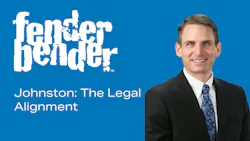
The Legal Alignment
Greetings, FenderBender Nation!
If you look at the landscape of the collision repair industry right now, one thing is abundantly clear: you aren't just managing technicians, parts delays, and paint booths anymore. You are navigating a complex, ever-shifting legal and regulatory minefield.
Every single day, your shop faces a push-and-pull with insurers, shifting state mandates, and intricate liability questions. For years, you’ve had columns dedicated to better leadership, cutting-edge tooling, and lean operational strategy. But in 2026, operational efficiency isn't enough if you're getting squeezed on the back end by insurer tactics or left exposed by a lack of legal leverage.
That’s where The Legal Alignment comes in.
This column is the launch of an ongoing fixture in FenderBender designed to give you a powerful new tool for your business toolbox: legal insight. My name is Chris Johnston, and I am a veteran trial attorney and law firm founder. Over my career, I’ve handled high-stakes litigation, fought big-time battles in the courtroom, and gone toe-to-toe with powerful corporate interests.
Now, I am turning that vast legal experience entirely toward the automotive ecosystem. My mission here is simple: to pull back the curtain on the legal mechanics affecting your business, arm you with knowledge, and help you level the playing field. In the coming months, we will dive into shop-related topics like contract liability, garage keepers' insurance traps, and the massive, underutilized leverage point of diminished value (DV) claims.
To give you a better idea of what this column will look like moving forward, let's take a look at a major headline currently rippling through the industry and break down what it actually means for your shop's day-to-day operations.
Under the Microscope: The State Farm Total Loss Class Action
FenderBender recently reported on a major class-action lawsuit filed against State Farm over its total loss claim payments ( Williams et al. v. State Farm Mutual Automobile Insurance Company , No. 1:22-cv-01422 (N.D. Ill.). The lawsuit alleges that the insurance giant systematically used a flawed, biased valuation methodology to deliberately underpay first-party total loss claims, shortchanging consumers on the actual cash value (ACV) of their vehicles.
The Legal Breakdown
From a legal standpoint, this case centers on a breach of contract and a violation of the covenant of good faith and fair dealing. When a consumer buys a policy, the insurer promises to indemnify them for the true market value of the vehicle if it’s totaled. By manipulating the data or applying arbitrary "negotiation adjustments" to lower the comps, insurers are allegedly failing to meet that contractual obligation.
Why This Matters to Your Shop
You might think, "If the car is a total loss, it’s out of my hands. Why do I care?"
You should care deeply. This case exposes the exact same mindset and algorithmic manipulation that drives insurer behavior on the repairable vehicles sitting in your bays right now.
- The Total Loss Threshold Squeeze: When insurers artificially depress a vehicle’s actual cash value, they inherently lower the dollar threshold at which a vehicle is declared a total loss. That means cars that should be repaired by your technicians are instead being sent straight to the salvage yard. It is a direct drain on your shop's revenue.
- The "Precedent" Lever: When a massive carrier faces systemic legal challenges over its valuation models, it provides your shop with a vital rhetorical weapon. When an estimator tries to tell you that their proprietary system says a procedure or a part value isn't "market standard," you can point directly to these lawsuits as proof that their systems are built to suppress costs, not reflect reality.
- The Diminished Value Horizon: This brings us to the flip side of the coin. If insurers are trying this hard to underpay on vehicles that are destroyed, imagine how hard they fight to ignore the lost value on vehicles that are perfectly repaired. A vehicle that undergoes major structural collision repair loses inherent market value the second the history report is pulled, even if your repair is flawless. By understanding how insurers manipulate value on the total loss side, we can better fight them on the diminished value side to ensure your customers are made truly whole.
Driving Ahead
Every month, I will use this space to dissect the laws, the lawsuits, and the strategies that directly impact your bottom line. My goal is to provide you with practical, battle-tested insights you can use to protect your business, support your customers, and push back against unfair pressures.
The industry is evolving at breakneck speed. It's time your legal strategy did, too.
Disclaimer: The information provided in this column is intended for general educational and informational purposes only. It does not constitute legal advice, nor does it create an attorney-client relationship between the author and any reader or shop entity. Because laws, regulations, and insurance mandates vary significantly by state and local jurisdiction, you should consult with a qualified attorney in your area regarding the specific legal issues or claims affecting your business.
About the Author

Chris Johnston
Senior partner
Attorney Chris Johnston is a Certified Civil Trial Specialist with over twenty-five years of legal experience. He is the senior partner of Johnston | Martineau, pllc, based in Minneapolis – St. Paul and practicing across the upper Midwest. To learn more or to contact Mr. Johnston, please visit here.