Rethinking the repairability of plastic parts
Editor's note: Whenever the topic of plastic repair is presented, a number of detractors bring up that bumper covers cannot be repaired because of ADAS sensors. ABRN, as always, recommends adhering to OEM repair procedures and performing repairs only when they won't affect ADAS operation. Additionally, it is our position that there are a large number of other plastic parts other than bumper covers that can be repaired economically and to a high standard of craftsmanship.
When you think about the amount of plastic that is on a vehicle today, sadly, most of that ends up in a landfill when a part is in need of repair. Surprisingly, one good change that came out of the COVID pandemic for body shops was the limited availability to obtain new parts leaving technicians having to repair and re-use, instead of simply disposing.
Not only is repairing the sustainable choice, but repairing can also help a shop's bottom line. Due to supply chain and backorder issues, quickly and easily ordering replacement parts is still not a given. What if that same dented part could be repaired instead – faster, and for less money?
The first step the technician must take is to properly identify whether the OEM allows the plastic to be repaired. In some cases, the technician may be forced to replace it.
Plastic welding in difficult angles
If restoring plastic is an option, this will save time, money, and the environment. And there are multiple methods/ products newer to the market that technicians may not have tried in the past, such as Easy Weld Strips.
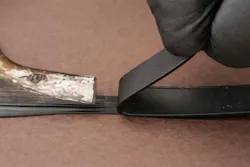
For years, there has been one standard way of repairing plastics. 4Plastic, in collaboration with SEM, developed plastic welding strips for repairing most plastics, including difficult angles. These automotive-grade strips are flexible and absorbent to stress and impact, while still being easy to shape and blend into the original part. Easy Weld Strips produce a strong repair and are easy to file, finish and use.
Industry research has shown that plastic welding demonstrates advantages over some traditional repair methods, particularly with minimal prep and improvements to impact resistance.
Whether restoring bumpers, headlights or tabs, rethink the plastic job: is replacing the only option, or can it be repaired to save money and waste?
What about textures?
Recent trends by OEMs have shown more textured plastics in manufacturing designs, challenging the repair industry as replacement textured components often did not match the existing faded plastic. Restoring those new textures accurately has become a struggle. Now, new texture products are being developed to address this shortcoming.
Textured parts are often in lower, high-impact positions on the vehicle, making most of the damage minor and highly repairable. If a shop has the ability to restore these parts rather than replace them, it will not only reduce overall costs but create a more sustainable business because of less plastic waste and parts-related emissions.
The newest generation of texture coatings to come to market are specially engineered to address the need created from OEMs' preference toward non-painted plastic parts.
These new advanced coatings are formulated to replicate today’s most common vehicle textures. They have undergone extensive laboratory testing, including UV fade durability, adhesion, gravel impact resistance, and more performance testing. Though they sound complex, these products have also been designed for ease of use, so that even beginner technicians can achieve consistent results.
There are now also new 2K texture solutions on the market to address the growing demand for OEM-grade texture finishes. You can find all texture ranges, whether smooth or heavy grain, which are lab-tested to ensure consistency and durability. Multiple shades of black and gray are also available.
With many of these plastic parts sustaining only minor damage, it has become a true value-add if a technician has the ability to repair and retexture them.
About the Author
 Alejandra Gallego
Alejandra Gallego
PPG Business Director, Allied Products, Automotive Refinish
Alejandra Gallego has been with PPG for more than 20 years, contributing across multiple business units, including Refinish, Protective and Marine Coatings, Traffic Solutions, and, most recently, SEM as business director. Her career includes leadership roles in operations, continuous improvement, and cross-functional team development, with a strong focus on operational excellence and customer collaboration.