Maximizing paint protection film performance
Key Highlights
- High-quality TPU in PPF enhances flexibility, conformability, and ease of installation, reducing waste and installation time.
- Market trends show increasing acceptance of full-body PPF wraps, especially for high-value and classic vehicles, in regions with diverse climate challenges.
- Customization options like colored, matte, or gloss finishes are expanding, driven by consumer demand for personalization and unique vehicle aesthetics.
- The lifespan of PPF heavily depends on TPU quality; premium formulations can last over a decade, even in extreme environments, while lower-quality films may degrade quickly.
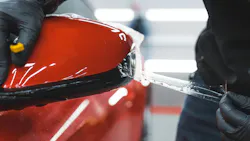
Lubrizol is one of the primary suppliers of thermoplastic polyurethane (TPU) for paint protection film (PPF). As a key component, TPU determines the performance of the PPF. Jason Schaner is an applications engineer with Lubrizol and recently answered a few questions about PPF and the TPU inside it that should be relevant to installers, body shops, and vehicle owners.
Are different types of PPF better suited for use with cutting software and plotters?
PPF made with lower quality TPU is less flexible and tends to tear easily when stretched or snagged. This is a common problem when trying to run that type of PPF through a plotter, and it can create large volumes of waste.
By contrast, PPF made with higher quality TPU typically stretches and conforms as it’s manipulated during cutting and installation. It’s more forgiving with dull or damaged cutting blades that can pull or tear less flexible films.
Is PPF only for luxury cars?
In the U.S., luxury car owners and automotive aficionados continue to dominate the PPF market, but in Europe and many parts of Asia, car owners routinely protect more mainstream vehicles with PPF. Consumers in those markets find the financial case for PPF compelling.
Even in the U.S., the case for mainstream adoption of PPF is growing. Consider: The average price of a new car in the U.S. reached $50,000 for the first time in 2025. Automobile owners are understandably motivated to preserve the condition and value of what has become a significant investment. Cars also are staying on the road longer than ever before – the average age of a car in the U.S. is almost 13 years, an all-time high – and even minor body repairs over that time can add up. You don’t need to be a car enthusiast to understand the case for an investment in PPF.
Why do some PPF brands pose more challenges when installing and removing compared to others?
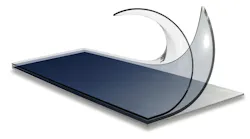
There are real differences in quality in all components of PPF – the topcoat, the adhesive, and especially the TPU that makes up the core of the PPF and provides its performance qualities. Lower quality TPU lacks conformability. Instead of the stretch and relax properties of quality alternatives, inferior TPU tears and sags when stretched around the corners and contours of a car’s body. It doesn’t stay supple when heat is applied and the PPF is pulled to try to smooth wrinkles and eliminate bubbles. This makes it difficult for installers to manipulate and often leads to waste that can be costly and time-consuming.
Upon removal, those lower quality PPF tend to become brittle, stick to the car’s surface, and cannot be removed cleanly in large pieces. At best, that can make removal a long, tedious process. At worst, it can pull paint from the surface and leave the car in need of significant repairs.
When should customers consider full-body PPF wraps?
I would strongly recommend targeted PPF installations for any new car purchase. By “targeted,” I mean areas prone to damage during routine use – front bumpers and hood, side mirrors, potentially around the high-touch areas of the trunk. As I noted earlier, a new car is such a significant financial commitment, that minimal investment in PPF is likely to preserve equivalent value over the car’s lifespan.
Full-body PPF coverage is a more significant expense, but there are times when it’s warranted. Full-body PPF coverage is becoming more common with higher-priced vehicles and classic cars, when owners are motivated to preserve a showroom-like appearance and the value of their investment. It is a strong investment for new car buyers hoping to preserve that showroom appearance and the value of their new vehicle. In high-sun and high-heat environments, where UV exposure can prematurely degrade the paint and cause fading, full-body coverage is an excellent idea. The same can be true in areas with a lot of rain, snow or ice, all of which can lead to damage to all parts of a vehicle, or if the car is routinely exposed to rocky terrain or gravel roads.
My customer is asking for features or performance that my current PPF supplier doesn’t offer. Are there options beyond standard, off-the-shelf products?
There can be, and we’re seeing more of these types of requests from PPF manufacturers. An example is colored PPF. Some vehicle owners are looking for creative color accents, --usually on the hood and trunk -- but it can be anywhere. By tailoring the PPF, we can help them create an appealing alternative to vinyl wrap. We’re seeing it with different finishes as well, with PPF often offered in matte and gloss finish.
As these types of PPF become more popular and consumer interest in personalization continues to increase, we anticipate even more creative applications. We can tailor TPU to prioritize certain performance characteristics – making a PPF that is more UV resistant or more durable or holds up better in extreme cold. Almost anything is possible with the right manipulation of TPU chemistries.
What is the expected lifespan of PPF, considering different climates (it will obviously have a much shorter lifespan on vehicles parked outdoors in Phoenix)?
Again, this depends on the quality of the TPU used in the PPF. Lower quality, typically low-cost TPU will not last as long. It will start yellowing, hazing or cracking relatively early – sometimes as soon as a few years or less after installation. Those vehicle owners are going to be frustrated, and installers and PPF suppliers are likely to hear about it.
PPF made with quality TPU lasts much longer – typically outlasting the standard 10-year warranty and routinely outlasting the vehicle lifespan. Premium TPU will protect a car for more than a decade without showing any signs of aging. This is true even in extreme environments, provided the TPU is formulated for the appropriate protection – UV protection, in your example.
What is the most effective removal method when repairing a panel with PPF installed? I’ve seen some people insert an inflation nozzle into a gap in the film and inflate it like a basketball. Are there any drawbacks to this approach?
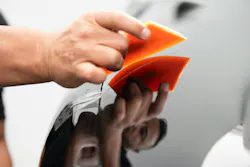
Typically, technicians remove PPF by heating the film with a steamer, heat gun, or hot water to soften the adhesive, then peeling the film away from the surface. Once the film is removed, any remaining adhesive can be removed using some common cleaning agents. But, again, the ease of removal depends on the PPF and the quality of the TPU used in the film. Lower quality PPF tends to over-adhere to the surface and can peel the paint from the surface during removal. PPF removal is more successful when the original film is made with quality TPU.
I’ve seen videos of PPF removal using air compressors to basically inflate the TPU, but I’ve never seen it done in person and would hesitate to recommend it without learning more.
How long should a shop wait after refinishing a panel to outgas before applying PPF?
This is a better question for a PPF installer, but here’s what I can tell you from our experience: There are variables in play, including the paint used, how it is cured, and the environment it’s exposed to after application. Broadly speaking, most installers would recommend 60-90 days to ensure outgassing is complete. I would recommend discussing with the PPF installer to reach an informed decision.
One final point: It’s not a stretch to say the only limitations to what we can create with PPF is our imagination. We can manipulate TPU formulations in countless ways to make new PPF that can deliver new colors and finishes, and any number of protective characteristics that might be a priority for a specific car owner. It’s up to installers to communicate demand for these features to PPF suppliers, so they can work with us to deliver these properties.