Baking requirements for high-voltage vehicles
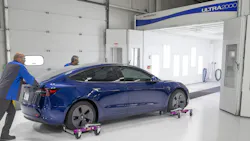
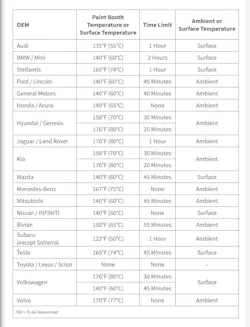
As professionals committed to safety for themselves, their teams, and their customers, it should be well understood that most manufacturers specify booth baking temperatures and time limits. Most vehicle makers clearly identify specific requirements. Some will say “no baking at all.” A typical temperature is around 140 degrees, but OEMs do vary. Always check OEM requirements to confirm whether baking is allowed, the required temperature, and the time limit. These details can change from month to month and may even vary by model. For example, a procedure may call for 140 degrees for 40 minutes or less, and the next time you repair that same model, the requirement may have changed. Check every time. Some paint makers are developing paint products specifically for EVs to avoid baking. There are also alternatives to baking, such as ultraviolet or infrared curing. It is worth repeating every time.
When a vehicle maker does not provide a specific refinish baking recommendation, the safest course of action is to avoid forced‑air curing entirely, as elevated temperatures can pose risks, especially for electric‑vehicle batteries whose thermal management systems may be disabled during repair. Some shops may choose to consider only very low bake temperatures to minimize this risk, but a more conservative approach, adopted by some repairers, is to skip baking altogether by performing the refinish work as the last task of the day and allowing the vehicle to cure naturally in the booth overnight, effectively eliminating unnecessary heat exposure to sensitive high voltage components. I-CAR's 2024 “High-Voltage Vehicle Paint Booth Quick Reference” at the RTS Portal is a helpful example of how procedures differ among vehicles. Since it is only a guide, confirmation of temperature limits, bake times, and any additional requirements such as state of charge should always be obtained from the specific year, make, and model service information before baking – each time.
When surface temperature is listed as the measuring point in a repair procedure, technicians may wonder if this relates to infrared or gas-catalytic curing. These methods typically cure from the inside out, which often means the temperature remains lower than the stated booth temperature. The vehicle itself is usually about 10 degrees cooler than the booth setting. If you set the booth to 150 degrees for 30 minutes, the vehicle may reach only about 135 degrees. It also takes 5 to 10 minutes for the booth to reach the set temperature, which effectively shortens the bake time. Due to the vehicle’s thermal mass, it will not reach 150 degrees in the remaining time. This is similar to how a sidewalk stays warm in the evening but remains cool for a while in the morning. Surface temperature is referenced for a reason. It is the measuring point that must be followed.
The risk of not following procedures
If precautions are not followed, a fire or thermal runaway event could occur. EVs have built-in systems designed to detect, log, and alert in high temperatures situations during normal operation. There are many variables, and these systems may not detect this if the vehicle is powered down. Overtemperature can lead to capacity loss that will eventually become noticeable, but there may be no diagnostics that can predict or identify this exposure beforehand.
For vehicle makers that specify checking ambient temperature, the term "ambient" refers to the temperature inside the paint booth. If the booth is 70 degrees, the vehicle may be 60 degrees, or it may be 90 degrees if it was parked outside on a hot day. Booth air temperature alone is not a reliable indicator of the vehicle temperature. An infrared thermometer should be used to check surface temperature. The thermometer in the booth should be used to check the ambient temperature.
Know what you are working with, because high-voltage vehicles require additional precautions when baking is part of the refinishing process. Be knowledgeable about how to identify EVs and hybrids. They may not always be clearly noted on the repair plan, and without familiarity it is possible to miss them. Another valuable tool available on the I-CAR Repairability Technical Support (RTS) website is the OEM Hybrid and Electric Vehicle Disable search, which allows collision repair professionals to search for year, make, and model specific information. Included in this search is a section titled "Refinish Precautions" that lists precautions for that specific vehicle.
Confidence is never a substitute for caution; technicians should apply the utmost caution when handling electric vehicles throughout the refinishing process — avoiding pushing the vehicle, adhering strictly to all high‑voltage safety and handling protocols, and ensuring that every spray booth cycle is fully completed and the booth is powered down before the facility is vacated for the day.
About the Author

Robert Lendabarker
I-CAR Senior Associate, Subject Matter Expert
Robert brings over 35 years of collision repair experience, from high-end restorations to armored motorcade vehicles for U.S. and international dignitaries. He holds GM and Chief structural measuring certifications and is an ASE Master Technician. After 13 years as a collision repair instructor, he now serves as a subject matter expert with I-CAR.

Luis Martinez
I-CAR Senior Associate, Subject Matter Expert
Luis has more than 25 years of refinishing experience, with expertise in BASF Glasurit, DuPont, and Axalta Standox systems, including advanced matte finishes and waterborne processes. His award-winning restoration work includes a first-place Pebble Beach Concours d’Elegance project. He now serves as a subject matter expert with I-CAR supporting curriculum development.